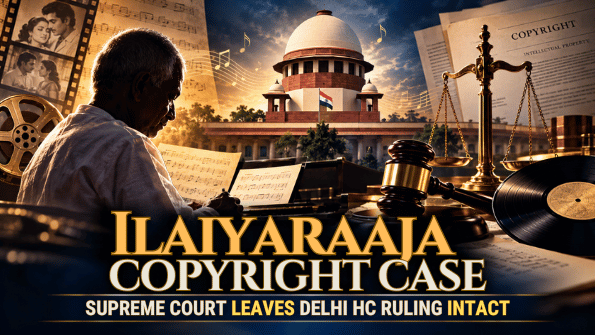
Updated: October 1, 2026. The Supreme Court of India has declined to interfere with a Delhi High Court ruling in the copyright dispute involving composer Ilaiyaraaja, Saregama India and the song “En Iniya Pon Nilave”. The decision leaves intact the High Court’s distinction between copyright in the underlying musical composition and copyright in the lyrics and original sound recording.
The dispute has attracted attention because it sits at the intersection of authors’ rights, producer-owned sound recordings and the commercial reuse of classic film music. It is also a useful example of why “owning the music” is not a single legal concept: Indian copyright law can recognize different rights in a composition, lyrics and a sound recording at the same time.
What did the Supreme Court do?
A bench comprising Justices J.B. Pardiwala and K. Vinod Chandran refused to interfere with the Delhi High Court’s earlier decision. The immediate effect is that the High Court ruling continues to govern the dispute between the parties.
The Supreme Court’s refusal to intervene should not be read as creating a completely new copyright rule from scratch. The detailed legal reasoning remains in the Delhi High Court judgment, which examined which rights belonged to Ilaiyaraaja and which belonged to Saregama.
What the Delhi High Court had ruled
In its May 21, 2026 decision, a Division Bench of Justices C. Hari Shankar and Om Prakash Shukla held that Ilaiyaraaja remained the first owner of copyright in the musical composition. At the same time, the court held that this did not give him ownership over the lyrics or the original sound recording.
The court treated those elements as separate copyright works. Saregama’s rights in the sound recording were linked to a 1980 agreement with the film producer. The High Court therefore concluded that Ilaiyaraaja could exploit or adapt his musical composition, but could not authorize use of protected lyrics or the original recording if those rights belonged to another copyright owner.
That distinction became central to the dispute over a recreated version associated with the film Aghathiyaa. The High Court found that the disputed use went beyond the underlying composition and incorporated protected elements connected with the lyrics and sound recording, supporting an injunction in Saregama’s favor.
Why one song can involve several copyrights
Copyright disputes around film music often become confusing because listeners experience a song as one finished work. Legally, however, multiple protected works can exist inside that recording.
| Element | Typical copyright interest |
|---|---|
| Musical composition | Melody, arrangement and underlying musical work created by the composer |
| Lyrics | Literary work created by the lyricist |
| Sound recording | The recorded performance/master, often owned or assigned to a producer or music label |
| New adaptation or recreation | May require rights depending on which protected elements are reused |
A person may therefore own one layer without owning every other layer. This is the key principle readers need to understand in the Ilaiyaraaja case.
What rights did the High Court recognize for Ilaiyaraaja?
The High Court did not say that the composer had no copyright interest. On the contrary, it recognized his ownership in the musical composition. That gives a composer meaningful rights in the underlying music, including certain rights to reproduce, adapt or otherwise exploit that musical work subject to the Copyright Act and any valid contractual arrangements.
The limitation identified by the court was equally important: those composition rights do not automatically transfer ownership of lyrics or an existing sound recording. If a new project uses those other protected elements, separate authorization may be required.
What rights did Saregama rely on?
Saregama relied on rights flowing from the producer agreement connected with the original film recording. The High Court accepted its claim to the sound recording and concluded that the recreated version used protected material beyond the bare musical composition.
This is why the case cannot accurately be reduced to “composer versus label” in a simple ownership contest. The courts examined different categories of copyright, their contractual chain of title and what was actually used in the later version.
Why the case matters to the Indian music industry
Indian cinema has a vast catalogue of songs created under older producer-label agreements. Many of those works are now being remixed, recreated, sampled, licensed for streaming, used in films or adapted for advertising. As the commercial value of music catalogues grows, so does the importance of identifying exactly which rights are being licensed.
The Ilaiyaraaja dispute highlights several practical questions for producers and creators:
- Who owns the underlying composition?
- Who owns the lyrics?
- Who owns the master sound recording?
- Does an old contract assign those rights, and for how long?
- Is a new version merely inspired by a composition, or does it reproduce protected lyrics or recording elements?
- What permissions are required before release?
Those questions are not unique to one composer or one label. They arise throughout the entertainment industry.
Does the ruling stop composers from reusing their own music?
Not in the broad way that phrase might suggest. The High Court recognized Ilaiyaraaja’s rights in the musical composition. The legal problem arose because the later use was found to involve additional protected elements.
A composer’s ability to reuse, adapt or license an underlying composition depends on the specific rights involved and the contracts governing them. A new recording built only around a lawfully controlled composition can present a different legal question from a recreation that copies lyrics, vocals, portions of a master recording or other material owned by another party.
What the Supreme Court refusal means procedurally
When the Supreme Court declines to interfere with a lower-court order, the lower-court result remains operative. It does not necessarily mean that every observation in the lower judgment becomes a universal rule for every future music dispute. Future cases will still depend on their facts, contracts and the particular rights claimed.
For this dispute, however, the practical position is clear: the Delhi High Court order remains in place.
A broader wave of copyright and technology disputes
Ownership questions are becoming more complicated as music is recreated with digital tools, AI systems and new distribution models. Rights holders increasingly need to distinguish between the composition, recorded master, performers’ rights and derivative uses.
BCC has also covered other high-profile legal disputes involving intellectual property and commercial rights. See our report on the Supreme Court’s Boulder climate case for another example of how a procedural Supreme Court decision can shape major litigation.
For a different Indian advertising-law dispute, read our explainer on the Patanjali misleading advertisements case.
What creators and producers can learn from the dispute
The most practical lesson is to clear rights by component rather than assuming one permission covers an entire song. Producers commissioning a remake or recreation should document the rights to the composition, lyrics and master recording separately.
For composers and lyricists, the case also underscores the importance of preserving contracts and understanding the scope of past assignments. Older film agreements can continue to affect exploitation decades later.
Music labels, meanwhile, need to establish a clear chain of title when enforcing catalogue rights. A claim to an old master is strongest when it is supported by the original producer agreements and a demonstrable history of rights acquisition.
Frequently asked questions
What is the En Iniya Pon Nilave copyright case?
It is a dispute involving rights in the classic film song and a later recreated version, with Ilaiyaraaja asserting rights in the composition and Saregama asserting rights connected with the sound recording and other protected material.
Did the Supreme Court reverse the Delhi High Court?
No. The Supreme Court declined to interfere, leaving the Delhi High Court ruling intact.
Did the Delhi High Court say Ilaiyaraaja owns nothing?
No. The court recognized him as the first owner of copyright in the musical composition, while distinguishing that right from ownership of the lyrics and original sound recording.
Why can a song have multiple copyright owners?
Because the musical composition, lyrics and sound recording are legally distinct works. Different people or companies may own each category.
What is the Delhi High Court case citation?
The decision has been reported as 2026 SCC OnLine Del 3846.
Sources and further reading
This article explains a reported court decision for general information and is not legal advice.