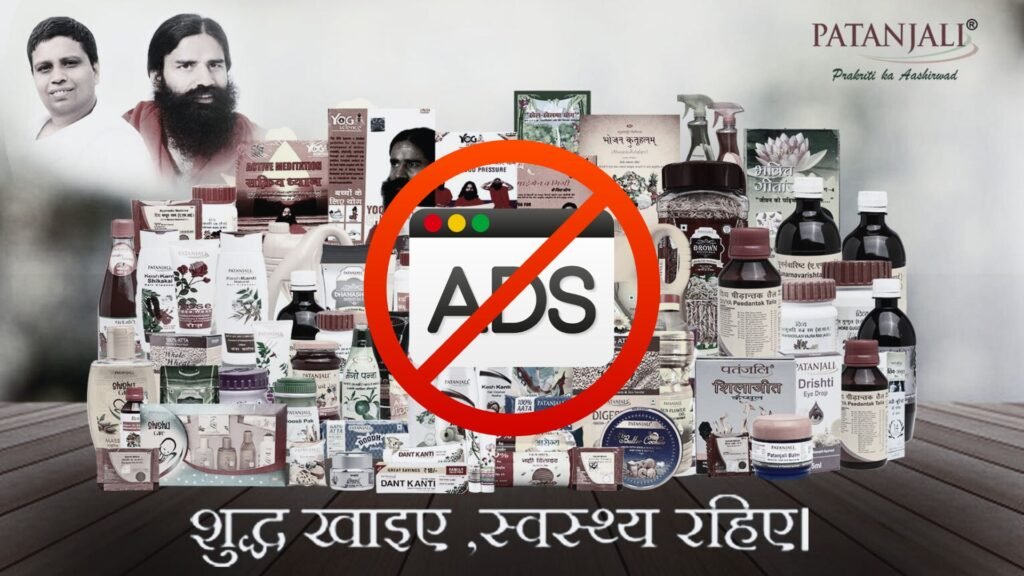
The Patanjali misleading ads case became one of India’s most closely watched disputes over health advertising after the Supreme Court questioned claims made in advertisements for certain Patanjali Ayurved products and the company’s statements about modern medicine.
The controversy intensified on February 27, 2024, when the Supreme Court issued contempt notices and temporarily restrained Patanjali Ayurved from advertising or branding products represented as curing diseases and conditions covered by India’s Drugs and Magic Remedies (Objectionable Advertisements) Act, 1954 and its Rules.
But describing the order simply as a “complete ban on Patanjali advertisements” is inaccurate.
The Court’s restraint was specifically directed at products marketed as cures for diseases and conditions covered by the law, while also cautioning Patanjali against making statements disparaging other systems of medicine.
The case subsequently expanded beyond Patanjali itself.
The Supreme Court examined the enforcement of India’s laws against misleading medical advertisements, questioned regulators, required corrective steps, issued broader directions to states and eventually closed the contempt proceedings after accepting apologies from Patanjali, Baba Ramdev and Acharya Balkrishna.
In August 2025, the Court also disposed of the main petition filed by the Indian Medical Association, concluding that the objectives of the proceedings had substantially been achieved.
Here is the complete timeline.
Why Did the Indian Medical Association Take Patanjali to the Supreme Court?
The case originated from a petition filed by the Indian Medical Association, or IMA, in 2022.
The IMA alleged that Patanjali Ayurved, its managing director Acharya Balkrishna and Baba Ramdev had engaged in a campaign that misrepresented aspects of modern medicine while promoting Patanjali’s own products.
According to the Supreme Court’s later judgment, the IMA complained that Patanjali was making misleading medicinal claims and disparaging the modern system of medicine.
The association also said it had previously raised complaints with government authorities without receiving sufficient action.
The dispute therefore involved two separate issues:
- claims made about the efficacy of certain Patanjali products; and
- public statements made about modern medicine and allopathy.
These concerns eventually became central to the Supreme Court proceedings.
What Did Patanjali Promise the Supreme Court in November 2023?
A critical moment came on November 21, 2023.
During proceedings before the Supreme Court, counsel representing Patanjali gave an assurance that the company would comply with laws governing advertising and branding.
The Court recorded that Patanjali had assured it there would be no violation of applicable advertising laws and that no casual statements claiming medicinal efficacy or attacking another system of medicine would be released through the media.
The Supreme Court formally bound Patanjali to that assurance.
That undertaking later became extremely important.
The February 2024 controversy was not simply about whether an advertisement was misleading.
It was also about whether Patanjali had breached an undertaking already given directly to India’s highest court.
What Happened Immediately After the November 2023 Undertaking?
The Supreme Court’s later judgment records that a press conference involving Baba Ramdev and Acharya Balkrishna took place on November 22, 2023 — one day after the undertaking was recorded.
The IMA later brought this press conference and subsequent advertisements to the Court’s attention.
The Court also examined an advertisement published on December 4, 2023.
According to the Supreme Court judgment, the advertisement contained claims about completely curing or providing permanent solutions for several medical conditions.
These included references to conditions such as:
- diabetes;
- high blood pressure;
- asthma;
- heart-related illness; and
- other medical conditions.
Those were advertising claims under scrutiny; they should not be interpreted as medically established treatment claims.
The Supreme Court observed that several of those diseases were specifically covered by restrictions under the Drugs and Magic Remedies law.
What Did the Supreme Court Order on February 27, 2024?
On February 27, the Supreme Court concluded on a prima facie basis that Patanjali appeared to have violated the undertaking given in November 2023.
It issued notice asking Patanjali and Acharya Balkrishna why contempt proceedings should not be initiated.
More importantly, the Court ordered that:
Patanjali was restrained, until further orders, from advertising or branding products manufactured and marketed by it that were represented as curing diseases, disorders or conditions specified under the Drugs and Magic Remedies (Objectionable Advertisements) Act, 1954 and its Rules.
The Court also cautioned Patanjali and its officers against making statements targeting another system of medicine.
Read the Supreme Court’s August 2024 judgment containing the February 27 order
Was Every Patanjali Advertisement Banned?
No.
This is an important correction to many early headlines and to the original Buzz Content Corner article.
The February 27 order did not say Patanjali could never advertise any product whatsoever.
The restraint applied to advertising or branding products represented as curing diseases, disorders or conditions covered by the relevant legislation.
Patanjali sells many categories of products beyond medicines, including food, personal-care and consumer products.
So the legally accurate description is:
The Supreme Court temporarily restrained Patanjali from advertising certain medicinal products with prohibited disease-cure claims.
That wording is considerably more precise than saying the Supreme Court “banned all Patanjali ads.”
What Law Governs Misleading Medical Advertisements in India?
A major law involved in the case was the:
Drugs and Magic Remedies (Objectionable Advertisements) Act, 1954.
Section 3 restricts advertising drugs for certain specified diseases, disorders and conditions.
Section 4 prohibits misleading advertisements relating to drugs.
Under Section 4, an advertisement can fall foul of the law if it:
- gives a false impression regarding the true nature of a drug;
- makes a false claim; or
- is otherwise false or misleading in a material respect.
The Supreme Court specifically discussed conditions including diabetes, heart disease, high or low blood pressure and obesity, while the accompanying Rules also include conditions such as asthma.
This matters because advertisements for health products are not treated in the same way as ordinary promotional claims.
A misleading claim involving treatment of a serious medical condition can potentially cause consumers to delay or abandon appropriate medical care.
Why Did Baba Ramdev Become Personally Involved in the Contempt Case?
The original February contempt notice was directed at Patanjali and Acharya Balkrishna.
The Court later examined Baba Ramdev’s role because the advertisements and public statements under scrutiny involved his endorsement and participation.
On March 19, 2024, the Supreme Court issued a show-cause notice to Baba Ramdev as well.
The Court said it was prima facie of the opinion that the conduct under examination may have violated Sections 3 and 4 of the 1954 Act along with the relevant Rules.
From that point, the contempt proceedings involved:
- Patanjali Ayurved Limited;
- Acharya Balkrishna; and
- Baba Ramdev.
Why Did the Supreme Court Initially Reject Their Apologies?
Ramdev, Balkrishna and Patanjali submitted apologies during the proceedings.
But the Court did not accept the initial attempts.
On April 10, 2024, the Supreme Court rejected another apology affidavit and questioned whether the apology demonstrated genuine acceptance of responsibility.
The Court viewed the breach of its undertaking seriously and warned that a court undertaking cannot simply be disregarded and followed by an apology after contempt proceedings begin.
This was one of the most widely reported phases of the case.
Ramdev and Balkrishna subsequently appeared personally before the Court and again expressed regret.
What Did Baba Ramdev Tell the Supreme Court?
On April 16, Baba Ramdev and Acharya Balkrishna personally tendered apologies before the Supreme Court.
Ramdev expressed regret over the conduct that led to the proceedings.
The Court did not immediately close the matter.
Instead, it examined whether Patanjali would take concrete corrective steps rather than relying solely on written apologies.
This distinction eventually became important to the final outcome.
The Court wanted evidence that the parties were actively trying to correct the situation.
Patanjali Publishes Public Apology Advertisements
Patanjali subsequently published public apologies in newspapers.
The Supreme Court examined whether those apology advertisements were sufficiently prominent and comparable in visibility to the advertisements that had triggered the controversy.
This reflected a broader principle:
A correction or apology should not be hidden where consumers are unlikely to see it after the original claim was widely publicized.
The Court later referred to these corrective advertisements when deciding whether the contempt proceedings should be closed.
What Happened to 14 Patanjali Products?
During the wider proceedings, licensing authorities in Uttarakhand took action involving licences for 14 Ayurvedic formulations.
The Supreme Court later asked Patanjali to explain whether advertisements relating to those products had been withdrawn from social-media platforms and other locations.
A July 2024 Supreme Court order directed Patanjali to file an affidavit confirming whether advertisements for all 14 medicines/formulations had been removed or withdrawn.
This licensing issue was connected with regulatory action but should not be confused with the original February advertising restraint.
They were related developments within the broader case.
Supreme Court Closes Contempt Proceedings in August 2024
The major turning point came on August 13, 2024.
The Supreme Court accepted the unconditional apologies tendered by Patanjali, Baba Ramdev and Acharya Balkrishna and closed the contempt proceedings.
The Court took into account steps they had taken after the proceedings began, including:
- expressing regret through affidavits;
- apologizing personally before the Court; and
- publishing apology advertisements in national and regional newspapers.
However, the Court did not treat the earlier conduct lightly.
Its judgment stated that the initial conduct showed violation of the undertaking given to the Court.
The contempt proceedings were closed because the subsequent corrective actions persuaded the Court that sincere efforts had been made to make amends.
Official Supreme Court judgment closing the Patanjali contempt proceedings
Did the Supreme Court Give Patanjali a Clean Slate?
The Court accepted the apologies and closed the contempt case, but it also issued a strong warning.
It cautioned Patanjali, Ramdev and Balkrishna to comply strictly with their undertaking in future.
The judgment made clear that future violations of Supreme Court orders or undertakings could lead to serious consequences.
So the accurate description is:
The contempt proceedings were closed after the Court accepted the apologies and corrective measures, but the Court warned against repeating the conduct.
The Case Expanded Beyond Patanjali
One of the most important outcomes of the case was that the Supreme Court eventually said the issue was much larger than one company.
In April 2024, the Court said it was concerned with misleading advertisements by FMCG and pharmaceutical companies generally, particularly where consumers’ health could be affected.
Its concerns included vulnerable groups such as:
- children;
- elderly people;
- pregnant or lactating women;
- sick people; and
- consumers relying on claimed health benefits.
The case therefore developed into a wider examination of how India regulates health-related advertising.
Supreme Court Strengthens Enforcement in March 2025
The case produced another major development on March 26, 2025.
A Supreme Court bench examined implementation of the Drugs and Magic Remedies Act and observed that the more than 70-year-old law had not been properly implemented in letter and spirit.
The Court issued several directions to states and Union Territories.
These included requiring governments to:
- appoint sufficient authorized gazetted officers;
- appoint officers responsible for scrutiny under the Rules;
- sensitize police through training;
- establish grievance-redressal systems for public complaints;
- publicize those complaint mechanisms; and
- ensure potentially unlawful advertisements are referred for enforcement action.
The Court also directed further development of a national dashboard through which regulatory action could be tracked.
This is arguably one of the most significant lasting outcomes of the Patanjali litigation.
The case moved from examining one company’s advertisements to strengthening the system for handling misleading medical advertising throughout India.
What Happened to Rule 170?
Another complicated part of the case involved Rule 170 of the Drugs and Cosmetics Rules, 1945.
Rule 170 had established restrictions and a prior-approval framework for advertisements involving Ayurvedic, Siddha and Unani medicines.
The Ministry of AYUSH issued a notification in July 2024 omitting Rule 170.
In August 2024, the Supreme Court temporarily stayed the effect of that omission, meaning the Rule remained operative while the matter was being examined.
But that position did not remain permanent.
Major 2025 Update: Supreme Court Disposes of the Main IMA Case
On August 11, 2025, the Supreme Court disposed of the Indian Medical Association’s main writ petition.
The Court observed that the purposes and reliefs originally sought by the petitioners had been substantially achieved through the different orders passed during the case.
It therefore concluded that continuing the writ petition would serve no further purpose.
This is the final major update missing from the original 2024 Buzz Content Corner article.
What Happened to the Rule 170 Stay?
When the Supreme Court disposed of the main writ petition in August 2025, it also vacated its August 2024 interim order that had stayed the government’s omission of Rule 170.
The Court left parties free to pursue appropriate legal remedies if they wished to challenge the omission separately.
This means the 2024 Supreme Court stay should not be described as still operating today.
The main IMA writ petition has been disposed of.
Did the End of the Case Make Misleading Medical Advertising Legal?
Absolutely not.
The disposal of the case did not eliminate India’s laws against false or misleading health-related advertisements.
The Drugs and Magic Remedies (Objectionable Advertisements) Act, 1954 still contains statutory prohibitions.
Section 4, for example, prohibits drug advertisements that create a false impression, make false claims or are materially misleading.
Other laws and consumer-protection mechanisms can also apply depending on the facts of a particular advertisement.
The end of the Patanjali writ petition therefore should not be interpreted as permission for companies to advertise unproven cures.
Patanjali Supreme Court Case: Timeline
| Date | Development |
|---|---|
| August 2022 | IMA petition against Patanjali reaches Supreme Court |
| Nov. 21, 2023 | Patanjali gives undertaking regarding advertising and statements about medicine |
| Nov. 22, 2023 | Press conference later scrutinized by the Court |
| Dec. 4, 2023 | Advertisement later examined by Supreme Court |
| Feb. 27, 2024 | Court issues contempt notice and temporarily restrains certain medicinal advertisements |
| March 19, 2024 | Baba Ramdev also receives contempt show-cause notice |
| April 2024 | Court rejects initial apologies; Ramdev and Balkrishna appear personally |
| April–May 2024 | Public apology and corrective-action process continues |
| Aug. 13, 2024 | Supreme Court accepts apologies and closes contempt proceedings |
| Aug. 27, 2024 | Court stays government’s omission of Rule 170 |
| March 26, 2025 | Supreme Court orders stronger enforcement of misleading-ad laws |
| Aug. 11, 2025 | Main IMA writ petition disposed of; Rule 170 interim stay vacated |
Why the Patanjali Misleading Ads Case Matters
The significance of the case extends far beyond Patanjali or Ayurveda.
It addresses one of the most sensitive forms of advertising:
health claims made to consumers who may be ill, vulnerable or looking for treatment.
A claim about detergent or clothing may influence a purchase.
A misleading claim about treatment of diabetes, heart disease or another serious medical condition can affect decisions involving a person’s health.
That is why courts and regulators treat misleading medical advertisements particularly seriously.
The Supreme Court’s March 2025 directions explicitly emphasized the potential harm caused when consumers rely on prohibited health advertisements.
Ayurveda vs Modern Medicine Was Not the Legal Question
Another important point is that the case should not be framed as:
Ayurveda versus allopathy.
The legal issue was not whether Ayurveda is legitimate or whether modern medicine is superior.
The principal questions involved:
- compliance with advertising law;
- prohibited disease-treatment claims;
- misleading representations;
- compliance with a Supreme Court undertaking; and
- enforcement by regulatory authorities.
Traditional medicine can be marketed legally.
Modern medicine can also be advertised only within applicable legal and regulatory limits.
The central principle is that health claims should comply with the law and should not mislead consumers.
What Should Health Advertisers Learn From the Case?
The case provides several lessons for companies selling health, wellness, pharmaceutical or traditional-medicine products.
1. Avoid absolute cure claims without lawful basis
Statements such as “permanent cure” or “complete cure” can attract particular scrutiny when they concern diseases covered by advertising restrictions.
2. Court undertakings are binding
An assurance given to a court is not a marketing guideline that a company may choose to interpret loosely.
3. Influencers and promoters are not necessarily separate from the advertisement
Public endorsements can become relevant when courts examine how health claims are communicated.
4. Corrections must be visible
Publishing an apology or correction in an obscure format after a highly visible advertisement may not satisfy regulators or courts.
5. Health marketing carries higher responsibility
Consumers may make medical decisions based on what they read or watch.
That makes accuracy more important than aggressive promotional language.
Frequently Asked Questions
Why did the Supreme Court restrict Patanjali advertisements?
The Supreme Court found prima facie evidence that Patanjali may have breached its November 2023 undertaking by continuing to publish claims involving medicinal efficacy. It therefore restrained advertising or branding of products represented as curing specified diseases and conditions until further orders.
Did the Supreme Court ban all Patanjali products?
No. The February 2024 restraint concerned advertising and branding of certain products represented as curing diseases and conditions covered by the Drugs and Magic Remedies legislation. It was not a blanket prohibition on every Patanjali consumer product.
What is the Drugs and Magic Remedies Act?
The Drugs and Magic Remedies (Objectionable Advertisements) Act, 1954 restricts advertising of drugs for certain diseases and prohibits false or misleading drug advertisements.
Was Baba Ramdev found guilty of contempt?
The Supreme Court initiated contempt proceedings, but ultimately accepted the unconditional apologies and corrective actions and closed the contempt proceedings in August 2024.
Why were Ramdev and Balkrishna’s first apologies rejected?
The Court was initially dissatisfied with the nature of their apologies and considered the apparent violation of the earlier undertaking serious. Subsequent apologies and corrective steps were later accepted.
Is the Patanjali Supreme Court case still pending?
The specific contempt proceedings were closed in August 2024. The broader IMA writ petition was then disposed of by the Supreme Court on August 11, 2025.
Did the Supreme Court permanently ban Ayurvedic advertisements?
No. The Court temporarily stayed the government’s omission of Rule 170 in August 2024, but that interim stay was vacated when the main writ petition was disposed of in August 2025.
Are misleading medical advertisements still prohibited in India?
Yes. Statutory restrictions such as Sections 3 and 4 of the Drugs and Magic Remedies Act continue to regulate prohibited and misleading health advertisements.
Final Takeaway
The Patanjali misleading ads case was never simply about whether one company could advertise Ayurveda.
It concerned a much narrower and more important legal question:
Can a company promote products using prohibited or misleading medical claims after assuring the Supreme Court that it would follow advertising laws?
In February 2024, the Supreme Court concluded on a prima facie basis that Patanjali appeared to have breached its earlier undertaking and temporarily restricted advertisements involving specified disease-cure claims.
The Court subsequently initiated contempt proceedings involving Patanjali, Acharya Balkrishna and Baba Ramdev.
Initial apologies were rejected.
Later, after repeated apologies and corrective steps including prominent newspaper notices, the Supreme Court accepted their unconditional apologies and closed the contempt proceedings on August 13, 2024.
The case then became much broader.
The Supreme Court examined India’s enforcement of misleading-health-advertising laws and, in March 2025, issued directions intended to strengthen enforcement across states and Union Territories.
Finally, on August 11, 2025, the Court disposed of the IMA’s main writ petition after concluding that its central objectives had substantially been achieved.
That is the complete legal position readers need today—not the incomplete March 2024 story that the original article currently tells.
For more legal and public-interest controversies, visit the Buzz Content Corner Controversy section:
Buzz Content Corner – Controversy
You can also read the updated analysis of the: