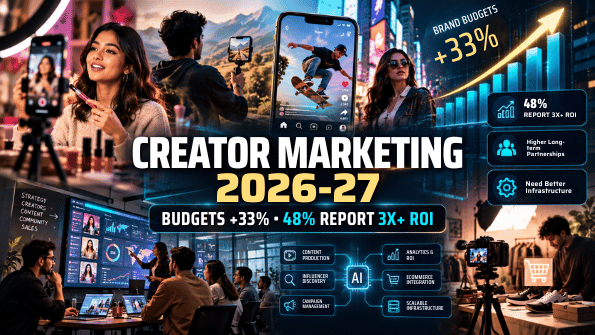
Updated October 1, 2026. Creator marketing is moving deeper into the core marketing stack. CreatorIQ’s newly released State of Creator Marketing 2026–2027 report says average annual creator-marketing investment reached $4.8 million, up 33% year over year, while 48% of brands now report returns of 3x or greater.
The growth story is not only about bigger budgets. The report’s more important signal is that creator programs are becoming harder to operate at scale. More teams, more content, more paid-media integration, more commerce, more AI tools and more measurement requirements are pushing brands toward a new problem: infrastructure.
Key takeaways
- Average annual creator-marketing investment reached $4.8M, up 33% YoY.
- 48% of brands report 3x+ ROI, up from 37% a year earlier.
- Enterprise creator investment averaged $8.8M.
- Systems integration, cross-team coordination and measurement are now major operating constraints.
- Creator commerce is becoming more central to performance programs.
Why creator budgets keep rising
Creator programs are no longer isolated awareness campaigns. Brands increasingly use creator content across organic social, paid ads, ecommerce, affiliate programs, product launches and brand storytelling. That broader role helps explain why investment continues to grow even as marketers become more demanding about attribution.
CreatorIQ says 66% of organizations increased creator investment year over year. The survey also found that 81% of brands report at least 2x ROI, while the share reporting 5x returns has doubled. Those are self-reported survey results rather than audited financial statements, but they show how decision-makers increasingly view creators as a measurable media and commerce channel.
The infrastructure gap is becoming the real bottleneck
The report identifies integrating creator data and workflows across marketing systems as the top roadblock. Coordinating across teams and improving measurement ranked close behind. High-return programs are not necessarily simpler: brands reporting 5x ROI often have more people involved and place greater emphasis on governance and operational streamlining.
For marketers, the implication is straightforward: adding more creators without improving briefing, approvals, rights management, attribution, paid amplification and reporting can create friction faster than it creates growth.
AI is increasing capability and complexity
AI can accelerate research, creator discovery, content analysis, reporting and workflow automation, but it also introduces new governance questions. Brands need clarity about where AI is acceptable, how synthetic content is disclosed, how brand safety is handled and how human review stays in the loop.
This connects with BCC’s 2026 marketing playbook and our guide to Google marketing in 2026.
Creator commerce is becoming a performance channel
CreatorIQ reports that 48% of brands have integrated creator-driven commerce directly into marketing or revenue strategy, with broader usage reaching 80% when campaign-specific commerce is included. That shift explains why agencies are being asked for stronger affiliate, conversion and revenue measurement—not just reach and engagement.
BCC’s analysis of D2C performance marketing strategy is relevant because creator programs increasingly depend on the same conversion discipline: strong creative, clean tracking, landing-page alignment and clear economics.
What brands should change in 2027
Brands should treat creator operations like a system. That means standardizing briefs, approval workflows, usage rights, creator vetting, naming conventions, UTM structures and reporting. It also means separating awareness, consideration, conversion and commerce metrics instead of forcing every campaign into one KPI.
Frequently asked questions
How much are organizations spending on creator marketing?
CreatorIQ reports average annual investment of $4.8M in 2026, up 33% year over year. Enterprise investment averaged $8.8M.
What percentage of brands report 3x or greater ROI?
48% of surveyed brands reported 3x or greater ROI, compared with 37% the previous year.
What is the biggest creator-marketing challenge?
Integration of creator data and workflows across marketing systems, followed closely by cross-team coordination and measurement.