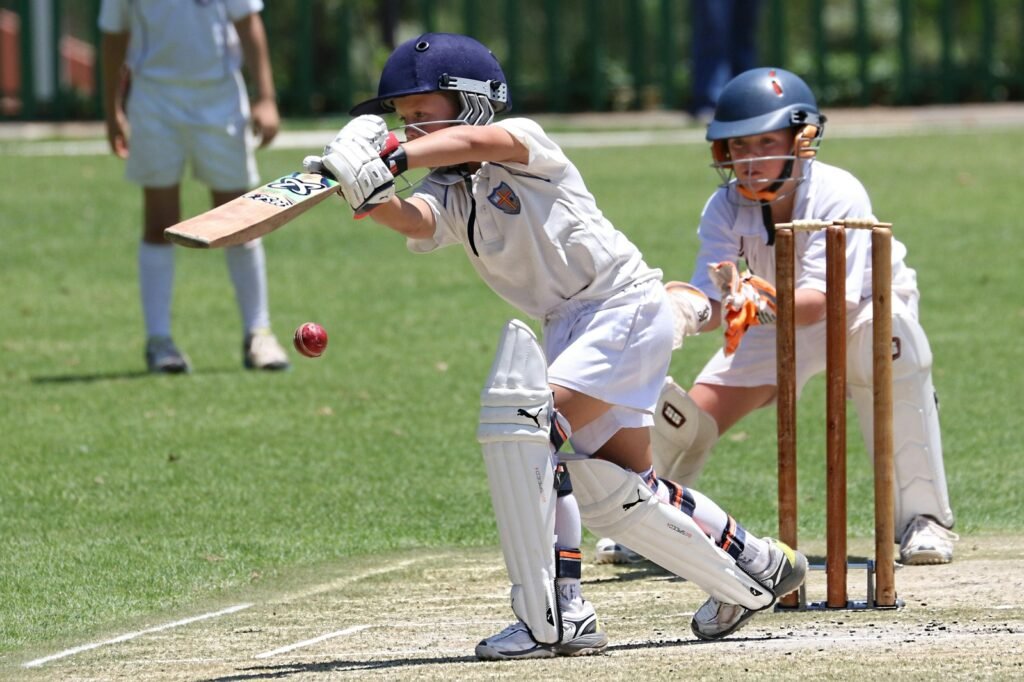
Cricket has developed from a regional bat-and-ball pastime in England into a global sport played in multiple formats across continents. Its history is not a single straight line: the game changed as its Laws were formalised, international travel became easier, new countries adopted it, broadcasting expanded its audience and shorter formats reshaped how cricket is played and watched.
This guide traces the major stages in that evolution, from cricket’s earliest documented references to Test cricket, one-day cricket and Twenty20.
Where did cricket begin?
The exact moment cricket was invented is uncertain. The International Cricket Council’s history of early cricket says expert opinion generally places its origins in south-east England, possibly as a children’s game during Saxon or Norman times. The ICC records a 1611 reference to cricket being played as an adult sport, while village cricket became established during the 17th century.
As the game became more organised, teams representing counties began to appear. The ICC notes that the first known match using county names dates to 1709. By the 18th century, cricket had become a significant sport in London and south-east England and was gradually spreading farther.
When were the Laws of Cricket created?
One of the most important steps in cricket’s development was the creation of a common rulebook. The first written Laws of Cricket date to 1744. They were later amended as the game evolved, including changes involving leg before wicket, the middle stump and bat width.
Marylebone Cricket Club was founded in 1787 and became the custodian of the Laws. That role continues today. MCC explains that it remains responsible for debating, drafting and interpreting the Laws of Cricket, while the ICC applies international playing conditions that can add competition-specific rules.
This distinction still matters: the Laws provide the foundation of the sport, while international matches may operate under additional ICC playing conditions.
How cricket spread around the world
Cricket expanded alongside British trade, migration and colonial networks. The ICC records early cricket in North America and notes that the sport reached the West Indies, India, Australia, New Zealand and South Africa over time.
The 19th century accelerated that growth. Improved transport made it easier for teams and spectators to travel. According to the ICC, the first recognised international cricket match was played between the United States and Canada in 1844. England’s touring professionals later travelled abroad, helping formalise international competition.
The birth of Test cricket
Matches between England and Australia in Melbourne in 1877 are now recognised as the first Test matches. Test cricket became the traditional international form of the game, eventually settling into the modern five-day format with two innings available to each side.
The rivalry between England and Australia also produced The Ashes after Australia’s famous victory at The Oval in 1882. South Africa later became another early Test nation.
For readers interested in how the equipment used in these eras changed alongside the sport, see BCC’s guide to the evolution of cricket equipment.
Cricket becomes an organised international sport
The organisation now known as the International Cricket Council was founded in 1909 as the Imperial Cricket Conference. England, Australia and South Africa were its original members. The West Indies, New Zealand and India joined the Test-playing group before the Second World War, while Pakistan followed in 1952.
Domestic competitions also became more structured. India introduced the Ranji Trophy in 1934, while other countries developed their own first-class competitions.
The growth of women’s cricket
Women’s cricket has a longer history than many casual fans realise. The ICC records a known women’s match in Surrey in 1745. During the 19th century, women’s teams and matches became more established, and the first women’s Test was played between England and Australia in 1934.
The modern international game now includes major women’s competitions across Test, ODI and T20 formats, with professional structures continuing to expand.
How one-day cricket changed the game
Test cricket remained the dominant international format for decades, but limited-overs cricket transformed the sport’s pace and commercial appeal. The ICC identifies 1971 as the beginning of One-Day Internationals. ODIs developed into 50-over-a-side contests and became especially prominent through World Cups and televised international series.
Limited overs encouraged different tactics: teams had to balance wicket preservation against a fixed number of deliveries, while bowlers and captains developed new approaches to field placement and run control.
The Twenty20 revolution
The most dramatic modern format change came with Twenty20 cricket. The ICC says the format was first played in English county cricket in 2003. The first women’s T20 International followed in 2004 and the first men’s T20 International in 2005.
T20 compressed a match into roughly three hours and accelerated innovation in batting, bowling and fielding. The inaugural ICC World Twenty20 in 2007 further expanded the format’s global audience.
Franchise competitions later made T20 a major part of the international cricket calendar. BCC’s sports coverage includes examples of how modern T20 tactics and individual performances shape tournaments, including our look at Yuzvendra Chahal’s IPL record and 2024 season.
What are the three main international formats today?
The ICC recognises three principal international formats:
- Test cricket: the longest format, played over as many as five days with two innings per team.
- One-Day Internationals: limited-overs matches with 50 overs per side.
- Twenty20 Internationals: the shortest major international format, with 20 overs per side.
Each format rewards a different balance of technique, endurance, tactical planning and risk. The coexistence of all three is one reason cricket can appeal to audiences looking for either long-form competition or faster entertainment.
Technology and modern cricket
Cricket’s evolution has not stopped with match formats. Broadcast technology, ball tracking, edge detection and the Decision Review System have changed how major umpiring decisions are reviewed and understood by viewers.
BCC covers this development in more detail in our guide to DRS technology and decision review in cricket.
Equipment standards have also changed, especially around helmets and player safety. MCC continues to update the Laws, and a new edition of the Laws is scheduled to take effect on October 1, 2026.
Why cricket’s history still matters
Understanding cricket’s history explains why the sport can sometimes look like several different games sharing one set of foundations. Test cricket preserves long-form traditions; ODIs combine strategy with a defined limit; and T20 prioritises speed, innovation and high-pressure decision-making.
Yet all three remain connected to the same core principles: two teams, batting and bowling contests, wickets, runs and a body of Laws that has been refined for centuries.
Frequently asked questions
Where was cricket invented?
The precise origin is uncertain, but cricket is generally associated with south-east England and may have developed as a children’s game before becoming an organised adult sport.
When was the first Test match played?
The matches between Australia and England in Melbourne in 1877 are recognised as the first Test matches.
Who writes the Laws of Cricket?
Marylebone Cricket Club is the custodian of the Laws of Cricket. The ICC uses those Laws alongside its own international playing conditions.
What are the main formats of international cricket?
Test matches, One-Day Internationals and Twenty20 Internationals are the three principal international formats recognised by the ICC.