A single umpiring decision can completely change a T20 match.
An LBW given incorrectly can remove a key batter. A faint edge can decide a close chase. A disputed wide in the final over can change both the target and the number of legal deliveries remaining.
That is why the IPL DRS, or Decision Review System, has become such an important part of the Indian Premier League.
DRS allows players to challenge certain on-field decisions while also giving match officials access to technology such as ball tracking, UltraEdge, high-speed video and LED wickets.
The system has also evolved considerably since it first appeared in the IPL in 2018.
By 2026, IPL reviews are no longer limited to traditional dismissals. Teams can challenge certain wide and no-ball decisions, while the Smart Replay System gives the TV umpire faster access to synchronized Hawk-Eye camera footage.
Here is how the technology works and why it matters.
What Is DRS in Cricket?
The International Cricket Council defines the Decision Review System as a technology-based process that assists match officials with decision-making.
There are two main types of review:
Player Review
A batter or fielding captain challenges an on-field decision.
Umpire Review
The on-field umpire refers a decision to the third umpire for assistance.
The ICC’s official DRS framework requires approved ball-tracking and sound-based edge-detection technology when full DRS is being used.
Readers who want the technical rules can see the ICC Decision Review System guide.
When Was DRS Introduced in the IPL?
DRS arrived in the Indian Premier League in 2018, during the tournament’s 11th season.
The BCCI approved its introduction shortly before the season after years of reservations about the reliability of some of the technology.
The first IPL use of DRS came during the Mumbai Indians vs Chennai Super Kings season opener on April 7, 2018.
Mumbai used a review after Evin Lewis was given out LBW to Deepak Chahar. The review did not overturn the decision, but it marked the beginning of the DRS era in the IPL.
You can read the original report on the first IPL DRS use in 2018.
How IPL DRS Has Evolved
The system used today is considerably more advanced than the one introduced in 2018.
| Year | Major Development |
|---|---|
| 2018 | DRS introduced in IPL |
| 2022 | Current two-unsuccessful-review structure in place |
| 2023 | Players allowed to review certain wide and no-ball decisions |
| 2024 | Smart Replay System introduced |
| 2026 | Smart Replay and expanded DRS protocols continue |
The changes show that IPL technology has moved beyond simply checking LBWs and caught-behind decisions.
How Many DRS Reviews Does a Team Get in IPL 2026?
Under the IPL 2026 Match Playing Conditions, each team can have up to:
Two unsuccessful Player Reviews per innings.
If a review successfully overturns the on-field decision, the team keeps the review.
If the original decision remains unchanged because of Umpire’s Call on an LBW review, the review is also retained.
So the system is better understood as:
A team can lose a maximum of two reviews per innings.
rather than simply saying it can take only two reviews.
A team that keeps making successful challenges could theoretically review more than twice.
The complete rules are available in the official IPL 2026 Match Playing Conditions.
What Decisions Can Be Reviewed?
Under current IPL playing conditions, a player can request reviews concerning whether a batter is dismissed, apart from specific exclusions such as Timed Out.
The IPL also allows players to review decisions concerning:
- wides;
- no-balls.
The ability to challenge wide and no-ball decisions was first introduced into the WPL and IPL in 2023.
This was a significant development because traditional DRS had primarily focused on dismissals.
In a T20 match, however, a wide or no-ball in the death overs can be extremely important.
A wrongly awarded wide can mean:
one extra run + one additional delivery.
A no-ball can mean:
one extra run + another delivery + a free hit.
Giving teams access to reviews in these situations can therefore directly affect close matches.
What Technology Does IPL DRS Use?
Current IPL playing conditions specify several technologies available to the third umpire.
These include:
Hawk-Eye Ball Tracking
Hawk-Eye helps evaluate LBW decisions by modelling the trajectory of the ball.
It answers three key questions:
Where did the ball pitch?
Where did it hit the batter?
Would it have hit the stumps?
The ICC’s DRS protocol similarly identifies approved ball-tracking technology as a core component of the review system.
UltraEdge
UltraEdge is a sound-based edge-detection system.
It combines synchronized video with audio from microphones to help determine whether the ball contacted:
- bat;
- glove;
- pad;
- another object.
A visible spike close to the moment when the ball passes the bat can help the third umpire assess caught-behind decisions.
However, the umpire still has to interpret the evidence rather than simply accepting every spike automatically.
Slow-Motion and High-Speed Replays
Camera footage can help determine:
- run-outs;
- stumpings;
- boundary catches;
- low catches;
- whether a fielder touched the boundary;
- other close incidents.
Zing Bails and LED Stumps
LED wickets can help determine the precise moment at which the wicket has been broken.
That matters for:
- run-outs;
- stumpings.
The IPL 2026 DRS protocol specifically lists Hawk-Eye, UltraEdge and Zing Bails/Stumps among available technologies.
How Does an LBW Review Work?
An LBW review generally involves several checks.
Step 1: Was the delivery legal?
The third umpire checks the relevant legality requirements.
Step 2: Did the ball hit the bat?
If necessary, UltraEdge can help determine whether the batter made contact before the ball hit the pad.
Step 3: Where did the ball pitch?
Ball tracking determines whether the delivery pitched:
- in line;
- outside off;
- outside leg.
Step 4: Where was the impact?
The system determines where the ball struck the batter relative to the stumps.
Step 5: Would the ball have hit the wickets?
Hawk-Eye predicts the continuation of the ball’s trajectory.
That information is then combined with the Laws of Cricket and DRS protocols to reach the final decision.
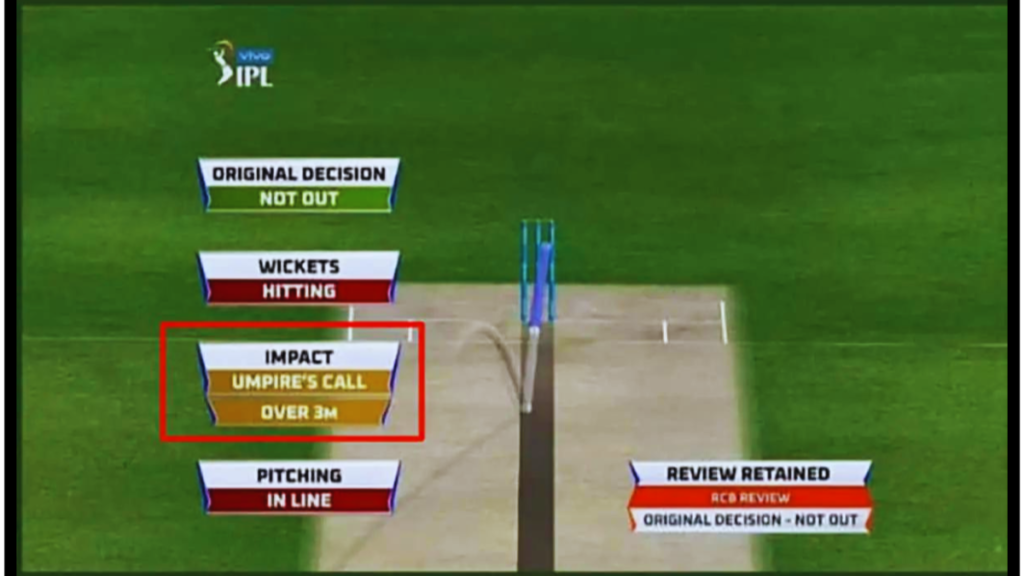
What Is Umpire’s Call?
Umpire’s Call is one of the most misunderstood parts of DRS.
Ball tracking is extremely sophisticated, but it is still a technological reconstruction based on measured data.
For marginal LBW situations, the rules preserve the original on-field decision.
For example, if ball tracking shows only a marginal amount of the projected ball hitting the wicket, the display may return:
Umpire’s Call.
In that situation:
- the original decision stays;
- the team does not lose its review.
The current IPL playing conditions explicitly state that an LBW review unchanged solely because of Umpire’s Call does not count as an unsuccessful review.
This is important because Umpire’s Call does not mean the technology failed.
It means the result falls within the system’s defined marginal zone, where the original umpire’s judgment is retained.
IPL 2023 Expanded Reviews to Wides and No-Balls
One of the biggest IPL DRS changes arrived in 2023.
Before then, teams generally could not challenge an on-field wide or no-ball call simply because they disagreed with it.
The BCCI expanded the review system so players could challenge decisions concerning wides and no-balls.
These reviews form part of the team’s available review allowance.
This change became particularly useful during death overs, where batters frequently move across the crease and umpires have to make split-second judgments about whether a delivery should be called wide.
The current 2026 IPL playing conditions continue to permit player reviews concerning wide and no-ball decisions.
IPL 2024 Introduced the Smart Replay System
The next major technological change came in IPL 2024.
The league introduced the Smart Replay System to make reviews faster and provide the TV umpire with better visual information.
Under the previous process, the TV umpire often communicated through the television broadcast director, who then coordinated the required replay.
With Smart Replay, the TV umpire receives information directly from Hawk-Eye operators sitting in the same room.
The system introduced access to images from eight high-speed Hawk-Eye cameras positioned around the ground.
Read the detailed explanation of the IPL Smart Replay System.
What Makes Smart Replay Different?
Smart Replay does not replace DRS.
Instead, it improves how replay evidence reaches the third umpire.
Direct communication
The TV umpire works directly with Hawk-Eye operators.
More camera angles
The system can provide more relevant high-speed footage.
Split-screen views
Different camera angles can be synchronized and displayed together.
Faster decisions
The umpire can request the exact image needed without going through as many communication steps.
More transparent broadcasts
Communication between officials and Hawk-Eye operators can be heard by viewers, helping audiences understand why a decision was reached.
Why Split-Screen Replays Matter
Imagine a fielder catching the ball close to the boundary.
The umpire may need to know two things at the same instant:
- Did the fielder have control of the ball?
- Was the fielder touching the boundary rope?
Watching those events through separate replay sequences can make it harder to identify the exact timing.
Smart Replay allows synchronized views—for example:
one showing the hands and ball + another showing the fielder’s feet near the boundary.
The same principle can help with:
- run-outs;
- stumpings;
- low catches;
- boundary catches.
That can make the decision both faster and easier to explain.
Smart Replay Remains in IPL 2026
Smart Replay was not simply a one-season experiment.
The IPL continues to use and promote the system in 2026.
On March 30, 2026, the official IPL website published a feature with umpire Rohan Pandit specifically explaining the Smart Replay System.
You can watch the official IPL 2026 Smart Replay explainer.
That makes an important update to this article:
Smart Replay introduced in 2024 has become part of the modern IPL review environment rather than disappearing after its first season.
Does DRS Make Every Decision 100% Accurate?
No technology should be described as perfect.
DRS improves the evidence available to umpires, but several situations still require human interpretation.
Examples include:
- very faint edges;
- simultaneous bat-pad sounds;
- marginal ball-tracking outcomes;
- low catches;
- unusual fielding incidents.
The ICC has itself historically acknowledged that technology is not always conclusive, even while noting that DRS substantially improves overall decision accuracy.
That is why the system is called a Decision Review System, not an automatic decision-making system.
The third umpire remains responsible for interpreting the evidence according to the playing conditions.
DRS Has Also Become a Tactical Tool
DRS is not only about technology.
It has become part of match strategy.
A fielding captain has to decide:
Is the bowler confident?
Did the wicketkeeper hear an edge?
Was impact outside the line?
Is the match situation important enough to risk a review?
Batters face similar questions after being given out.
Using a review carelessly can leave a team without protection later in the innings.
In a T20 match, this can become particularly important during the final overs.
A team may have to choose between reviewing a marginal decision in the eighth over or saving the review for a potentially decisive moment in the 19th.
The Wicketkeeper’s Role in DRS
The wicketkeeper often has one of the best views of:
- edges;
- LBW impact;
- ball trajectory;
- stumpings.
That makes communication between the:
bowler + wicketkeeper + captain
extremely important.
A bowler may be convinced that a batter edged the ball.
But the wicketkeeper may know the sound came from the bat hitting the ground.
Making that judgment quickly is part of modern captaincy.
This is why DRS has created an additional tactical skill that did not exist in the same way before technology-assisted reviews became standard.
DRS and the IPL’s Push for Better Decision-Making
The history of IPL review technology can essentially be divided into three stages.
Stage 1 — 2018: Correct Major Umpiring Errors
DRS arrives with ball tracking and edge-detection technology.
Stage 2 — 2023: Expand What Players Can Challenge
Wides and no-balls become reviewable.
Stage 3 — 2024 onward: Improve the Review Process Itself
Smart Replay gives third umpires more direct and synchronized visual information.
By IPL 2026, the system combines human umpiring with sophisticated technology rather than trying to replace the umpire altogether.
IPL DRS: Key Technology at a Glance
| Technology | Main Purpose |
|---|---|
| Hawk-Eye | Ball trajectory and LBW analysis |
| UltraEdge | Detecting possible bat/ball contact |
| High-speed replay | Catches, run-outs, stumpings and boundaries |
| Zing LED wickets | Identifying when the wicket is broken |
| Smart Replay | Faster access to synchronized replay angles |
| Third umpire | Interprets evidence and makes review decision |
Frequently Asked Questions
When was DRS introduced in IPL?
DRS was introduced in the IPL in 2018. It was first used during the Mumbai Indians vs Chennai Super Kings opening match that season.
How many DRS reviews are allowed in IPL 2026?
Each team can have up to two unsuccessful reviews per innings. Successful reviews do not reduce the allowance, and an unchanged LBW review based solely on Umpire’s Call also does not cost a review.
Can players review wides in the IPL?
Yes. IPL players have been able to review certain wide decisions since 2023, and the current playing conditions continue to permit reviews concerning wides and no-balls.
What is Hawk-Eye used for?
Hawk-Eye’s ball-tracking system helps assess LBW decisions by determining pitching, impact and the projected path toward the stumps.
What does UltraEdge do?
UltraEdge combines audio information with replay footage to help determine whether the ball contacted the bat or glove.
What is the IPL Smart Replay System?
Smart Replay gives the TV umpire direct access to Hawk-Eye operators and synchronized high-speed camera footage, reducing unnecessary communication steps and providing more replay options.
Is Smart Replay still used in 2026?
Yes. The official IPL website continued explaining and showcasing the Smart Replay System during IPL 2026.
Does Umpire’s Call mean DRS is wrong?
No. Umpire’s Call applies to defined marginal situations in LBW reviews. The original decision remains, and the reviewing team retains the review.
Final Takeaway
The evolution of IPL DRS shows how quickly technology has changed cricket officiating.
When the system entered the IPL in 2018, its main purpose was to give players a way to challenge potentially incorrect dismissal decisions.
Since then, it has expanded considerably.
Players can now challenge certain wide and no-ball decisions.
Hawk-Eye and UltraEdge provide detailed technical evidence.
High-speed cameras help with catches, stumpings and run-outs.
And since 2024, the Smart Replay System has given TV umpires more direct access to synchronized Hawk-Eye footage.
By 2026, the IPL’s review process is therefore much more than a simple replay.
It combines:
on-field judgment + player strategy + Hawk-Eye + UltraEdge + high-speed cameras + Smart Replay + third-umpire interpretation.
Technology cannot remove every controversial decision from cricket.
But it can give officials better information, provide teams with a mechanism to challenge important calls and make the decision-making process more transparent for viewers.
For more IPL and cricket coverage, visit the Buzz Content Corner Sports section.
Also read:
Yuzvendra Chahal IPL 2024: 200-Wicket Record & Purple Cap Story
GT vs MI IPL 2024: Gujarat Titans Beat Mumbai Indians by 6 Runs