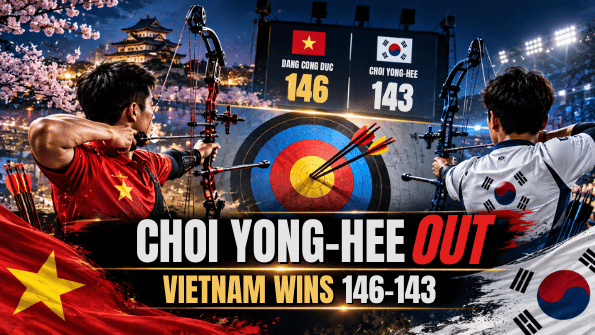
Updated: October 1, 2026. South Korean compound archer Choi Yong-hee has been eliminated from the men’s individual event at the Aichi-Nagoya Asian Games after Vietnam’s Dang Cong Duc produced a composed 146-143 quarterfinal victory.
The result is one of the notable archery upsets of the Games. Choi entered the knockout stage as the No. 3 seed and had already progressed through two strong elimination matches, but Dang — seeded sixth — maintained the cleaner scoring line when the pressure peaked. Vietnamese reporting said Dang strung together six consecutive 10-point arrows during the contest, giving him enough separation to close out the three-point win.
For South Korea, the loss adds to a mixed compound-archery campaign in which the country has remained competitive without converting every medal opportunity. For Vietnam, the quarterfinal result is another sign of the growing depth in Asian compound archery, where the established powers are increasingly being challenged by athletes from across the region.
Choi Yong-hee vs Dang Cong Duc: quarterfinal result
| Archer | Nation | Seed | Score |
|---|---|---|---|
| Dang Cong Duc | Vietnam | 6 | 146 |
| Choi Yong-hee | South Korea | 3 | 143 |
Compound archery is decided by extremely small margins. At elite level, a single arrow outside the 10-ring can change the shape of a match. That made Dang’s six-arrow run of 10s particularly important: rather than merely surviving Choi’s scoring pressure, the Vietnamese archer forced the Korean to chase.
How Choi reached the quarterfinal
Choi had looked comfortable earlier in the individual bracket. He defeated the United Arab Emirates’ Abdalla Hasan Al-Mansoori 147-141 before beating Malaysia’s Ghazali 149-145. Those scores reinforced his status as a medal threat and showed the high scoring standard he was carrying into the last eight.
Dang’s route was similarly convincing. He advanced past Kazakhstan’s Andrey Tyutyun 148-146 and had qualified sixth with a 709-point ranking-round score. The quarterfinal therefore matched two archers already shooting at a level where one imperfect end could decide everything.
Why the 146-143 score matters
A three-point difference can look modest in most sports, but in compound archery it is significant. The format rewards repeatability: athletes use compound bows with mechanical aids and shoot at a relatively small scoring face, meaning elite competitors routinely place arrows in the nine and 10 rings. A run of six consecutive 10s can completely change the psychological and tactical pressure of a match.
Once Dang established that rhythm, Choi had little room to recover. The Korean could not simply wait for a major mistake; he needed to match near-perfect shooting while hoping his opponent dropped points. Dang did not give him that opening often enough.
A difficult stretch for South Korea’s compound team
The individual defeat comes after South Korea also missed the men’s team compound podium. The Korean team finished fourth following a 234-233 loss to Chinese Taipei in the bronze-medal match on September 30.
There was success elsewhere. Choi and his partner won silver in the mixed team event after a tense final against India. The teams were tied at 157 before India prevailed 20-19 in the shoot-off. That result showed how close the medal margins have been throughout the competition.
The pattern is important: South Korea’s compound archers have remained within one or two arrows of the medals, but the event has not offered the kind of margin for error associated with some of the country’s historically dominant recurve performances.
Vietnam’s compound archery progress
Dang’s victory matters beyond one quarterfinal. Vietnam has invested steadily in international archery, and an Asian Games win over a seeded South Korean contender provides a visible benchmark of that progress.
Asian compound archery has become increasingly competitive. India has developed one of the world’s strongest compound programs, South Korea retains enormous technical depth, and nations such as Chinese Taipei, Kazakhstan, Malaysia and Vietnam can now produce athletes capable of winning high-level elimination matches.
That broader competitive field makes tournament seeding less predictive than it might appear. Qualification ranking still matters because it shapes the bracket, but knockout archery resets the contest: the athlete who executes best over a short sequence advances.
What makes compound archery so unforgiving?
Compound bows use cams and pulleys that reduce the holding weight at full draw. Archers also use magnified sights and mechanical release aids. Those technologies allow remarkable precision, but they also raise the expected scoring standard. When both athletes are capable of repeated 10s, the contest becomes a test of micro-consistency.
Three factors often decide elite matches:
- Shot execution under pressure: a small release error can turn a 10 into a nine.
- Wind reading: even with high-speed compound arrows, changing conditions can affect impact position.
- Momentum within an end: a perfect sequence can force the opponent to attack rather than simply maintain rhythm.
This is one reason archery audiences often see established names eliminated before medal rounds. The sport’s precision compresses the gap between favorites and challengers.
What the result says about the 2026 Asian Games
The Aichi-Nagoya Games have already produced tight medal contests across several sports. In archery, the compound competition in particular has highlighted the strength of the wider Asian field. Rather than one nation controlling every bracket, medals are being contested by a broader group of programs.
BCC has been following that theme across the Games. India’s women’s hockey team, for example, reached the final after a 2-0 semifinal win over South Korea. Read our report on India women’s Asian Games 2026 hockey final qualification.
Technology is also increasingly shaping elite preparation and injury management. Our feature on smart uniforms and AI-driven injury prediction in sports looks at how data is changing athlete development.
What comes next?
For Choi, the individual medal route is over, but his Games still include a mixed-team silver and evidence that he remains among Asia’s highest-scoring compound archers. The quarterfinal should be viewed as a narrow knockout loss rather than a collapse in form.
For Dang, the win pushes Vietnam deeper into the men’s individual medal race and gives the team one of its most significant archery results of the tournament. The next challenge will be maintaining the same scoring discipline when the stakes rise again.
That is the defining feature of compound archery at this level: there is almost no space between a medal and elimination. In the quarterfinal, Dang Cong Duc found that space and Choi Yong-hee did not.
Frequently asked questions
Who beat Choi Yong-hee at the 2026 Asian Games?
Vietnam’s Dang Cong Duc defeated South Korea’s Choi Yong-hee in the men’s individual compound archery quarterfinal.
What was the score?
Dang won 146-143.
What seed was Choi Yong-hee?
Choi entered the knockout stage as the No. 3 seed. Dang was seeded sixth.
Did Choi win another medal at the Games?
Choi was part of South Korea’s mixed compound team that won silver after losing a shoot-off to India.
How did Dang Cong Duc reach the quarterfinal?
He defeated Kazakhstan’s Andrey Tyutyun 148-146 before facing Choi.