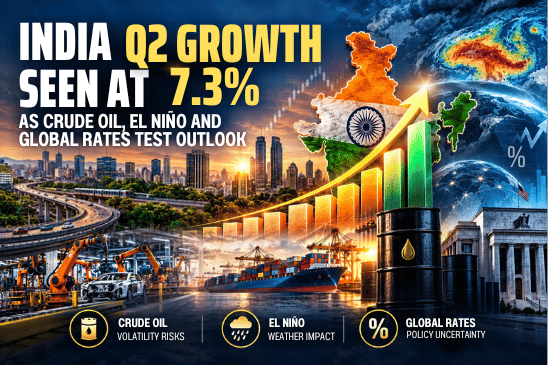
Updated: October 1, 2026. India’s economy is entering the second quarter of FY2026-27 with strong domestic momentum, but the external environment is becoming harder to ignore. The Finance Ministry’s latest assessment indicates that growth for the July-September quarter is tracking around 7.3%, supported by resilient demand and healthy high-frequency indicators. At the same time, the government has flagged a cluster of risks that could make the second half of the fiscal year more difficult: elevated crude oil prices, geopolitical tensions, tighter global financial conditions, volatile capital flows and the possibility of an El Niño-related shock to winter crops.
The 7.3% figure is important, but it should be read correctly. It is a nowcast based on available economic indicators, not the final official GDP estimate for the quarter. The signal is that India’s expansion remains firm after real GDP grew 7.8% in the April-June quarter, even as the global backdrop becomes less supportive.
That creates a more complicated economic picture. Strong growth gives India a buffer, but expensive energy, higher global borrowing costs and imported inflation can gradually erode that buffer if they persist.
Key takeaways
- India’s Q2 FY27 growth is currently tracking near 7.3%, according to the Finance Ministry’s assessment of recent indicators.
- Q1 FY27 real GDP growth was 7.8%, giving the economy relatively strong momentum entering the July-September period.
- The government has warned that geopolitical tensions and high crude prices could increase imported inflation.
- A stronger El Niño could affect winter crop output and create fresh food-price pressure.
- Higher global interest rates can influence the rupee, bond yields and foreign portfolio flows even when India’s domestic economy remains resilient.
- India’s foreign-exchange reserves remain an important buffer, but they do not eliminate the impact of sustained oil or financial-market shocks.
What does the 7.3% Q2 growth estimate actually mean?
The 7.3% number is best understood as a real-time estimate of economic momentum rather than a final GDP print. The government’s assessment uses high-frequency indicators to judge how the economy is performing before the complete quarterly national accounts are available.
According to reports on the Finance Ministry’s review, activity through July and August remained consistent with growth of roughly 7.3% in the second quarter. That would represent a moderation from Q1’s 7.8% growth rate, but it would still indicate a comparatively strong pace of expansion.
This distinction matters for headlines. A nowcast can change as new data arrive. Industrial production, GST collections, credit, exports, consumption, government spending and other indicators can strengthen or weaken before the official quarterly estimate is released.
For broader context, BCC previously examined the World Bank’s FY27 India growth outlook and its key risks. The latest Finance Ministry signals reinforce the same broad theme: India’s domestic growth engine is relatively strong, while global shocks remain the biggest source of uncertainty.
Why India entered Q2 with strong momentum
India’s 7.8% growth in the April-June quarter provided a strong starting point for the fiscal year. The Finance Ministry and the Chief Economic Adviser have pointed to continuing strength in several high-frequency indicators, including tax collections, credit activity and exports.
Domestic demand remains especially important because it reduces India’s dependence on a single external growth engine. Household consumption, public capital expenditure, services activity and investment can help absorb some weakness from international trade or global financial conditions.
Government capital expenditure also has a multiplier effect across infrastructure-linked industries. Roads, railways, energy, logistics and urban projects can generate demand for steel, cement, machinery, transport and professional services while improving productive capacity over time.
None of this makes India immune to external shocks. It simply means the economy begins the period with more internal support than an economy that is already stagnating.
Crude oil is the biggest imported-inflation risk
For India, energy prices are not just a market story. They directly affect the import bill, transport costs, business margins, government finances and inflation expectations.
Reuters reported on October 1 that the Finance Ministry’s September review highlighted geopolitical tensions and elevated crude prices as potential sources of imported inflation. The concern is straightforward: when India pays more for imported energy, the impact can spread through freight, manufacturing, aviation, chemicals, fertilizers and household budgets.
The effect is rarely uniform. A temporary spike in crude may have limited macroeconomic impact if it reverses quickly. A sustained period of high oil prices is more difficult because it can widen the trade deficit, weaken the currency and keep inflation elevated even when domestic demand begins to cool.
Oil risk has also become more closely connected to monetary policy. BCC’s analysis of the Federal Reserve’s 2026 rate hike and the global market impact explains how higher US yields can tighten financial conditions internationally. When high oil and high global rates occur together, oil-importing emerging economies face pressure from both the trade channel and the capital-flow channel.
Inflation is becoming a more important constraint
The Finance Ministry’s review comes at a time when inflation indicators have moved higher. Reuters reported that retail inflation reached 4.82% in August, with food inflation at 5.95%, while wholesale inflation accelerated sharply as fuel and power costs increased.
These figures do not automatically mean that India is entering a persistent inflation spiral. But they do reduce the room for policymakers to treat growth as the only priority.
The challenge is that several inflation drivers are largely outside the control of domestic interest rates. The Reserve Bank of India cannot produce crude oil, end geopolitical conflicts or change the weather. Monetary policy can influence demand, expectations and financial conditions, but supply-side shocks often require a combination of fiscal, trade, inventory and administrative responses.
Why El Niño matters for winter crops
The government has also identified climate risk as a potential economic headwind. A strong El Niño can influence rainfall patterns and agricultural conditions, which matters because food prices carry significant weight in Indian household budgets and inflation measures.
The risk is particularly relevant for winter crops if weather conditions weaken yields or disrupt supply. A poor agricultural outcome can affect food inflation, rural incomes and consumer demand at the same time.
Climate risk is difficult to model precisely because the economic effect depends on geography, crop type, irrigation coverage, reservoir levels and the timing of rainfall. The appropriate interpretation is therefore not that an agricultural shock is certain, but that the probability deserves attention when policymakers assess the inflation outlook.
Higher global rates can pressure capital flows
India’s domestic economy can remain healthy while its financial markets experience pressure from developments abroad. That is because global investors constantly compare risk and return across countries.
When US Treasury yields rise, dollar assets become relatively more attractive. Some global investors may then reduce exposure to emerging-market equities or bonds. The result can be weaker portfolio flows, pressure on emerging-market currencies and higher local bond yields.
The Finance Ministry’s concern about capital-flow volatility is therefore not a contradiction of the strong-growth story. The two can exist at the same time: domestic activity can expand while financial markets reprice because global funding conditions have changed.
For additional background on this transmission mechanism, see BCC’s guide to how geopolitical alliances and global shocks can affect economic growth.
Foreign-exchange reserves provide a buffer
One of India’s important defenses against external volatility is its stock of foreign-exchange reserves. Reuters reported reserves of approximately $765.9 billion, equivalent to about 11.1 months of imports, in the government review.
Large reserves can help reduce disorderly currency moves and improve confidence that external payment obligations can be met. They also give the central bank greater flexibility when global capital flows turn volatile.
However, reserves are a buffer, not a shield against every shock. If oil remains expensive for an extended period, the underlying trade and inflation effects still have to work through the economy. Likewise, persistent global risk aversion can affect equity valuations and borrowing costs even when reserve adequacy is strong.
What the outlook means for the RBI
The growth-inflation trade-off is becoming more complex. Strong domestic growth can reduce the urgency for aggressive policy support, while rising imported inflation can argue for caution. At the same time, the RBI must consider financial stability, currency conditions and the risk that overly tight monetary conditions eventually weaken credit and investment.
That does not mean a specific interest-rate move is predetermined. The path will depend on incoming inflation, growth, liquidity, exchange-rate and financial-market data.
The key point is that the policy discussion is shifting. Earlier in the year, the focus was heavily on sustaining growth. As oil, global yields and food risks become more prominent, the balance between growth support and inflation control becomes more delicate.
What businesses should watch in the second half of FY27
For companies operating in India, the macro picture remains broadly supportive but more uneven. Businesses with high exposure to fuel, freight, imported raw materials or foreign-currency borrowing may feel external pressure earlier than domestically oriented service businesses.
1. Energy and logistics costs
Persistent crude strength can raise operating expenses across transport, manufacturing, aviation and distribution. Companies with limited pricing power may experience margin pressure before the effect is visible in headline GDP.
2. The rupee
A weaker currency increases the rupee cost of imported inputs and foreign-currency liabilities. Exporters may benefit in some circumstances, but the effect depends on imported content and hedging.
3. Consumer demand
If food and fuel inflation rise together, households may redirect spending toward essentials. That can slow discretionary categories even when aggregate GDP remains solid.
4. Interest rates and credit conditions
Higher global yields can influence domestic borrowing costs. Highly leveraged companies and rate-sensitive sectors should pay particular attention to refinancing conditions.
5. Government capital expenditure
Continued infrastructure spending would remain an important source of demand for construction, industrial and logistics businesses.
What investors should watch
The same macro environment can create different outcomes across asset classes. Strong GDP growth can support corporate earnings, while high oil and rising yields can pressure valuations.
Rather than treating the 7.3% growth estimate as a single bullish or bearish signal, investors are likely to focus on the interaction among five variables: growth, inflation, oil, interest rates and the rupee.
If growth remains firm while inflation stabilizes, the economy may absorb external pressure relatively well. If oil rises further and inflation remains sticky, the policy environment could become less supportive. If global growth weakens sharply, exporters and cyclical sectors could face a different set of challenges even if oil prices ease.
Three scenarios for India’s near-term outlook
Base case: growth stays firm, external pressure remains manageable
Domestic demand and investment continue to support expansion, while oil and global yields remain elevated but do not worsen dramatically. Under this scenario, Q2 growth near the current 7.3% nowcast would be consistent with a resilient economy facing manageable headwinds.
Upside case: oil cools and financial conditions stabilize
A decline in energy prices combined with more stable global bond markets would reduce imported inflation and currency pressure. That could improve household purchasing power and business margins while giving policymakers more flexibility.
Downside case: oil, climate and global rates hit together
The most difficult combination would be sustained high crude, a weather-related food shock and continued tightening in global financial conditions. That mix could lift inflation while simultaneously weakening consumption, investment and capital flows.
India Q2 growth outlook: the bigger picture
India’s current economic story is not simply that growth is strong or that risks are rising. Both are true.
The 7.3% Q2 nowcast suggests that the economy retains significant momentum after a strong first quarter. Domestic demand, investment and high-frequency indicators provide a solid foundation. But the second half of FY27 is beginning under more difficult external conditions than the first.
Crude oil, geopolitics, global interest rates, capital flows and weather are now the variables most likely to test that resilience. If those pressures remain contained, India may continue to post strong growth. If several intensify at the same time, the gap between headline GDP strength and the financial pressure felt by households and businesses could widen.
That is why the next set of inflation, industrial production, trade, credit and quarterly GDP releases will matter. The 7.3% estimate is a useful signal, but the direction of energy prices and global financial conditions may determine how durable that momentum proves to be.
Frequently asked questions
What is India’s expected Q2 FY27 GDP growth rate?
The Finance Ministry’s recent assessment indicates growth is tracking around 7.3% based on available high-frequency indicators. This is a nowcast, not the final official quarterly GDP estimate.
How fast did India grow in Q1 FY27?
Real GDP grew 7.8% in the April-June 2026 quarter.
Why are crude oil prices a risk for India?
India imports a large share of its energy needs. Higher crude prices can increase the import bill, transportation costs and inflation while also affecting the rupee and corporate margins.
Why does the US Federal Reserve matter for India?
Higher US interest rates can lift Treasury yields and support the dollar. That can influence global portfolio flows, emerging-market currencies and borrowing costs, including in India.
How can El Niño affect the economy?
Unfavorable weather can reduce crop yields or disrupt agricultural supply, potentially increasing food inflation and affecting rural incomes.
Are India’s foreign-exchange reserves strong?
The Finance Ministry review cited reserves of about $765.9 billion, equivalent to roughly 11.1 months of imports, providing an important buffer against external volatility.
Sources and further reading
- Reuters — India flags risks to economic outlook from climate and monetary pressures, October 1, 2026
- Department of Economic Affairs — Monthly Economic Review
- The Economic Times — CEA on Q2 growth and H2 risks, September 30, 2026
Disclaimer: This article is for informational purposes only and does not constitute investment or financial advice.