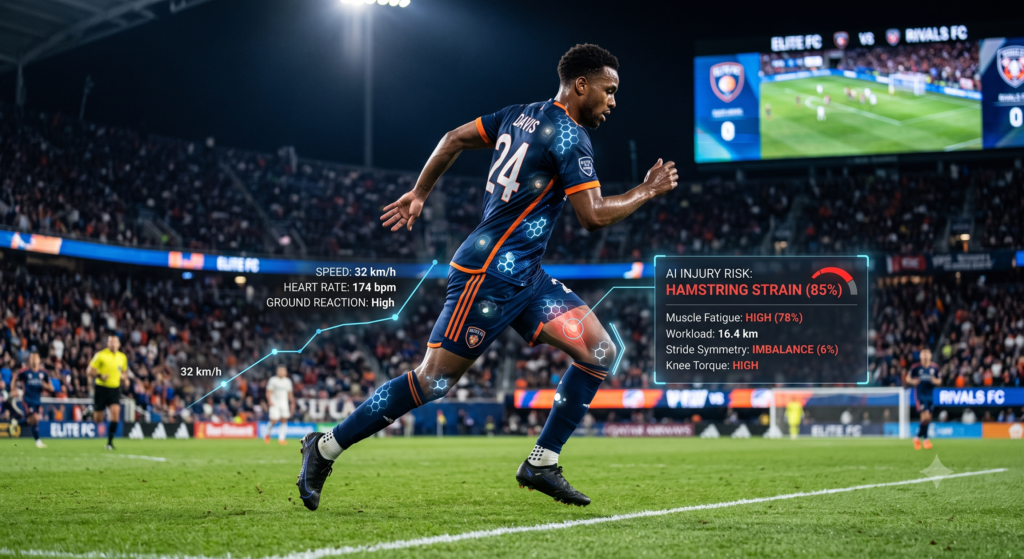
For decades, sports medicine operated on a reactive basis—waiting for a player to limp off the pitch or report a nagging pain. Today, relying on subjective clinical screening is officially obsolete. The sports industry has entered a data-driven era where artificial intelligence, machine learning, and advanced wearable textiles fuse together to predict injuries before they ever happen.
With elite AI models now continuously analyzing an athlete’s physical output, professional sports are fundamentally altering how they optimize human performance. Here is a deep dive into the technology that is actively preventing season-ending tragedies.
Unveiling the Technology Inside Smart Uniforms
The wearables of 2026 are completely unobtrusive, woven directly into the fabric worn by athletes. These smart uniforms collect billions of data points through intelligent sensing, forming the foundation of a modern injury risk assessment framework.
- Real-Time Biomechanical Tracking: Advanced sensors track kinematic indicators like joint stability, prolonged eccentric braking, and gait asymmetry. By catching early movement abnormalities (like excessive knee valgus during a landing), teams can predict and prevent devastating issues like ACL tears and tibial stress fractures.
- Metabolic and Biochemical Sensors: Today’s athletic wear can monitor internal physiological markers that deteriorate well before a player feels pain. These uniforms track continuous sweat biomarkers (including pH, electrolytes, and lactate), while near-infrared spectroscopy (NIRS) monitors muscle oxygen saturation to detect early hypoxia and muscular overload.
- Multimodal Fusion Systems: The modern competitive frontier lies in combining this wearable sensor data with camera-based computer vision streams, giving coaches a composite view of biomechanical risk patterns.
The AI Engines Predicting the Future
Collecting biological data is useless without a brain to process it. That is where deep learning architectures and statistical inference engines come into play.
The NFL’s Digital Athlete Simulation
Partnering with AWS, the NFL’s Digital Athlete project has established a new benchmark for collision sports.
- The system utilizes 38 perfectly calibrated cameras in stadiums, recording 5K video at 60 frames per second to capture 38 unique angles of every single play.
- By combining this visual data with player tracking, the AI runs millions of simulations to calculate precise injury risks.
- The results are undeniable: relying on insights from the Digital Athlete, the NFL recorded a 17% drop in concussions in 2024, achieving its lowest rate on record.
Zone7 and the Football Revolution
In the world of global soccer, an AI platform named Zone7 is acting as a crystal ball for team medical staffs.
- By digesting 200 million hours of training and match data, Zone7 predicted injury risks with an incredible 72% accuracy across 423 injuries evaluated among 11 professional teams.
- Spanish club Getafe utilized the platform and experienced a 40% drop in injury volume in year one. As the AI engine grew smarter in its second year, Getafe’s injury reduction skyrocketed to an astonishing 66%.
What is Next? The Digital Twin Architecture
While current AI-informed prevention strategies are already yielding overall injury reductions of 23% to 42% across sports, the horizon looks even more promising. The upcoming architectural shift is centered on “Digital Twins”.
By creating a real-time virtual replica of an athlete’s musculoskeletal and physiological system, teams can run localized fatigue modeling. This means a coach can virtually test how a specific player’s body will react to a heavy upcoming schedule, allowing for completely individualized rest and rotation planning.
The convergence of AI algorithms and smart textiles is no longer science fiction. It is the new baseline for athletic success, proving that the best way to treat a catastrophic sports injury is to mathematically ensure it never occurs in the first place.