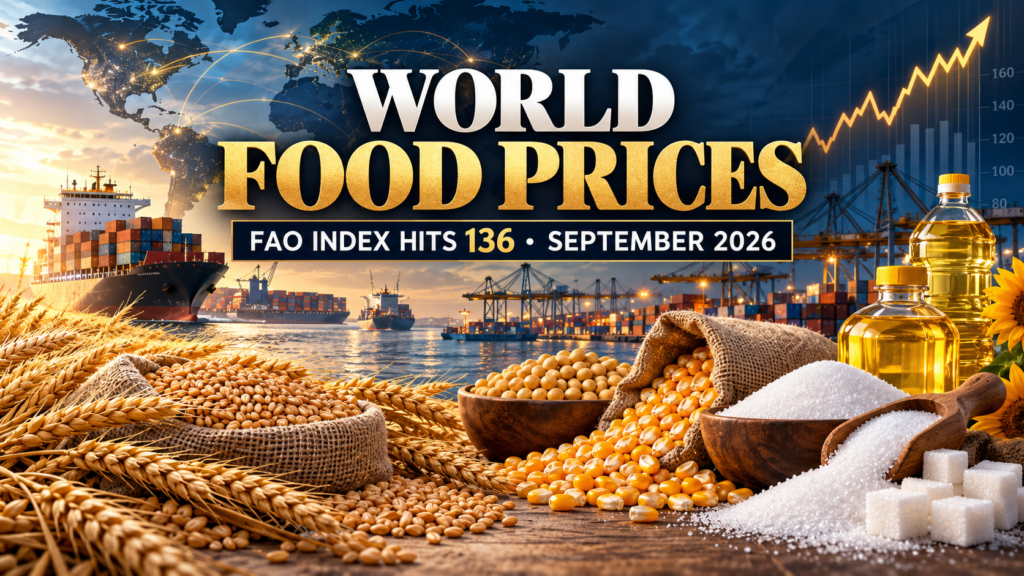
Updated: October 2, 2026. Global food prices climbed to their highest level in almost four years in September, adding another layer of pressure to household budgets and import-dependent economies.
The United Nations Food and Agriculture Organization’s Food Price Index reached 136.0 points in September 2026, up from a revised 134.0 in August. According to Reuters, that was the highest reading since November 2022.
The increase was not spread evenly across every food category. Cereals, sugar and vegetable oils moved higher, while meat and dairy prices eased. That matters because the index is not simply a measure of supermarket bills; it tracks international prices for globally traded food commodities, which can feed into local inflation with a lag.
Key takeaways
- The FAO Food Price Index rose to 136.0 in September 2026 from 134.0 in August.
- It was the highest level in nearly four years.
- Cereal, sugar and vegetable-oil prices increased; meat and dairy prices declined.
- Black Sea shipping disruption, Strait of Hormuz risks and El Niño concerns are all affecting market expectations.
- FAO still expects global cereal production of roughly 2.979 billion tonnes, close to a record level.
- High international prices can hurt food-importing countries even when global production remains strong.
Why did world food prices rise in September 2026?
There is no single cause. The current rise combines logistics, weather and energy risk.
Black Sea shipping remains a pressure point
The Black Sea is a major route for wheat, maize and other agricultural commodities. When shipping capacity is constrained or insurance and freight costs rise, global buyers compete for fewer readily available cargoes. That can lift benchmark prices even before physical shortages appear.
Energy prices affect more than transportation
Higher energy costs influence fertilizer production, farm machinery, refrigeration and freight. The Strait of Hormuz risk therefore matters to food markets as well as oil markets. A prolonged disruption can raise the cost of producing and moving food across borders.
El Niño risk is changing expectations
Commodity markets price the future. Traders do not wait for a crop failure to happen before reacting. Concerns about El Niño can raise the risk premium on grains, sugar and other crops if weather models point to unfavorable growing conditions.
What does the FAO Food Price Index measure?
The FAO index tracks monthly changes in international prices for five broad food commodity groups: cereals, vegetable oils, dairy, meat and sugar. It is weighted by the average export shares of those groups.
That means a 136 reading does not mean food at the supermarket is 36% more expensive than a specific base year. It is a benchmark designed to show how internationally traded food prices are moving over time.
Which food categories became more expensive?
Reuters reported that September’s increase was led by cereals, sugar and vegetable oils. Sugar prices reached an 18-month high, while wheat futures climbed to a three-year high amid reduced Black Sea trade availability.
Meat and dairy moved lower, helping to limit the overall increase. This mix is important because individual countries consume and import different baskets of food. A country heavily dependent on imported edible oil or wheat may experience more pressure than one with large domestic supplies.
If global cereal production is strong, why are prices still high?
This is one of the most useful questions in the current food-price story. FAO’s 2026 global cereal production estimate remains close to 2.979 billion metric tonnes, which would be the second-largest harvest on record.
But production is only one part of price formation. Food has to be stored, financed, insured and transported. If a large crop cannot move efficiently from exporting regions to importing countries, local scarcity and higher freight costs can push international prices up.
FAO also trimmed its cereal trade forecast as shipping constraints reduced expected wheat and maize exports.
What could higher world food prices mean for India?
India is a large food producer, so global commodity moves do not pass directly into domestic prices one-for-one. Still, imported edible oils, energy costs, fertilizer inputs and currency movements can affect the local inflation picture.
This comes just as India’s growth outlook is being tested by external pressures. BCC’s latest analysis of India’s Q2 growth, crude oil and El Niño risks explains why food and fuel can complicate monetary policy even when headline growth remains strong.
For households, the most important issue is whether higher wholesale commodity prices persist long enough to reach retail prices. Government stocks, import policies, domestic harvests and currency conditions can all soften—or amplify—the impact.
Which countries are most vulnerable?
Food-importing economies with weak currencies are usually the most exposed. They can face a double hit: the dollar price of food rises, while their own currency buys fewer dollars. Low-income households are particularly vulnerable because food takes a larger share of their monthly spending.
Countries that depend heavily on wheat, edible-oil or sugar imports may feel the impact faster than diversified agricultural exporters.
What could bring food prices back down?
Several developments could ease pressure: improved Black Sea shipping, lower energy prices, favorable harvest weather, stronger export availability and a reduction in geopolitical risk. A stronger-than-expected crop cycle could also rebuild inventories.
The reverse is equally important. A combination of severe El Niño effects, prolonged shipping disruption and high fuel costs could keep the index elevated even with healthy global production.
Frequently asked questions
What is the FAO Food Price Index for September 2026?
The index reached 136.0 points in September, up from a revised 134.0 in August.
When were global food prices last this high?
According to Reuters, the September 2026 reading was the highest since November 2022.
Which foods increased the most?
The September rise was driven mainly by cereals, sugar and vegetable oils, while meat and dairy prices declined.
Does a higher FAO index immediately increase grocery prices?
Not necessarily. Retail prices also depend on domestic production, taxes, subsidies, inventories, exchange rates, transportation and retailer margins. International prices are an important input, but the pass-through can take time.
Sources and further reading
This article is for general information and is not financial or commodity-trading advice.
Follow Buzz Content Corner
Want more clear, timely explainers without the noise? Follow Buzz Content Corner (BCC) on Instagram and Facebook for new stories, updates and analysis.