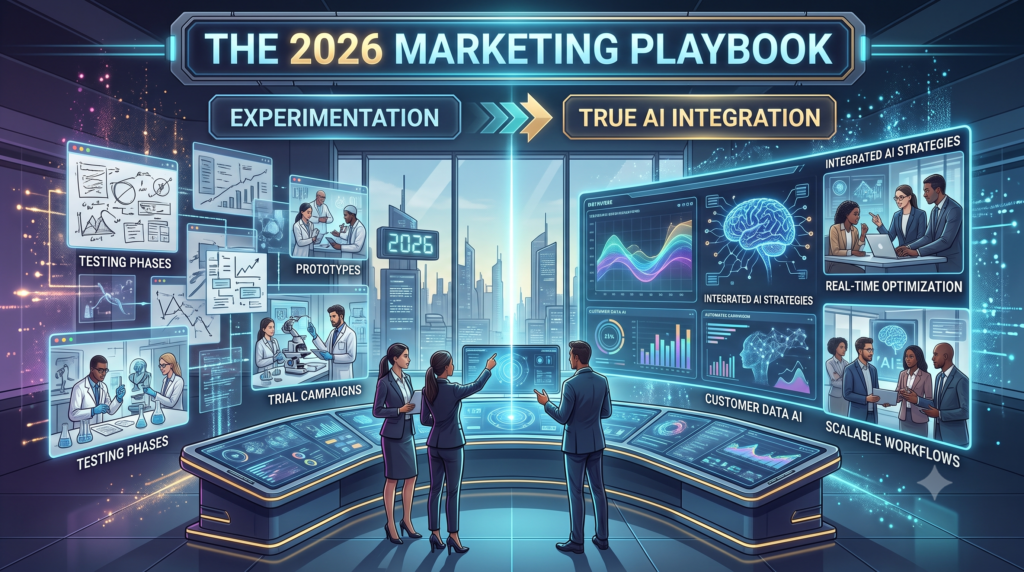
Marketing in 2026 is no longer about simply testing AI tools and seeing what happens. The focus has shifted toward true AI integration, where teams use AI as part of a real system for content, targeting, automation, analysis, and decision-making.
Businesses that once used AI for isolated tasks are now moving toward full workflow integration. That shift is changing how campaigns are planned, how content is produced, and how performance is measured across the entire marketing funnel.
From tools to systems
Earlier, many marketers used AI for one-off tasks like writing captions, generating ideas, or summarizing reports. In 2026, that approach is no longer enough for brands that want consistent growth.
The new standard is to build AI into the full marketing process. That means using it for research, customer segmentation, creative planning, content production, email automation, ad optimization, and reporting in a connected way.
Why AI integration matters
AI integration matters because marketing has become faster, more competitive, and more data-heavy. Teams need to react quickly, personalize better, and reduce wasted effort across channels.
When AI is properly integrated, it helps marketers spend less time on repetitive work and more time on strategy. It also improves consistency because campaigns can be guided by data rather than guesswork.
Content creation at scale
One of the biggest changes in 2026 marketing is content production. Brands now need large volumes of content for blogs, social media, landing pages, email sequences, product pages, and short-form video.
AI helps teams create that content faster, but the real advantage comes when AI is part of a structured content workflow. Instead of generating random posts, marketers can use AI to support topic research, content briefs, SEO optimization, and publishing schedules.
Smarter personalization
Personalization has also moved beyond basic name inserts in email campaigns. In 2026, AI helps brands analyze user behavior, predict intent, and deliver more relevant offers across channels.
This means audiences can receive different messages depending on what they browse, click, buy, or ignore. The result is a more natural customer journey and a stronger chance of conversion.
Better ad performance
Paid media is another area where AI integration is becoming essential. Ad platforms already rely heavily on machine learning, but marketers are now using AI on their side too.
AI can help test ad angles, generate copy variations, spot weak creative, and identify patterns in campaign performance faster than manual review alone. That gives brands a better chance to scale winning ads and cut poor-performing ones early.
Automation without losing control
The goal of AI integration is not to remove human control. It is to automate repetitive steps while keeping strategy, brand voice, and quality checks in human hands.
Brands that succeed in 2026 will be the ones that combine automation with judgment. AI can move the work faster, but people still need to decide what fits the brand, what feels authentic, and what supports long-term trust.
The role of data
AI becomes much more powerful when it is connected to clean, useful data. Without good data, even the best tools produce weak results.
That is why marketing teams are focusing more on analytics, customer records, campaign tracking, and performance dashboards. The better the input, the better the AI-supported decisions.
What brands should do next
Brands should stop treating AI as a side experiment and start using it as part of daily operations. That means building repeatable AI workflows, training teams to use them properly, and measuring results carefully.
The most effective marketing teams in 2026 will not be the ones using the most AI tools. They will be the ones using AI in the smartest way across their entire system.
Final take
The 2026 marketing playbook is about maturity, not novelty. Experimentation helped brands understand what AI can do, but true integration is what turns that potential into real business results.
For marketers working on AI-driven growth, GEO (Generative Engine Optimization) is one of the clearest examples of how strategy is moving beyond traditional SEO and into AI-native content systems.
For more Updates, visit: Buzz Content Corner
Follow us on
Facebook: https://www.facebook.com/Buzzcontentcorners/
Instagram: https://www.instagram.com/buzzcontentcorner