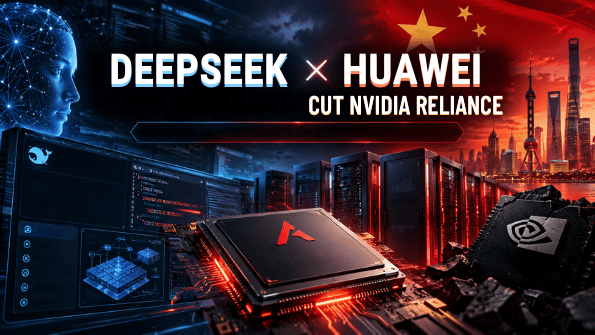
Updated October 1, 2026. DeepSeek and Huawei are working together on programming tools designed for Huawei’s Ascend AI chips, a move that targets one of Nvidia’s biggest competitive advantages: software.
Reuters reported on September 30 that DeepSeek is open-sourcing programming infrastructure for Ascend, including compute and communication libraries, while the collaboration also includes TileLang, a high-level open-source programming language intended to make AI-chip programming easier.
Key takeaways
- DeepSeek and Huawei are collaborating on software for Huawei Ascend AI processors.
- The work includes open-source compute and communication infrastructure.
- TileLang is positioned as a simpler high-level programming approach for AI hardware.
- The strategic goal is to make the Ascend ecosystem easier to use and reduce dependence on Nvidia CUDA.
- Software maturity, developer adoption and model compatibility will determine whether the effort can scale.
Why CUDA is the real target
Nvidia’s dominance in AI is not based only on GPUs. CUDA, its software platform and developer ecosystem, gives researchers and companies a mature environment for training and deploying AI models. Libraries, tooling, documentation and developer familiarity all create switching costs.
That is why competitors increasingly treat software as seriously as silicon. A faster chip is not enough if developers struggle to port models, debug workloads or access optimized libraries.
BCC explored the same issue in our AMD–Nvidia AI system rivalry.
What DeepSeek is contributing
DeepSeek brings experience building and optimizing large AI models under constrained compute conditions. Reuters reported that the company is helping develop programming infrastructure optimized for Huawei’s Ascend hardware and is open-sourcing parts of the stack.
What is TileLang?
TileLang is described as a high-level open-source programming language for AI chips. The idea is to let developers express computation in larger logical tiles instead of manually handling every low-level hardware detail. If successful, that can make optimization more accessible while still exposing enough control to extract performance.
Huawei’s Ascend strategy
Huawei has been expanding Ascend processors, large-scale supernode systems and domestic AI infrastructure as U.S. export controls limit access to leading Nvidia products in China. Reuters said the collaboration includes a supernode design using 128 Ascend 950 chips.
BCC’s earlier feature on China’s emerging chip technologies shows why domestic alternatives have become strategically important.
Can Huawei and DeepSeek replace CUDA?
Not quickly. CUDA has years of accumulated tooling, developer knowledge and optimization behind it. Replacing that ecosystem requires stable compilers, libraries, profilers, documentation, framework support and predictable deployment.
But the collaboration can still matter without fully replacing CUDA. A credible alternative can reduce vendor dependence, improve bargaining power and create a parallel ecosystem for Chinese AI development.
Why open source matters
Open-source infrastructure can accelerate adoption because developers can inspect, modify and contribute to the stack. It also makes it easier for universities, startups and research labs to experiment without waiting for proprietary tools.
Frequently asked questions
What are DeepSeek and Huawei building together?
Programming tools and open infrastructure optimized for Huawei’s Ascend AI chips, including compute and communication libraries and TileLang.
What is TileLang?
An open-source high-level programming language intended to simplify AI-chip programming and optimization.
Why does Nvidia CUDA matter?
CUDA is the mature software ecosystem surrounding Nvidia GPUs. Its tools and libraries make Nvidia hardware easier to use, creating strong developer lock-in.