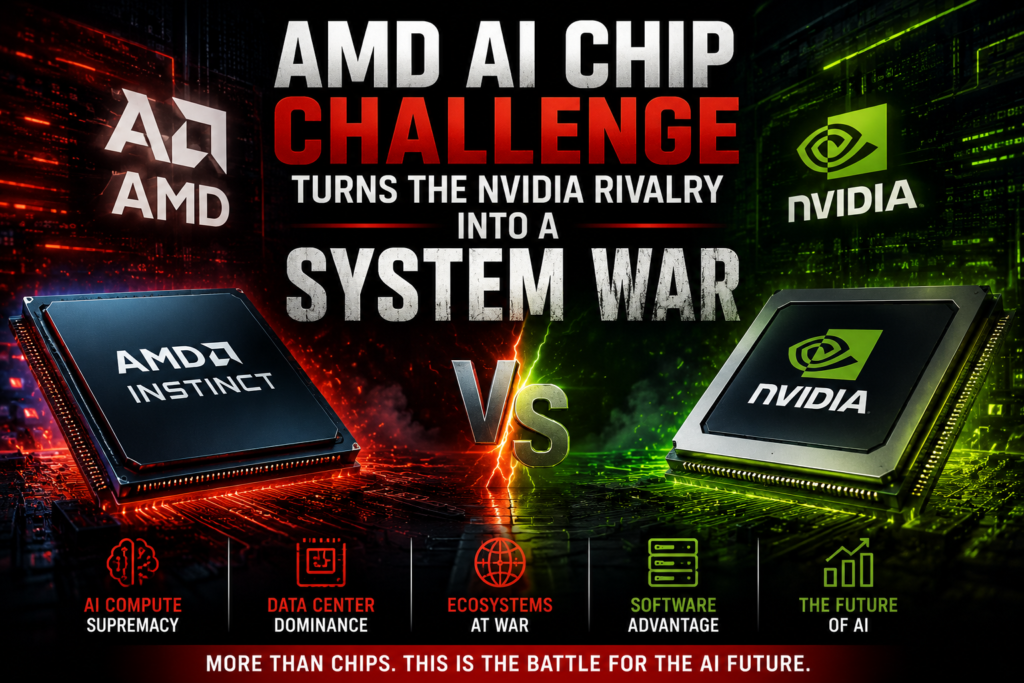
AMD AI chip challenge is no longer just about beating Nvidia chip for chip. The competition is shifting into a full system war built around racks, networking, software, memory, CPUs, and data-center efficiency.
Key Highlights
- AMD is pushing beyond chips into full AI infrastructure systems.
- Nvidia still leads the AI market, but AMD is targeting efficiency and inference workloads.
- Helios is AMD’s rack-scale platform for integrated AI deployment.
- MI350 and MI400 are part of AMD’s broader effort to challenge Nvidia’s AI lineup.
- The contest is now about total system value, not only raw GPU speed.
What Changed In The Rivalry
The AMD AI chip challenge has changed the conversation from individual GPUs to complete AI systems. Buyers are no longer just asking which chip is faster. They want to know which company can deliver the better full-stack platform for large-scale training and inference.
That is why AMD is focusing on integrated infrastructure instead of standalone accelerators. The company is trying to make itself more attractive to cloud providers, enterprises, and AI labs that care about deployment speed, cost, and power efficiency.
Why Now
The AI market is entering a new phase. Training remains important, but inference is becoming a bigger opportunity because it powers real-world AI usage after models are built.
That shift makes efficiency more important than ever. Companies want systems that can handle heavy AI workloads without driving up power use or operational complexity.
AMD sees that shift as an opening. Instead of competing only on peak performance, it is positioning itself as a practical alternative for the next generation of AI infrastructure.
AMD’s System-Level Strategy
AMD is building its challenge around complete platforms, not just accelerators. The Helios rack-scale platform is a major part of that plan because it combines GPUs, CPUs, and networking into one deployment model.
This matters because AI customers want faster implementation and fewer integration problems. A system that is easier to install and manage can be more valuable than a chip that looks stronger on paper.
AMD is betting that end users care about total infrastructure value. That includes performance, cost, energy use, and how quickly the system can be put into service.
MI350, MI400, And The Next Step
AMD’s MI350 series is part of its effort to compete directly with Nvidia’s latest AI hardware. The MI400 family is expected to push that challenge further with stronger performance and more advanced system support.
These products are important, but they are only part of a larger strategy. AMD is trying to prove that it can scale from a chip vendor into a full AI infrastructure provider.
That is the real shift in the rivalry. The fight is no longer just about winning benchmarks. It is about winning the trust of customers building huge AI deployments.
Why Nvidia Still Leads
Nvidia still dominates the AI data-center market. Its software ecosystem, customer base, and early lead remain major advantages.
AMD is not trying to ignore that reality. Instead, it is attacking the market from a different angle by focusing on efficiency, rack design, and total system cost.
That gives AMD a way to compete even if it does not overtake Nvidia in raw market share right away. If AMD can offer better value at scale, it can still win meaningful business.
What This Means For Buyers
For cloud companies and enterprises, the AMD AI chip challenge creates more competition. That usually means better pricing, more innovation, and more options.
For buyers focused on inference, AMD’s system-first approach may be especially attractive because it can simplify deployment and reduce cost. For large training workloads, Nvidia still appears to have the stronger position for now.
The most important buying question is no longer only about chip speed. It is about which AI system delivers the best mix of performance, cost, and scalability.
Bigger Industry Shift
AMD’s strategy reflects a broader shift in the AI hardware market. Vendors are increasingly competing on complete systems instead of isolated chips.
That means racks, networking, software compatibility, memory bandwidth, and power efficiency are becoming just as important as silicon specs. The chip war is turning into an infrastructure war.
Frequently Asked Questions
What is the AMD AI chip challenge?
It is AMD’s effort to compete with Nvidia through complete AI systems, not just individual chips.
Why is the rivalry becoming a system war?
Because AI buyers want integrated infrastructure that includes CPUs, GPUs, networking, and software.
Does Nvidia still lead?
Yes, Nvidia still leads the AI market, but AMD is pushing harder on efficiency and full-system value.
What is Helios?
Helios is AMD’s rack-scale AI platform built for integrated data-center deployment.
Why does inference matter?
Inference is the part of AI that serves real user requests, and it is becoming a major growth area.
Final Thoughts
AMD AI chip challenge is reshaping the Nvidia rivalry into a system-level battle. AMD is betting that the future of AI hardware will be decided by complete infrastructure, not just the fastest chip.
Nvidia still leads, but the game is changing. The winner of the next phase may be the company that delivers the best end-to-end AI system.
For more Updates, visit: Buzz Content Corner
Follow us on
Facebook: https://www.facebook.com/Buzzcontentcorners/
Instagram: https://www.instagram.com/buzzcontentcorner