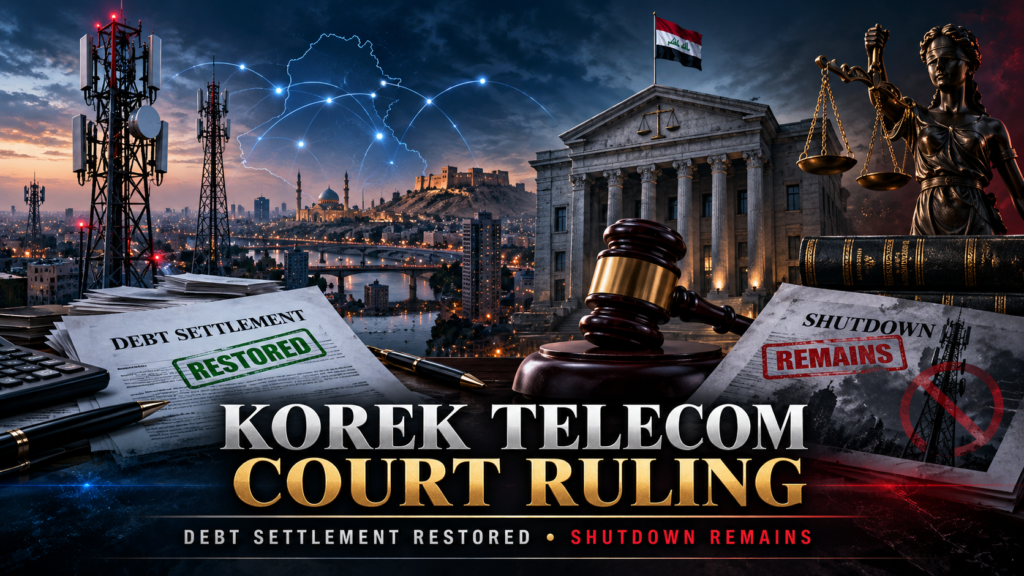
Updated: October 2, 2026. A court ruling involving Iraq’s Korek Telecom has produced two headlines that can sound contradictory: a debt settlement was reinstated, but the company’s shutdown remains in force.
Both can be true because they concern different legal and regulatory actions.
According to Iraqi reporting and statements from the Communications and Media Commission (CMC), the Rasafa Court decision reinstated a previous arrangement concerning Korek’s financial obligations. The regulator, however, says the judgment did not overturn separate measures that led to suspension or shutdown of company operations.
Key takeaways
- The court ruling concerns Korek Telecom’s debt-settlement arrangement.
- The Iraqi CMC says the ruling does not cancel separate regulatory shutdown actions.
- Debt, licensing and operational enforcement are different legal issues even when they involve the same company.
- Korek’s dispute with the regulator has developed through multiple decisions and court proceedings.
- The case remains important for Iraq’s telecom market because Korek has historically been one of the country’s major mobile operators.
What did the Iraqi court decide on Korek Telecom?
Reporting on the Rasafa Court decision says the court restored a 2025 debt-settlement arrangement. That means the legal status of how certain financial obligations are handled changed in Korek’s favor.
It does not automatically mean every other regulatory decision against the operator disappeared.
This distinction is central to understanding the story. A company can prevail on one financial or procedural issue while remaining subject to a separate licence, compliance or enforcement action.
Why is Korek still shut down if it won in court?
The CMC’s position is that the shutdown stems from regulatory measures separate from the settlement challenged in court. In other words, the court decision did not, in the regulator’s reading, amount to an order restoring full operations.
That is why headlines saying “Korek won” or “Korek remains closed” can both oversimplify the situation. The correct question is: what specific decision did the court overturn or restore?
What is the dispute between Korek Telecom and the CMC?
Korek has faced a long-running series of financial, licensing and regulatory disputes in Iraq. The CMC is responsible for communications regulation, and its decisions can affect spectrum, licence compliance, fees and operational status.
The current litigation sits inside that broader history. Public statements from the regulator stress that financial settlement issues should not be conflated with compliance actions.
Does the ruling erase Korek’s debt?
No credible reading of the current ruling supports the simple claim that Korek’s obligations disappeared. The dispute is about the validity and operation of a settlement framework, not a blanket judicial declaration that no money is owed.
The CMC has publicly pushed back against interpretations suggesting that the debt itself was simply cancelled.
What happens to Korek customers?
The customer impact depends on whether operations remain suspended and whether services are restored through regulatory or judicial action. For users, the practical issues are network access, number continuity, balances, contracts and any migration arrangements.
Those operational details should be taken from current CMC or Korek notices rather than social-media claims because the legal status can change quickly.
Why this case matters beyond Korek
Telecom operators rely on long-term regulatory certainty. Networks require huge investments in towers, spectrum, backhaul and software. When licensing and debt disputes remain unresolved for years, the uncertainty can affect investment and competition across the wider market.
The case also illustrates a common legal-reading problem: one court decision rarely resolves every dispute between a regulated company and its regulator.
BCC saw a similar need for careful separation of issues in the Perplexity–Amazon appeals case, where one procedural ruling changed what could happen while the broader dispute continued.
What should readers watch next?
The key developments are whether Korek seeks additional court orders specifically addressing the shutdown, whether the CMC changes its enforcement position, and whether a negotiated settlement emerges.
Any restoration of service would also need a clear operational announcement. A financial court judgment alone is not the same thing as a network restart.
For more legal context on how different rights and remedies can coexist in one dispute, see BCC’s Ilaiyaraaja copyright case explainer.
Frequently asked questions
Did Korek Telecom win its court case?
The company obtained a ruling reinstating a debt-settlement arrangement, but that does not mean it won every regulatory dispute involving its operations.
Is Korek Telecom operating again?
The Iraqi regulator has said the court ruling did not cancel the separate shutdown measures. Readers should check current official notices for any service-restoration announcement.
Did the court cancel Korek’s debt?
The ruling concerns the settlement framework; it should not be described as a simple erasure of all obligations.
Who regulates telecom companies in Iraq?
The Communications and Media Commission is Iraq’s communications regulator.
Sources and further reading
- Peregraf — coverage of the Rasafa Court ruling
- Iraq Communications and Media Commission
- Rudaw — Korek Telecom regulatory dispute coverage
This article is for general information and does not provide legal advice.
Follow Buzz Content Corner
For more legal, business and public-interest explainers, follow Buzz Content Corner (BCC) on Instagram and Facebook.