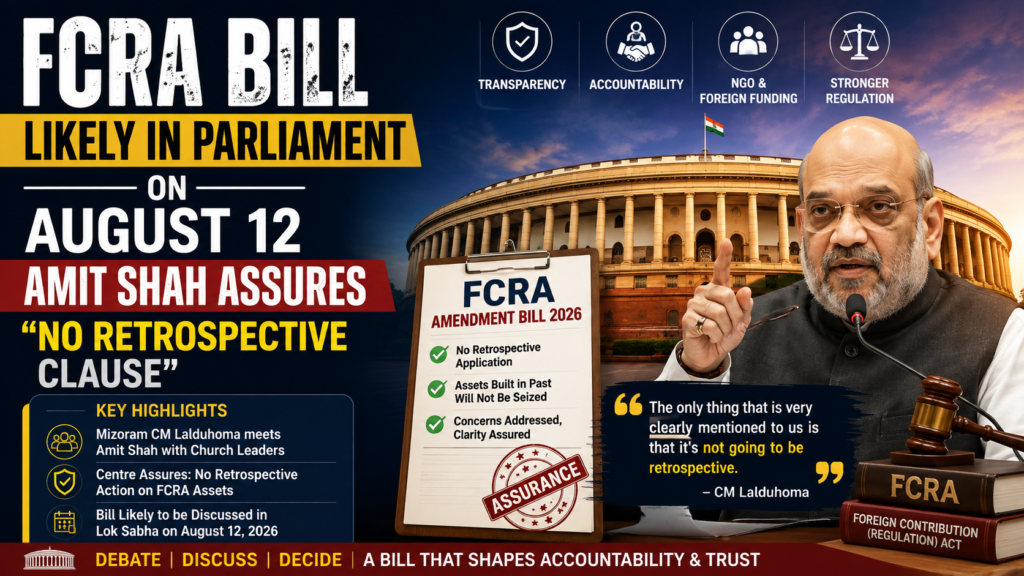
The ongoing Monsoon Session of the Indian Parliament is set to witness a crucial debate on August 12, 2026, regarding the highly debated Foreign Contribution (Regulation) Amendment Bill, 2026.
Amidst growing apprehension from civil society and Christian organizations regarding how the government manages assets funded by foreign donations, a high-level delegation from Mizoram met with Union Home Minister Amit Shah on August 6 to seek clarity and present their concerns.
The biggest takeaway? The government has officially assured that the bill will not be applied retrospectively.
The Crux of the Controversy: What Sparked the Meeting?
The anxiety surrounding the proposed FCRA Amendment Bill 2026 centered on specific new provisions—namely Sections 14B, 16A, and 16B.
Under the proposed law, if an organization’s FCRA registration ceases (whether it is cancelled, surrendered, or allowed to expire without renewal), any unused foreign funds and physical assets created using those foreign contributions would temporarily vest in a government-appointed “Designated Authority.”
The primary fear was the retrospective clause (Section 16B). Critics and religious bodies worried that this framework would apply to assets that were built years ago, potentially allowing the government to take over schools, hospitals, or churches whose FCRA registrations had lapsed long before this amendment was even drafted.
The August 6 Delegation: Who Met Amit Shah?
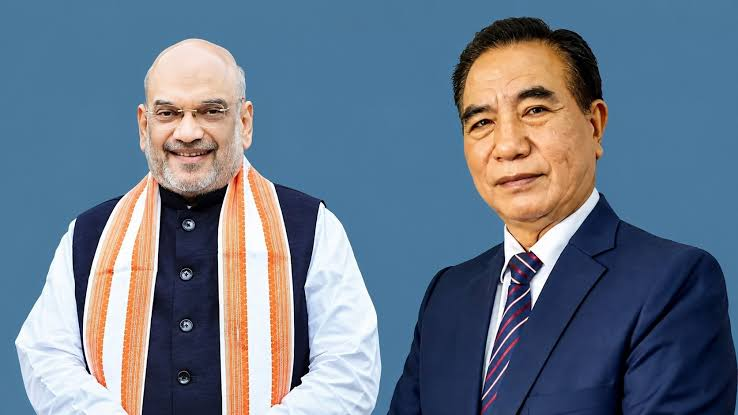
To officially register these regional and community concerns, Mizoram Chief Minister Lalduhoma led a high-profile delegation to New Delhi. He was accompanied by prominent church leaders:
- Reverend John Raldosanga: Chairman of the Mizoram Kohhran Hruaitu Committee (MKHC).
- Reverend Lalhmangaiha: General Secretary of the Council of Churches in Mizoram (CCM).
The delegation submitted a joint memorandum, urging the Centre to either withdraw the contentious provisions or send the bill to a Joint Parliamentary Committee (JPC) for further scrutiny.
Amit Shah’s Assurance
Following the 45-minute meeting, Chief Minister Lalduhoma addressed the media with a significant update.
“The only thing that is very clearly mentioned to us is that it’s not going to be retrospective. That assurance was given to us,” Lalduhoma stated.
The Home Minister assured the delegation that:
- No Retrospective Seizures: The law will only apply going forward. Assets built prior to the amendment by NGOs whose licenses have already lapsed will not be seized.
- Paragraph-wise Clarification: The Home Ministry will provide detailed, point-by-point comments addressing the other concerns raised in the memorandum.
- August 12 Debate: Amit Shah indicated that the discussion on the FCRA Amendment Bill will commence in the Lok Sabha on August 12, 2026.
Understanding the Government’s Standpoint
Government officials maintain that the core objective of the 2026 Amendment is to enhance transparency, accountability, and the proper management of institutions built with foreign money.
If there is a discontinuity in an NGO’s FCRA registration, the “Designated Authority” acts as an interim management body to ensure the property is maintained. The government has explicitly clarified that religious institutions will continue to be managed according to the practices of the religion to which they belong, and assets will be handed back once the original owner secures renewed registration.
Most Searched Q&A on the FCRA Amendment Bill 2026
To help you understand the broader context, here are the most frequently asked questions regarding the FCRA and the latest bill:
Q: What is the FCRA?
A: The Foreign Contribution (Regulation) Act (FCRA) is an Indian law that regulates how non-governmental organizations (NGOs), charities, and religious bodies receive and utilize foreign donations, ensuring these funds do not adversely affect internal security.
Q: Why are Christian organizations specifically concerned about the 2026 Bill?
A: Many churches and institutions (like hospitals and schools) in India, particularly in the Northeast and Kerala, have been built using foreign contributions over the decades. They feared that a technical glitch in renewing their FCRA license could lead to the government permanently taking over these community assets under the new rules.
Q: Can the government turn a church into a government office under this new bill?
A: No. The bill contains specific safeguards for places of worship. If a religious property temporarily comes under the Designated Authority, the authority is legally bound to maintain its “religious character” and entrust its operation to an eligible person from that community.
Q: What happens if an NGO’s FCRA license expires?
A: Under the proposed rules, if a license expires, is cancelled, or isn’t renewed, the organization’s foreign funds and assets created by foreign funds are temporarily managed by a government Designated Authority. If the NGO successfully renews its license within a prescribed period (with a 12-month appeal window), the assets are returned.
Q: When will the FCRA Amendment Bill 2026 become law?
A: The bill was introduced in the Lok Sabha for adoption during the Monsoon Session. Home Minister Amit Shah is slated to initiate the parliamentary discussion on August 12, 2026. It must pass both houses of Parliament and receive the President’s assent to become law.
For more Updates, visit: Buzz Content Corner
Follow us on
Facebook: https://www.facebook.com/Buzzcontentcorners/
Instagram: https://www.instagram.com/buzzcontentcorner