Building a data-driven marketing strategy doesn’t require a six-figure enterprise software budget. In 2026, the ecosystem of free, freemium, and open-source analytics tools is powerful enough to cover the entire marketing stack—from website tracking and SEO to deep product analytics and data pipelining.
Whether you are tracking user engagement across a content network or measuring conversion rates for an e-commerce store, the challenge today isn’t finding tools; it’s selecting the right combination that matches your team’s technical skills and business goals.
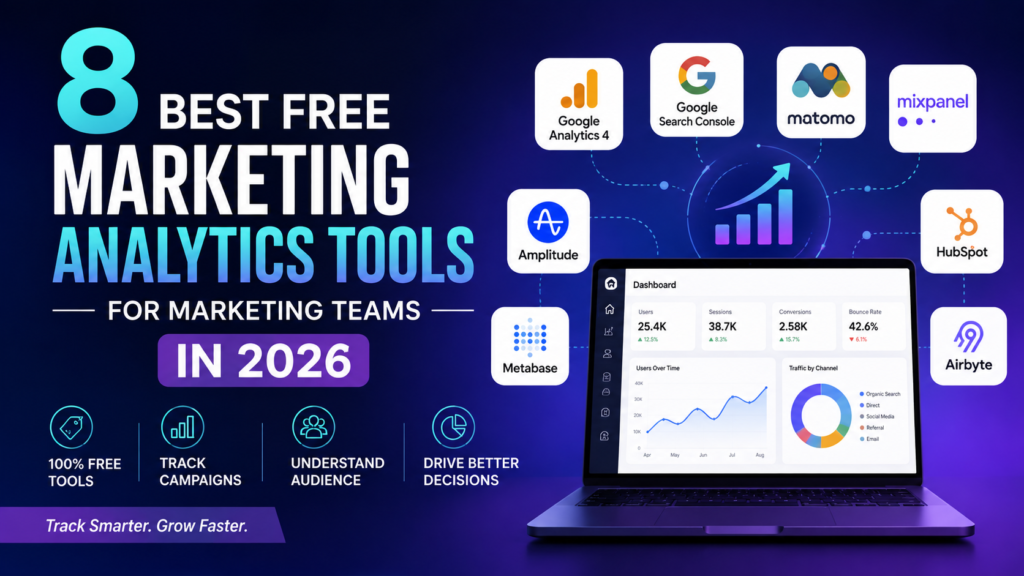
Here are the 8 best free marketing analytics tools that can help your team measure what actually matters.
1. Google Analytics 4 (GA4)
Best for: General web and app analytics, and baseline tracking.
GA4 has become the definitive standard for understanding user behavior. Moving away from the old session-based model, GA4 uses an event-based tracking system that provides a holistic view of the customer journey across multiple devices.
- Key Features: Advanced event tracking, funnel reports, and predictive metrics (like purchase probability).
- The Free Advantage: It connects natively with Google Ads and offers a free export to BigQuery—a feature that used to cost thousands of dollars in the previous generation of Google Analytics.
- Keep in mind: The interface has a steep learning curve, and some native reports are subject to data sampling if your traffic is very high.
2. Google Search Console
Best for: SEO performance and technical site health.
If you care about organic traffic, Google Search Console is non-negotiable. It is the only tool that provides exact data straight from Google regarding how your site performs in the search results.
- Key Features: Track impressions, clicks, and average positions for specific search queries. It also flags crawling errors and mobile usability issues.
- The Free Advantage: 100% free with no premium tiers. It pairs perfectly with GA4 to give you the complete picture of your organic acquisition pipeline.
3. Matomo On-Premise
Best for: Complete data ownership and privacy compliance.
For teams operating in strictly regulated industries (or those simply tired of feeding data to Big Tech), Matomo On-Premise is the ultimate free Google Analytics alternative.
- Key Features: Goal tracking, e-commerce performance, and detailed funnel analysis without any data sampling.
- The Free Advantage: The open-source version is completely free and gives you 100% ownership of your data, making GDPR compliance much easier.
- Keep in mind: Because it is self-hosted, your team is responsible for server maintenance, updates, and security.
Use the widget below to compare how the top free and open-source platforms stack up against your specific team requirements:
4. Mixpanel (Free Tier)
Best for: Product-led growth teams and deep behavioral analytics.
While GA4 is great for seeing how people arrived at your site, Mixpanel excels at showing you exactly what they do once they sign up. It is built for product analytics, helping you track feature adoption and user retention.
- Key Features: Interactive funnel analysis, user flows, and behavioral cohorts.
- The Free Advantage: Mixpanel’s free tier is incredibly generous, allowing you to track up to 20 million events per month, making it perfect for startups and mid-market SaaS teams.
5. HubSpot Analytics (Free CRM Tools)
Best for: Connecting marketing efforts directly to sales revenue.
HubSpot’s free analytics are built into their free CRM, making it the ideal choice for B2B marketing teams who need to track the entire lifecycle from a first-time blog visitor to a closed-won deal.
- Key Features: Traffic analytics, lifecycle stage tracking, and basic conversion reporting.
- The Free Advantage: It unifies marketing and sales data in one place. You can see exactly which marketing channels are generating the highest quality leads, rather than just the most traffic.
6. Airbyte Open Source
Best for: Building custom data pipelines without software fees.
As your marketing stack grows, data becomes siloed across different platforms (Facebook Ads, LinkedIn Ads, your CRM, etc.). Airbyte is a data integration tool that pulls data from all these sources into a single database.
- Key Features: Hundreds of pre-built connectors to extract, load, and transform (ELT) your marketing data.
- The Free Advantage: The open-source version has no subscription costs or volume-based pricing.
- Keep in mind: Like Matomo, you need to host and maintain the infrastructure yourself.
7. Amplitude Analytics (Free Tier)
Best for: Real-time product analytics and user journey mapping.
Similar to Mixpanel, Amplitude focuses heavily on event-based tracking to help growth teams understand user behavior.
- Key Features: Pathfinder reports (to see the exact routes users take) and real-time behavioral analytics.
- The Free Advantage: The free plan supports up to 10 million events per month and includes unlimited data retention and core analytics charts.
8. Metabase (Open Source)
Best for: Creating centralized marketing scorecards and BI dashboards.
Once you have your data sitting in a warehouse (perhaps routed there by Airbyte and GA4), you need a way to visualize it. Metabase is a business intelligence (BI) tool that allows non-technical marketers to query data and build dashboards.
- Key Features: No-code visual query builder, automated report scheduling, and support for complex SQL if needed.
- The Free Advantage: The open-source version has no per-seat licensing fees, meaning you can share interactive dashboards with your entire company for free
For more Updates, visit: Buzz Content Corner
Follow us on
Facebook: https://www.facebook.com/Buzzcontentcorners/
Instagram: https://www.instagram.com/buzzcontentcorner