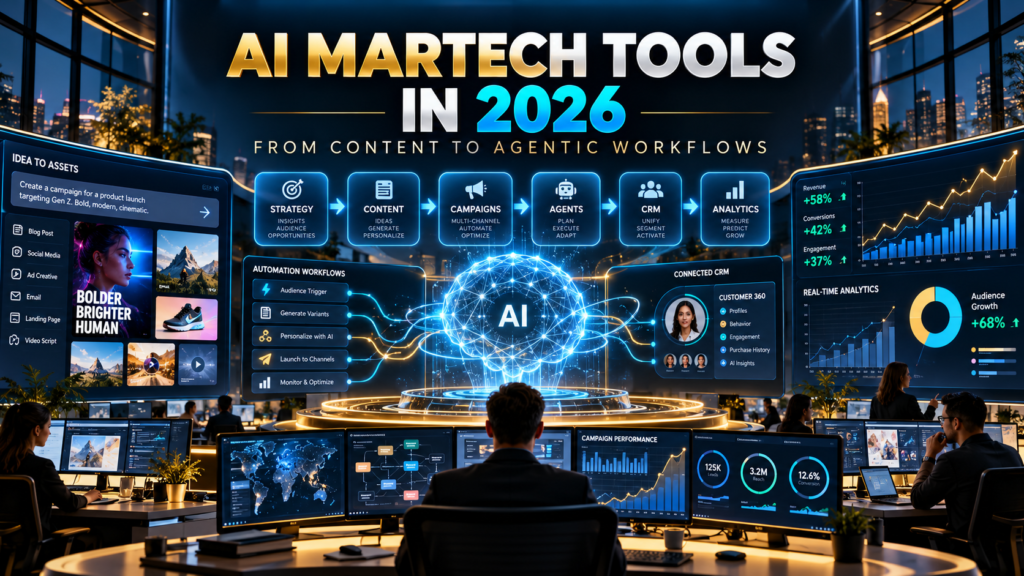
Updated: October 2, 2026. The most important change in marketing technology this year is not another chatbot. It is the steady move from AI that suggests work to AI that can carry out parts of a marketing workflow.
MarTech’s rolling tracker of AI-powered releases shows the shift happening across campaign operations, customer service, creative production, data analysis, SEO research and revenue workflows. Products such as agent studios, AI quality evaluators and autonomous project collaborators are moving closer to the day-to-day stack used by marketing teams.
For anyone searching for the latest AI martech tools in 2026, the useful question is not “Which tool is newest?” It is “Which part of my workflow can be improved without giving an AI system more authority than the data and controls can support?”
Key takeaways
- AI martech is moving from content generation toward multi-step workflow execution.
- Agent platforms can now analyze campaign data, identify funnel problems and trigger actions.
- Marketing teams still need human approval, clean data and clear ownership.
- AI visibility in search and recommendation engines is becoming a dedicated measurement category.
- The biggest risk is automating decisions on top of poor CRM or attribution data.
What are the biggest AI martech trends in 2026?
Agentic campaign operations
Tools such as Auxia Agent Studio are designed to connect analysis with action. Instead of simply showing a dashboard, an agent can identify a funnel drop-off, generate a creative brief and coordinate changes across connected tools.
AI quality assurance
As brands deploy voice and service agents, new products are emerging to evaluate those agents. 3CLogic’s AI Agent Evaluator is one example, scoring conversations and triggering quality workflows.
AI inside project management
Adobe’s Workfront AI Collaborators represent another direction: virtual workers that can read project context, draft content, localize it and return work into an approval queue.
AI visibility measurement
Brands now want to know whether ChatGPT, Gemini, Perplexity and other answer engines mention or recommend them. Tools are appearing specifically to track these responses and audit the content sources AI systems can access.
How is agentic AI different from normal marketing automation?
Traditional automation usually follows predefined rules: if a lead does X, send email Y. Agentic systems can interpret context and decide among several actions to reach a goal.
That flexibility is powerful, but it also makes governance more important. A rules engine is predictable; an AI agent can take an unexpected path if the instructions, data or permissions are unclear.
What should marketers automate first?
The best starting points are usually repetitive, reversible tasks with clear quality checks. Examples include campaign tagging, first-draft creative briefs, reporting summaries, translation workflows and QA against a defined checklist.
High-risk actions—large budget changes, legal claims, pricing, customer refunds or sensitive data decisions—need stronger approval gates.
Why data quality is the real bottleneck
An AI agent can process data faster than a human, but it cannot magically make incorrect CRM fields accurate. If duplicate contacts, bad attribution or missing consent data feed the system, automation can simply spread those errors more efficiently.
This is why teams adopting AI should treat data hygiene and permissions as part of the implementation, not as a separate future project.
How does this affect SEO and AI search?
The marketing stack is expanding beyond rankings and paid-media dashboards. Teams increasingly need to understand how brands appear in AI-generated answers, which sources are cited and whether website content is structured clearly enough for machines to interpret.
BCC’s guide to Generative Engine Optimization (GEO) explains how AI visibility differs from traditional keyword ranking. Our Google Marketing 2026 guide also covers the overlap between SEO, paid media, Maps, analytics and AI search.
Do marketers need more tools—or fewer?
Ironically, the AI boom may make stack consolidation more important. Every new tool adds another data connection, permission layer and reporting interface.
A sensible evaluation starts with the problem, not the demo. Ask whether a new product replaces work, improves a measurable outcome or only creates another dashboard.
BCC’s marketing analytics tools guide is a useful reminder that a smaller set of well-used tools can outperform a large stack nobody fully understands.
Questions to ask before buying an AI martech platform
- What data can the agent read?
- What actions can it take without approval?
- Can every action be logged and reversed?
- How is customer data stored and used?
- What happens when the model is uncertain?
- Can the system integrate with the existing CRM and analytics stack?
- How will the team measure incremental value?
Frequently asked questions
What is agentic marketing technology?
It is marketing software that uses AI agents to plan or execute multi-step tasks rather than only generating content or following fixed automation rules.
Will AI agents replace marketing teams?
The current tools are more useful as workflow accelerators than autonomous replacements. Strategy, accountability, creative judgment and governance still require human ownership.
What is the biggest risk with AI martech?
Giving an agent broad permissions while feeding it poor-quality data is one of the most practical risks.
How can brands track visibility in AI answers?
Dedicated AI-visibility platforms and prompt-tracking tools can monitor mentions and cited sources, while structured, authoritative web content improves the chance of being understood and referenced.
Sources and further reading
Follow Buzz Content Corner
For more practical marketing analysis, follow Buzz Content Corner (BCC) on Instagram and Facebook.