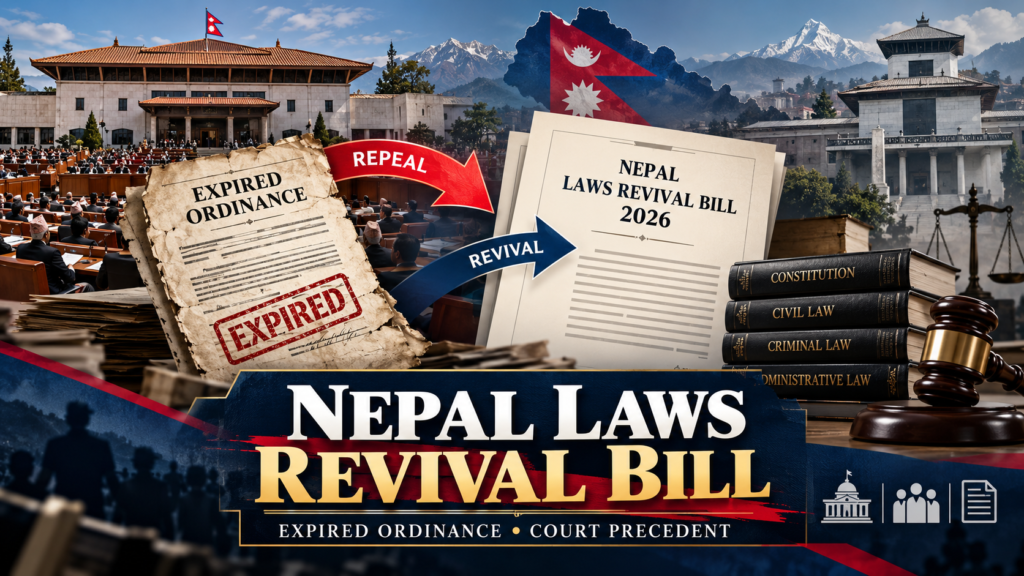
Updated: October 2, 2026. Nepal’s government is trying to restore provisions of dozens of laws that were changed by an ordinance earlier this year, but the move has opened a legal and parliamentary question: if the ordinance expired, did the old laws already revive automatically?
The dispute stems from the Special Provisions Related to the Removal of Public Officials Ordinance, 2026, issued on May 2. According to Nepal News, the ordinance amended 110 Acts and resulted in the removal of 1,594 public officials. It later lapsed on July 10 after failing to receive parliamentary approval within the constitutional period.
The government has now introduced the Bill Related to Reviving Provisions of Certain Nepal Acts, which seeks to restore prior provisions across 85 Acts.
Key takeaways
- The May 2 ordinance amended 110 Acts and led to the removal of 1,594 officials.
- The ordinance lapsed on July 10 after it was not approved within the required period.
- A new bill seeks to revive earlier provisions in 85 Acts.
- A Supreme Court precedent says provisions of a principal Act generally revive when an ordinance that changed them lapses.
- That precedent is central to criticism questioning why a separate revival bill is required.
- The current parliamentary session is being prorogued from midnight on October 2, so the bill is expected to wait for a later session.
What did the 2026 removal ordinance do?
The ordinance allowed broad removal of people serving in public bodies under appointments made before a specified cut-off. Nepal News reports that it amended 110 laws and automatically removed 1,594 office-holders.
Among the affected officials was Hitendra Dev Shakya, who had served as managing director of the Nepal Electricity Authority. His litigation is now one of the cases testing the legal consequences of the ordinance’s expiry.
Why did the ordinance expire?
Under Nepal’s constitutional framework, an ordinance is temporary and must pass through the parliamentary process within the required period to remain in force. The removal ordinance did not secure approval and lapsed on July 10.
Once that happened, the legal status of the provisions it had amended became the key issue.
What does the new revival bill propose?
The government registered the bill on September 22 and presented it in the House of Representatives on September 28, according to Nepal News. It seeks to restore the previous form of provisions across 85 statutes, including laws governing public institutions such as Nepal Airlines Corporation, Nepal Electricity Authority, Lumbini Development Trust and other bodies.
The government’s financial note says the measure is intended to maintain the earlier legal arrangements rather than create a new spending obligation.
Why do critics say the bill may be unnecessary?
The argument is based on a Supreme Court precedent. Nepal News reports that a full bench held in a previous ordinance case that when an ordinance lapses, the former provisions of the principal law are revived.
On that reading, some lawyers and opposition voices question why Parliament needs to “revive” provisions that may already have returned automatically.
The government, by introducing the bill, is seeking an explicit statutory restoration. The legal debate concerns whether that extra legislative step is required and how it affects people removed under the now-expired ordinance.
What is happening with the dismissed officials?
Several former office-holders have gone to court seeking reinstatement. Shakya’s case is particularly visible because of his history of removal and reinstatement through earlier government and judicial decisions.
Other officials from transitional-justice bodies have also filed petitions, according to Nepal News.
These cases may help clarify whether the expiry of the ordinance restores only the old statutory text or also affects appointments and removals that occurred while the ordinance was in force.
Why can’t Parliament finish the bill immediately?
President Ramchandra Paudel, on the government’s recommendation, prorogued the ongoing federal parliamentary session with effect from midnight on October 2. Nepal News reports that passage will therefore have to wait for the winter session unless circumstances change.
That timing leaves the courts dealing with immediate disputes while the legislative response remains unfinished.
What should readers watch next?
Three developments matter: Supreme Court rulings in reinstatement cases, any amendments to the revival bill when Parliament reconvenes, and the government’s administrative treatment of offices affected by the lapsed ordinance.
This is a legal process rather than a simple political scorecard. Different institutions—the executive, Parliament and the Supreme Court—are addressing different parts of the problem.
For a comparison with another case where implementation timing became as important as passage, see BCC’s explainer on Egypt delaying its new criminal procedure law. For a broader legislative example, read our report on the FCRA bill and parliamentary process.
Frequently asked questions
What was Nepal’s public-official removal ordinance?
It was a May 2026 ordinance that amended numerous laws and enabled the removal of officials serving in public bodies.
How many officials were removed?
Nepal News reports that 1,594 people were removed under the ordinance.
When did the ordinance lapse?
It lapsed on July 10, 2026 after failing to secure parliamentary approval within the required period.
What does the new bill do?
It seeks to restore prior provisions across 85 Acts that had been altered by the ordinance.
Why is there a legal dispute?
A Supreme Court precedent says old statutory provisions revive when an ordinance lapses, raising a question about whether a separate revival law is necessary and how past removals should be treated.
Sources and further reading
Follow Buzz Content Corner
For more sourced political and policy explainers, follow Buzz Content Corner (BCC) on Instagram and Facebook.