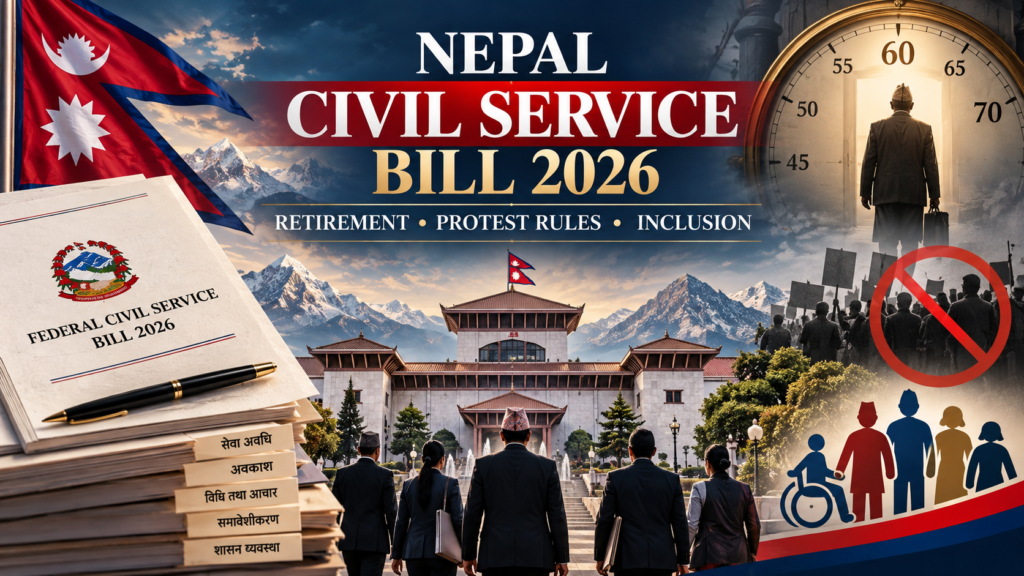
Updated: October 2, 2026. Nepal’s government has registered a new Federal Civil Service Bill that would reshape how the country’s federal bureaucracy is recruited, evaluated, transferred and retired. Some provisions have already drawn criticism from former employee groups and experts, while the government presents the bill as an effort to modernize the civil service.
The legislation is formally titled the Bill to Amend and Consolidate Laws Relating to the Formation, Operation and Service Conditions of the Federal Civil Service. It was registered in the Federal Parliament Secretariat on October 1, according to Ratopati.
For readers searching for the Nepal Federal Civil Service Bill 2026, the most discussed provisions concern retirement transition rules, restrictions on strikes and demonstrations, performance agreements, inclusion quotas and professional conduct.
Key takeaways
- The bill proposes 11 federal civil-service groups or services.
- It strengthens performance-based evaluation and would require performance agreements for senior officials.
- Section 83 proposes restrictions on strikes, demonstrations and other actions that obstruct government work.
- A transition clause involving employees who have reached 55 years of age or 30 years of service has drawn criticism from some stakeholders.
- The bill also contains inclusion provisions covering women, Indigenous nationalities, Madhesi, Dalit, Tharu, Muslim, backward-region and disability categories.
- The bill is still part of a parliamentary process; proposals can be debated or amended before final enactment.
What is the Nepal Federal Civil Service Bill 2026?
The bill is intended to consolidate and update the legal framework governing Nepal’s federal civil service. Ratopati reported that it would organize the service into 11 areas, including administration, engineering, agriculture, justice, foreign affairs, audit, forest, education, information technology and economic planning/statistics.
The legislation also attempts to standardize professional development, transfer procedures, performance evaluation and disciplinary rules across the federal bureaucracy.
Why is the retirement provision controversial?
One of the most discussed clauses is Section 57. The bill proposes a general mandatory retirement age of 60, but Ratopati reports that a transition provision would apply existing rules to employees who have already completed 55 years of age or 30 years of service when the law begins.
Some employee representatives and experts quoted by Ratopati argue that this could create unequal treatment between employees who cross the threshold just before commencement and those who do so later. That is an attributed criticism, not a settled legal conclusion.
Supporters of transition clauses in general often argue that a new system needs a clear cut-off date. The parliamentary debate will determine whether lawmakers keep, amend or replace the proposed arrangement.
Does the bill ban civil-service strikes and protests?
Section 83, as reported by Ratopati, proposes that civil servants may not take part in strikes, pen-down actions, lockouts, blockades or other acts that obstruct government work. It also provides for departmental action and, in some circumstances, recovery of damages.
The stated policy issue is continuity of public services. The competing concern raised in debates over similar restrictions is how public employees can express workplace grievances while remaining bound by duties attached to government employment.
The bill’s final legal effect will depend on the text Parliament ultimately passes and any subsequent judicial interpretation.
How would performance evaluation change?
The legislation proposes a stronger performance-management framework. Senior officials, including secretaries and office chiefs, would be required to sign performance agreements and be evaluated against them.
That approach is intended to connect promotions and career development more closely to measurable work. Its effectiveness would depend on how performance targets are designed, audited and applied across very different government departments.
What are the inclusion provisions?
Ratopati’s summary says the bill retains structured inclusion measures for groups that have historically been underrepresented in public service. The listed categories include women, Indigenous nationalities, Madhesi, Dalit, Tharu, Muslims, residents of backward regions and persons with disabilities.
Because quotas and representation rules are politically sensitive, exact percentages and eligibility conditions should be read from the final enacted text rather than assumed from an early bill summary.
What else is in the bill?
The proposal covers predictable transfer systems, codes of conduct and an institutional mechanism described as a Good Governance and Integrity Unit. It also contains rules concerning professional behavior and conflicts with public duties.
Those details matter because a civil-service law affects not only government employees but also how citizens experience administration—from permits and public records to infrastructure and social services.
What happens next in Parliament?
Registration is only one stage. Parliament can hold general discussion, send provisions for committee consideration and amend clauses before a final vote. Political parties and stakeholders may also propose changes during that process.
Readers should therefore distinguish between what the bill currently proposes and what the final law ultimately contains.
BCC has used the same distinction in other legislative explainers, including our coverage of Egypt’s criminal-procedure law delay and the Italian judicial reform bill.
Frequently asked questions
Has Nepal’s Federal Civil Service Bill become law?
As of October 2, 2026, the reported measure is a bill registered for parliamentary consideration. Registration should not be confused with final enactment.
What is the proposed retirement age?
The bill proposes 60 as the general mandatory retirement age, alongside a transition clause affecting certain employees who have reached specified age or service thresholds.
Would civil servants be allowed to strike?
The current bill text, as reported, proposes restrictions on strikes, demonstrations and other actions that obstruct government work.
Why are some stakeholders criticizing the bill?
Ratopati reports criticism focused especially on the retirement transition rule, which some stakeholders describe as discriminatory or impractical. Parliament can still debate the provision.
Sources and further reading
- Ratopati — criticism of provisions in the Federal Civil Service Bill
- Ratopati — bill registration and service provisions
- Ratopati — Section 83 protest and strike provisions
Follow Buzz Content Corner
For more sourced political and policy explainers, follow Buzz Content Corner (BCC) on Instagram and Facebook.