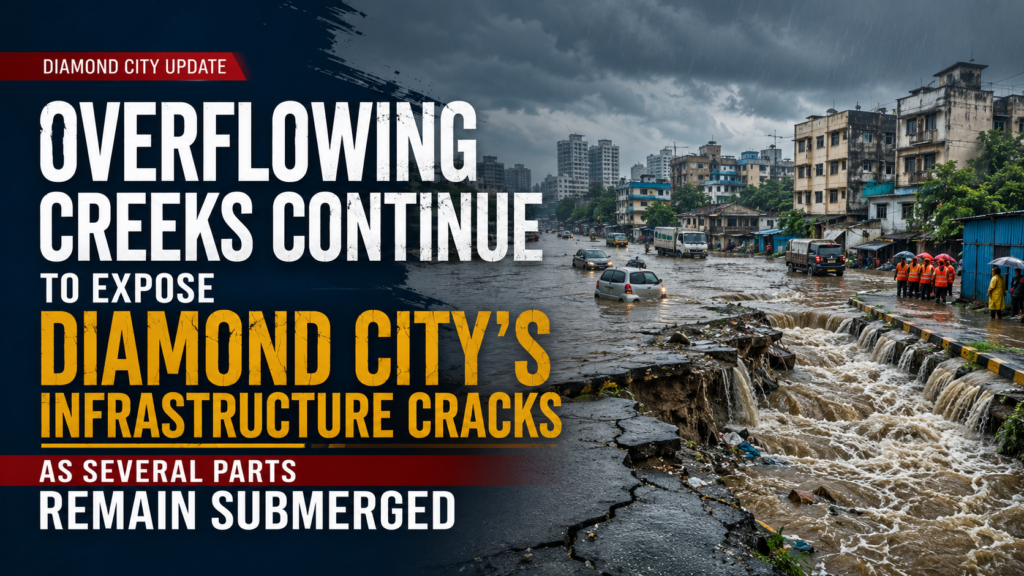
Diamond City flooding is once again exposing the city’s infrastructure cracks as overflowing creeks leave several parts submerged and residents struggling to move through waterlogged streets. The repeated flooding has disrupted daily life, damaged commercial areas, and raised fresh questions about drainage capacity and long-term flood planning.
Diamond City flooding and the worst-hit areas
Several low-lying parts of the city have been among the worst affected by Diamond City flooding. Roads remained submerged in multiple localities even after rainfall slowed, showing that the drainage system could not clear water quickly enough.
Residents in these areas have faced major difficulty getting around, especially where floodwater stayed trapped for hours or days. In some spots, people have had to rely on tractors or other makeshift transport just to cross flooded stretches.
Why Diamond City flooding keeps returning
The main reason Diamond City flooding keeps returning is the gap between heavy rain, overflowing creeks, and weak drainage discharge. When creeks spill over, nearby neighbourhoods are quickly exposed because stormwater has nowhere to go.
This is not just a rain problem. It is an infrastructure problem that becomes visible every time the city faces intense monsoon conditions. If drainage channels cannot carry water away fast enough, the same areas will keep flooding again and again.
Diamond City flooding and business losses
Diamond City flooding has also hit commercial zones hard. Shops, warehouses, and trade areas have reported stock damage, ground-floor water entry, and disruption to regular business activity.
For traders, even a short flood event can create long-lasting losses. Goods, packaging, and equipment stored at lower levels are especially vulnerable, and business recovery often takes longer than the water itself.
Daily life under water
For residents, Diamond City flooding has meant more than blocked roads. It has disrupted school runs, work commutes, shopping, and access to essentials like milk, groceries, and drinking water.
In submerged localities, normal life becomes difficult very quickly. Families often have to wait for the water to recede before they can move freely again, which turns a weather event into a daily hardship.
What the civic response looks like
Civic teams have been deploying pumps, sanitation crews, waste-clearing workers, and health measures to manage the aftermath. Fogging and cleaning operations are especially important after floodwater begins to recede because stagnant water can create health risks.
These efforts help reduce the immediate damage, but they do not solve the root problem. The repeated flooding shows that emergency response alone is not enough without stronger infrastructure planning.
Diamond City flooding and the infrastructure gap
The latest flooding has highlighted a clear infrastructure gap. Drainage, creek maintenance, and stormwater planning all need to work together, but the city still appears unable to handle heavy overflow events efficiently.
That is why Diamond City flooding remains such a recurring issue. As the city grows and more areas are built up, the pressure on the drainage system increases. Without long-term upgrades, the same problem will keep returning during strong rain events.
What residents can expect next
Water levels may fall gradually as pumps continue to work and clean-up operations move forward. But recovery will likely remain slow in the worst-hit areas, especially where roads and ground-floor spaces have been soaked for too long.
Residents should expect continued disruption until the affected stretches are fully cleared. The bigger question is whether this flooding episode will finally lead to stronger drainage fixes and better creek management.
Frequently Asked Questions
What is causing Diamond City flooding?
Heavy rain, overflowing creeks, and weak drainage capacity are the main reasons behind the flooding.
Which areas are most affected?
Low-lying neighbourhoods and commercial pockets near the creeks are facing the worst waterlogging.
Why does the water stay so long?
Because the drainage system cannot remove floodwater quickly enough after the creeks overflow.
How does Diamond City flooding affect businesses?
It damages stock, disrupts trade, and slows down normal commercial operations.
What is the biggest long-term issue?
The biggest issue is the city’s infrastructure gap, especially in stormwater drainage and creek discharge.
Final Thoughts
Diamond City flooding continues to expose the city’s infrastructure cracks because overflowing creeks and weak drainage keep leaving several parts submerged. Until the drainage system is upgraded and creek management improves, these floods are likely to return.
For residents and businesses alike, the latest flooding is another reminder that long-term planning matters more than short-term cleanup. If the city wants to break the cycle, it will need more than pumps and patchwork fixes.
For more Updates, visit: Buzz Content Corner
Follow us on
Facebook: https://www.facebook.com/Buzzcontentcorners/
Instagram: https://www.instagram.com/buzzcontentcorner