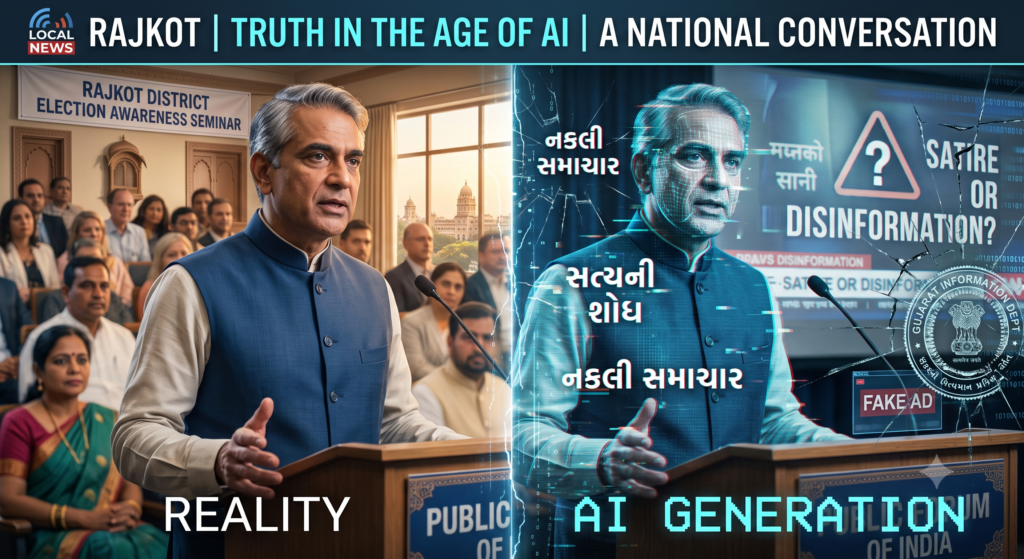
You are scrolling through your social media feed when you see a prominent politician confessing to a massive scandal, their voice shaking with emotion. You share it, only to find out hours later that the video never happened. It was entirely generated by artificial intelligence.
In the rapidly evolving landscape of digital politics, AI-generated content is the new battleground. As we navigate the complexities of 2026, the technology to clone voices, map faces, and generate hyper-realistic videos is accessible to anyone with a smartphone.
But this technological leap has birthed a massive controversy: Where do we draw the legal line between harmless political satire and malicious, election-altering disinformation?
The Rise of the “AI Clone” in Political Campaigns
Historically, political attack ads relied on out-of-context quotes or unflattering photographs. Today, generative AI can fabricate entirely new realities.
Using advanced neural networks and deepfake technology, creators can synthesize a public figure’s exact vocal cadence and facial micro-expressions. While some of these videos are poorly made and easily identifiable, the top-tier “AI Clones” are indistinguishable from reality to the average voter.
This has led to a surge in AI-generated political ads. Some campaigns use AI to translate their candidate’s speeches into multiple languages perfectly, but rogue PACs (Political Action Committees) and anonymous internet trolls are using the same tools to put false words into the mouths of their opponents.
Satire vs. Sabotage: The Legal Gray Area
The core of the controversy lies in legal loopholes. In many democracies, including the United States, political speech and satire are heavily protected under free speech laws (like the First Amendment).
When a creator is caught distributing a deepfake of a politician making controversial statements, the immediate legal defense is almost always: “It was clearly a parody.”
This creates a dangerous legal gray area:
- The Intent of Satire: Traditional satire (like a late-night comedy sketch) uses exaggeration to critique power, and the audience implicitly understands it is a joke.
- The Intent of Deepfakes: AI clones are often designed specifically not to look like a joke. They are engineered to look like leaked, clandestine footage. By the time a fact-checker flags the video as synthetic, millions of voters have already watched and believed it.
Can courts prosecute someone for creating a deepfake if they claim it was just a joke, even if it damaged a candidate’s reputation or swayed voter behavior? Legal scholars are currently fiercely divided on this issue.
How Global Regulators Are Responding
The legal system is notoriously slow, but the explosive growth of AI has forced governments worldwide into rapid action to protect election integrity.
- Mandatory Watermarking: The most prominent legislative push requires all AI-generated political content to feature a highly visible digital and visual watermark, boldly stating “Generated by AI.” However, enforcing this on decentralized social media platforms remains incredibly difficult.
- Platform Accountability: Social media giants are facing intense pressure. Platforms are heavily updating their algorithms to detect synthetic media, threatening to completely de-platform users who post undisclosed deepfakes. Yet, AI generation tools are evolving faster than detection algorithms can keep up.
- Outright Bans on Deceptive Audio/Video: Several regional governments have moved to explicitly ban “materially deceptive audio or visual media” of candidates within 60 to 90 days of an election.
The Future of Voter Trust
The most significant casualty of deepfake political ads is not a single candidate’s campaign—it is the concept of truth itself. We are entering an era known as the “Liar’s Dividend,” where politicians caught in genuine scandals can simply claim that the real audio or video of their misdeeds is just an “AI Deepfake.”
Navigating this new era requires more than just government regulation; it requires a massive shift in digital literacy. Voters can no longer trust their own eyes and ears. Moving forward, the source of the information will be vastly more important than the content of the video itself.
For more Updates, visit: Buzz Content Corner
Follow us on
Facebook: https://www.facebook.com/Buzzcontentcorners/
Instagram: https://www.instagram.com/buzzcontentcorner
[…] Deepfake Political Ads: Where Does AI Satire End and Disinformation Begin? […]
[…] Deepfake Political Ads: Where Does AI Satire End and Disinformation Begin? […]