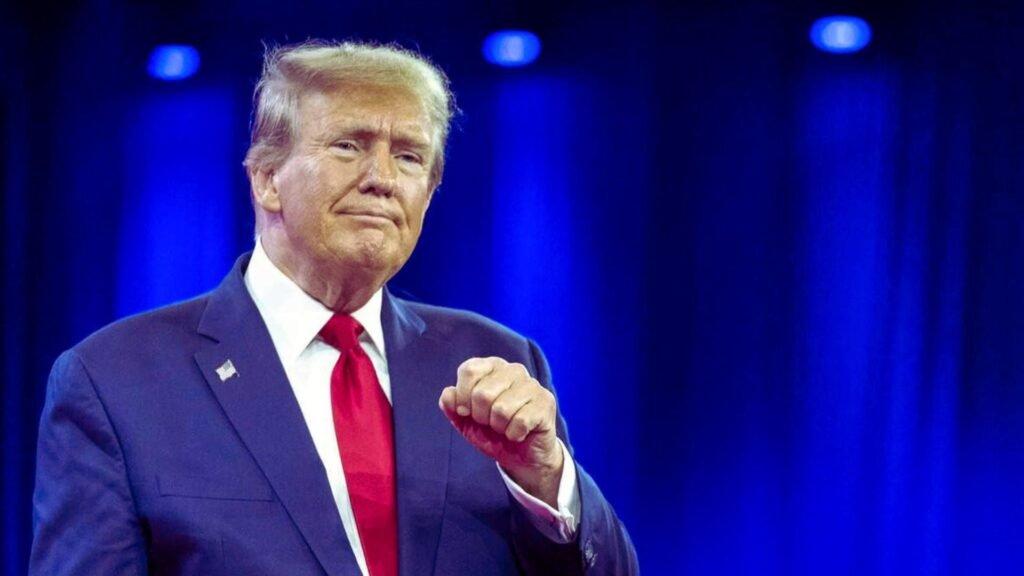
The U.S. Supreme Court’s decision in Trump v. Anderson became one of the most consequential constitutional rulings of the 2024 presidential election.
On March 4, 2024, the Court unanimously reversed a Colorado Supreme Court decision that would have excluded Donald Trump from Colorado’s Republican presidential primary ballot under Section 3 of the Fourteenth Amendment, commonly called the Insurrection Clause.
But the ruling is frequently misunderstood.
The Supreme Court did not decide whether Donald Trump engaged in an insurrection on January 6, 2021.
It also did not decide several other disputed constitutional questions surrounding Section 3.
Instead, the central holding was that individual states do not have constitutional authority to enforce Section 3 against candidates for federal office, particularly the presidency.
That distinction is essential to understanding what the case actually established.
What Is the Insurrection Clause?
Section 3 of the Fourteenth Amendment was adopted after the American Civil War.
It was principally intended to prevent certain former government officials who had sworn to support the U.S. Constitution and later participated in rebellion against it from returning to positions of governmental power.
Section 3 applies to certain people who:
- previously took an oath to support the Constitution; and
- subsequently engaged in insurrection or rebellion against it, or gave aid or comfort to its enemies.
The provision also states that Congress can remove a Section 3 disqualification by a two-thirds vote of each chamber.
Readers can view the official constitutional text through the Congressional Constitution Annotated.
Why Did Section 3 Become an Issue for Donald Trump?
The controversy followed the January 6, 2021 attack on the U.S. Capitol, when Congress was meeting to certify the results of the 2020 presidential election.
A group of Colorado voters argued that Trump’s actions surrounding January 6 meant he had “engaged in insurrection” within the meaning of Section 3.
They therefore argued that he was constitutionally disqualified from again serving as president and should not appear on Colorado’s 2024 Republican primary ballot.
Trump disputed the effort to remove him and challenged the legal and constitutional theories being used against him.
The dispute eventually reached Colorado’s courts.
What Did the Colorado Trial Court Decide?
The state trial court conducted a five-day hearing.
It concluded that Trump had “engaged in insurrection” for purposes of Section 3.
However, it still declined to remove him from the ballot.
Why?
The trial court concluded that the presidency was not an “office under the United States” and that the president was not an “officer of the United States” within the specific meaning of Section 3.
That produced an unusual result:
The court found that Trump had engaged in insurrection but concluded that Section 3 did not apply to the presidency in the necessary way.
Colorado Supreme Court Reverses
The Colorado Supreme Court reached a different conclusion in December 2023.
By a 4–3 vote, it held that:
- the presidency was covered by Section 3;
- Trump had engaged in an insurrection;
- Section 3 applied to him; and
- Colorado could exclude him from its presidential primary ballot.
The court therefore ordered Colorado’s secretary of state not to list Trump as a candidate, although its ruling was stayed while Trump appealed to the U.S. Supreme Court.
The case became:
Donald J. Trump v. Norma Anderson, et al.
Supreme Court docket number 23-719.
The official case materials remain available on the U.S. Supreme Court docket.
What Did the U.S. Supreme Court Decide?
On March 4, 2024, the Supreme Court reversed Colorado.
All nine justices agreed that Colorado could not remove Trump from the presidential ballot under Section 3.
The Court explained that states may have authority to apply Section 3 to their own state officials, but states cannot independently decide whether a person may hold federal office.
The opinion warned that allowing each state to reach its own Section 3 conclusion could produce a chaotic national election system.
One state could declare a candidate eligible.
Another could declare the same candidate disqualified.
Different states could also use different:
- legal standards;
- procedures;
- evidentiary rules;
- deadlines.
In a presidential election, those conflicting decisions could affect voters across the entire country.
The Court concluded that the Constitution does not allow that state-by-state system for Section 3 enforcement against federal candidates.
The complete ruling is available from the U.S. Supreme Court – Trump v. Anderson opinion.
Did the Supreme Court Rule That Trump Did Not Engage in Insurrection?
No.
This is probably the most important correction to make when discussing the decision.
The Supreme Court did not overturn Colorado’s factual finding by declaring:
“Trump did not engage in insurrection.”
Nor did it affirm that finding.
The Court resolved the case on a different constitutional ground:
Colorado lacked authority to enforce Section 3 against a federal presidential candidate.
That allowed the Supreme Court to reverse Colorado’s ballot decision without deciding whether Trump’s conduct constituted insurrection under the Fourteenth Amendment.
Therefore, headlines saying:
“Supreme Court clears Trump of insurrection”
would be inaccurate.
A better description is:
“Supreme Court rules states cannot disqualify Trump from federal office under Section 3.”
Did the Court Decide Whether the President Is an “Officer of the United States”?
No.
This was another major constitutional question surrounding the case.
Trump’s opponents argued that the presidency falls within Section 3.
Some legal scholars disputed whether the wording covering an “officer of the United States” includes a president who previously took the presidential oath.
The Colorado courts addressed that issue.
But the U.S. Supreme Court did not need to resolve it because the Court decided that Colorado lacked the power to enforce Section 3 against federal candidates in the first place.
So Trump v. Anderson did not settle every interpretive question contained in Section 3.
Was the Supreme Court Decision Really 9–0?
Yes — on the outcome.
All nine justices agreed that Colorado could not exclude Trump from the presidential ballot under Section 3.
But they did not agree completely about the reasoning.
This is where the old Buzz Content Corner article needs more precision.
Five Justices Supported the Broader Reasoning
The Court’s main opinion explained that responsibility for enforcing Section 3 against federal candidates rests at the federal level and emphasized Congress’s enforcement authority under Section 5 of the Fourteenth Amendment.
Justice Amy Coney Barrett Wanted a Narrower Decision
Justice Barrett agreed that states lack power to enforce Section 3 against presidential candidates.
But she said that was enough to resolve the case.
She did not think the Court needed to answer the broader question of whether congressional legislation is the exclusive mechanism for federal enforcement of Section 3.
Sotomayor, Kagan and Jackson Also Objected to Going Further
Justices Sonia Sotomayor, Elena Kagan and Ketanji Brown Jackson agreed that Colorado could not remove Trump.
But they sharply criticized the majority for resolving additional questions about how Section 3 could be enforced at the federal level.
They believed principles of federalism alone were sufficient to decide the case.
Their position was essentially:
Colorado cannot make this decision for the nation, but the Court should not use this case to close off other possible federal methods of enforcing Section 3.
That makes the most accurate description:
The result was unanimous, but the justices were divided over how broadly the Court should define Section 3 enforcement.
Why Did the Court Reject State-by-State Enforcement?
The Supreme Court was particularly concerned about national consistency.
Presidential elections are national in consequence even though individual states administer elections.
If states could independently enforce Section 3 against presidential candidates, the Court reasoned that the same candidate might appear on the ballot in:
- Texas;
- Florida;
- California;
but be excluded in:
- Colorado;
- Maine;
- another state.
Even worse, those decisions could potentially change during the election.
The Court warned that this type of patchwork could affect campaign strategy, voter behaviour and ultimately the national result.
That federalism concern was the point on which all nine justices agreed.
Can States Ever Use Section 3?
Yes.
The Supreme Court specifically distinguished state offices from federal offices.
Its decision recognizes that states can have authority to enforce Section 3 against people attempting to hold state offices, subject to applicable law.
What they cannot do after Trump v. Anderson is independently use Section 3 to determine eligibility for federal office.
That distinction is one of the most important lasting consequences of the decision.
Did Trump Remain on the Colorado Ballot?
Yes.
The Supreme Court’s decision eliminated the constitutional basis for Colorado to exclude him through that Section 3 proceeding.
Trump therefore remained eligible to participate in Colorado’s presidential election process.
The ruling also effectively resolved similar efforts in other states seeking to use Section 3 to exclude him from the 2024 presidential race.
What Happened in the 2024 Presidential Election?
The political story did not end with the Supreme Court decision.
Donald Trump secured the Republican presidential nomination and faced Democratic nominee Kamala Harris in the November 5, 2024 general election.
Trump won the Electoral College:
| Candidate | Electoral Votes |
|---|---|
| Donald Trump | 312 |
| Kamala Harris | 226 |
| Required to win | 270 |
These are the official Electoral College results published by the U.S. National Archives.
You can view the full state-by-state results on the National Archives 2024 Electoral College page.
Trump was subsequently sworn in on January 20, 2025 as the 47th President of the United States.
That gives the Trump v. Anderson decision substantial historical importance: the candidate at the center of the Section 3 dispute ultimately won the election and returned to the presidency.
What Does Trump v. Anderson Mean in 2026?
The ruling remains a major precedent for interpreting Section 3.
The Congressional Research Service’s Constitution Annotated describes Trump v. Anderson as the Supreme Court’s only decision specifically interpreting Section 3 and summarizes its central rule:
states cannot enforce Section 3 against federal officeholders or federal candidates.
That means a state could not simply announce in a future presidential election:
“We believe this federal candidate engaged in insurrection, so we are removing that person from our ballot under Section 3.”
Trump v. Anderson establishes that Section 3 enforcement against federal candidates cannot operate that way.
What the Ruling Did — and Did Not — Decide
This table is the simplest way to understand the case.
| Question | Supreme Court Answer |
|---|---|
| Could Colorado remove Trump under Section 3? | No |
| Can individual states enforce Section 3 against federal candidates? | No |
| Can states enforce Section 3 regarding state offices? | Potentially yes |
| Did SCOTUS rule Trump engaged in insurrection? | No decision |
| Did SCOTUS rule Trump did not engage in insurrection? | No decision |
| Did SCOTUS definitively decide whether the president is an “officer of the United States”? | No |
| Did all nine justices agree with every part of the reasoning? | No |
| Did all nine agree Colorado could not remove Trump? | Yes |
| Did Trump later win the 2024 election? | Yes — 312 electoral votes |
Why the Decision Matters Beyond Donald Trump
Trump v. Anderson is important even after the 2024 election because the ruling establishes rules for future disputes.
It Limits Individual States
States cannot independently use Section 3 to determine who may hold federal office.
It Protects National Uniformity
The decision reduces the possibility that presidential eligibility could vary from state to state based on different legal procedures.
It Clarifies Federalism
The ruling distinguishes the power of states over state officials from their authority over federal qualifications.
It Leaves Some Constitutional Questions Open
The Court did not resolve every disagreement about:
- what constitutes “insurrection”;
- exactly who qualifies as an “officer of the United States”;
- every conceivable federal mechanism for applying Section 3.
The separate opinions show that the justices themselves disagreed about how many of those issues the Court should address.
Trump Insurrection Clause Timeline
| Date | Development |
|---|---|
| Jan. 6, 2021 | U.S. Capitol attack during certification of 2020 election |
| Sept. 2023 | Colorado voters file Section 3 challenge |
| Nov. 2023 | Trial court finds Trump engaged in insurrection but declines to disqualify him |
| Dec. 19, 2023 | Colorado Supreme Court rules Trump disqualified, 4–3 |
| Jan. 5, 2024 | U.S. Supreme Court agrees to hear Trump appeal |
| Feb. 8, 2024 | Supreme Court hears oral arguments |
| March 4, 2024 | Supreme Court unanimously reverses Colorado |
| Nov. 5, 2024 | Trump wins presidential election |
| Jan. 6, 2025 | Electoral votes formally counted |
| Jan. 20, 2025 | Trump inaugurated as 47th U.S. president |
| 2026 | Trump v. Anderson remains the Supreme Court’s principal Section 3 precedent |
Frequently Asked Questions
What is the Trump insurrection clause case?
It is Trump v. Anderson, the Supreme Court case involving Colorado’s attempt to disqualify Donald Trump from the 2024 presidential ballot under Section 3 of the Fourteenth Amendment.
What did the Supreme Court decide?
The Court ruled that states cannot enforce Section 3 against candidates for federal office and therefore Colorado could not remove Trump from the presidential ballot.
Was the Supreme Court vote 9–0?
Yes, all nine justices agreed Colorado lacked authority to remove Trump. However, four justices disagreed with parts of the broader reasoning about federal enforcement.
Did the Supreme Court say Trump did not participate in an insurrection?
No. The Court did not decide that question.
Did the Colorado Supreme Court say Trump engaged in insurrection?
Yes. The Colorado Supreme Court reached that conclusion before its judgment was reversed on the separate issue of state authority.
Did the Supreme Court decide whether January 6 was an insurrection?
No. The U.S. Supreme Court did not need to resolve that factual/legal question to decide Trump v. Anderson.
Can a state remove a future presidential candidate using Section 3?
Not on its own. Trump v. Anderson establishes that states do not have power to enforce Section 3 against federal candidates.
Did Donald Trump win the 2024 presidential election?
Yes. The official Electoral College result was Trump 312, Harris 226.
Is Donald Trump president in 2026?
Yes. He was sworn in as the 47th president on January 20, 2025.
Final Takeaway
The Trump insurrection clause ruling is easier to understand once one separates two very different questions:
Did Trump engage in insurrection?
and
Did Colorado have authority to remove a presidential candidate under Section 3?
The U.S. Supreme Court decided the second question.
It unanimously ruled that Colorado could not enforce Section 3 against a candidate for federal office.
The Court therefore reversed the Colorado Supreme Court and kept Trump eligible for the state’s presidential ballot.
But the Supreme Court did not issue a ruling declaring that Trump had or had not engaged in an insurrection.
Nor did all nine justices agree that the Court needed to establish a broad congressional-enforcement framework.
Justice Barrett and Justices Sotomayor, Kagan and Jackson agreed with the result but argued that the Court should have issued a narrower ruling based on states’ lack of authority over federal presidential qualifications.
The political consequences were significant.
Trump remained in the 2024 race, won 312 electoral votes, and returned to the White House as the 47th president in January 2025.
Today, the lasting constitutional rule from Trump v. Anderson is clear:
An individual state cannot use Section 3 of the Fourteenth Amendment to disqualify a candidate from federal office.
For more political coverage, visit the Buzz Content Corner Politics section.
Also read: