Introduction
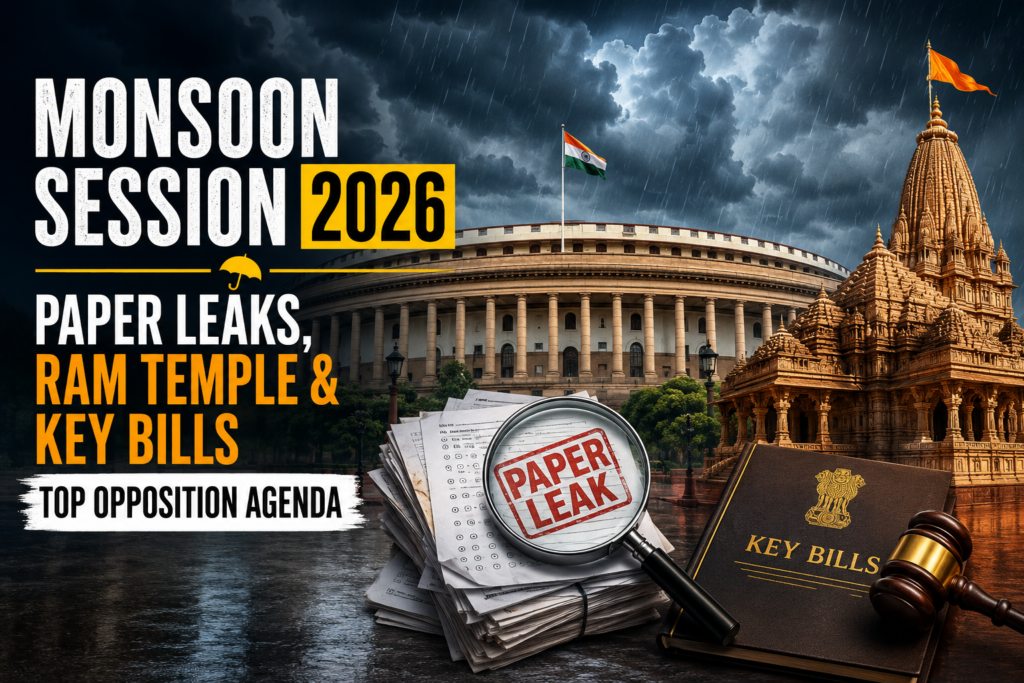
The Monsoon Session of Parliament is set to begin on Monday, July 20, 2026, and run until August 13, 2026, with both Houses expected to witness intense political battles. While the government plans to push through key legislative reforms, the Opposition has already signalled that it will make the session difficult by raising hot-button issues like exam paper leaks, Ram Temple donation controversies, and fears around a possible Delimitation Bill.
Ahead of the session, the Centre held an all-party meeting on Sunday to seek cooperation for smooth functioning, but Opposition leaders have made it clear that they will not let major controversies go unchallenged.
What Is the Monsoon Session of Parliament?
The Monsoon Session is one of the three regular sessions of the Indian Parliament, typically held between July and August. It is crucial for:
- Passing new Bills and amendments
- Debating national issues through Question Hour and Zero Hour
- Holding the government accountable via debates and motions
This year, the session gains extra significance due to several high-profile controversies and a packed legislative agenda.
Opposition’s Top Agenda: Paper Leaks and Education Scams
The alleged NEET-UG paper leak is expected to be the single biggest weapon in the Opposition’s arsenal. Congress and other parties plan to:
- Demand the resignation of Education Minister Dharmendra Pradhan over the NEET-UG leak.
- Seek a detailed discussion on the conduct of national entrance exams.
- Push for stricter action against agencies involved in exam conduction.
In addition, Congress has flagged what it calls the “E-20 scam”, though details remain politically charged.
Congress President Mallikarjun Kharge has already stated that “paper leaks, price rise, and corruption” will be among the main issues raised in the session, directly targeting the Modi government’s governance record.
Ram Temple Donation Controversy: “Chanda Chori” Charge
Another major flashpoint will be the Ram Temple in Ayodhya, specifically around donations collected for its construction. Opposition parties, especially Congress, allege:
- Irregularities in how donations were collected and managed
- Possible misuse of religious sentiment for political gain
Congress general secretary Jairam Ramesh has said the party will raise the issue of “chanda chori” (donation theft) and demand transparency and accountability from the government and temple trust.
This issue is politically sensitive, as the Ram Temple remains a symbol of majoritarian politics for the ruling dispensation, while the Opposition aims to frame it around financial transparency and trust.
Sonam Wangchuk Protest and Jantar Mantar Row
The removal of climate activist and Ladakh leader Sonam Wangchuk from his hunger strike site at Jantar Mantar, along with the proposed march to Parliament by his supporters, has added another layer of tension.
Opposition parties are expected to:
- Criticize the government’s handling of the Ladakh statehood and protection demands
- Raise questions on freedom of protest and treatment of activists
This issue resonates strongly in the context of regional identity and environmental concerns, and could be used to paint the government as anti-dissent.
Delimitation Fears and Two-Thirds Majority Allegations
Congress and several regional parties fear that the government may reintroduce a Delimitation Bill during this session.
Key Opposition concerns:
- Delimitation could be used to reshape constituencies in favour of the ruling party
- Recent defections, including seven AAP Rajya Sabha MPs joining BJP, fuel allegations of engineering a two-thirds majority in Parliament.
- A two-thirds majority would enable the government to push major constitutional amendments, including changes linked to delimitation or other structural reforms.
Jairam Ramesh has warned that Congress is in touch with parties like DMK and AAP to build a united front against any such move.
Government’s Legislative Agenda: Five New Bills
While the Opposition prepares to attack, the government has its own priorities. The Monsoon Session is expected to see the introduction of five new Bills, including:
- Prevention of Insults to National Honour (Amendment) Bill, 2026
- Income Tax (Amendment) Bill, 2026
- Supreme Court (Number of Judges) Amendment Bill, 2026
- Micro, Small and Medium Enterprises Development (Amendment) Bill, 2026
- Viksit Bharat Shiksha Adhisthan Bill, 2025, which includes the proposed 130th Constitutional Amendment
These bills cover areas from taxation and judicial capacity to education reform and MSME support, and the government will try to portray them as critical for India’s development trajectory.
Other Key Issues Likely to Be Raised
Beyond the headline controversies, the Opposition is expected to raise several additional issues:
- Inflation and price rise of essential commodities
- Unemployment and job creation
- Foreign policy challenges, especially regarding China, the US, West Asia, and Pakistan
- Corruption allegations in various government schemes
Congress and other parties plan to use debates, adjournment motions, and protests inside the House to keep these topics in the national spotlight.
How the Session Could Play Out
Parliamentary watchers expect a highly disruptive session, with:
- Frequent walkouts by Opposition members
- Attempts to stall proceedings until the government agrees to discussions on key issues
- Possible suspensions if protests breach House rules
The government, on its part, will try to:
- Ensure business gets done, especially passage of key Bills
- Portray the Opposition as anti-development for blocking legislative work
- Use its numerical strength to push through votes if necessary
The balance between governance and accountability will be tested sharply in the coming weeks.
Why This Session Matters for You
Even if you’re not in Delhi, the outcomes of the Monsoon Session can affect:
- Education policies and future entrance exam reforms
- Taxation rules impacting salaried employees and businesses
- MSME support schemes, relevant for small business owners and entrepreneurs
- Constitutional changes that may reshape representation and federal dynamics
For digital marketers, entrepreneurs, and professionals, these changes can influence policy-driven sectors, compliance requirements, and even consumer sentiment.
FAQs: Monsoon Session 2026
1. When does the Monsoon Session 2026 start and end?
The Monsoon Session begins on July 20, 2026, and is scheduled to continue until August 13, 2026.
2. What are the main issues the Opposition will raise?
Key issues include:
- NEET-UG and other exam paper leaks
- Ram Temple donation irregularities
- Delimitation fears and alleged attempts to engineer a two-thirds majority
- Sonam Wangchuk protest and Ladakh-related demands
3. How many new Bills is the government planning to introduce?
At least five new Bills are expected, covering national honor, income tax, Supreme Court strength, MSMEs, and education reform, including a proposed 130th Constitutional Amendment.
4. Could the Delimitation Bill be introduced this session?
It is possible but not confirmed. Congress and several regional parties suspect the government may try to bring it, which is why they are preparing a strong united response.
Conclusion
The Monsoon Session 2026 is shaping up to be one of the most contentious in recent years, with the Opposition determined to make paper leaks, Ram Temple donations, and Delimitation fears the central narrative. Meanwhile, the government aims to advance its reform agenda through a set of important Bills.
How this tug-of-war plays out will not only define the political tone for the rest of the year but also impact key policy areas that touch education, taxation, business, and governance.
For more Updates, visit: Buzz Content Corner
Follow us on
Facebook: https://www.facebook.com/Buzzcontentcorners/
Instagram: https://www.instagram.com/buzzcontentcorner