What happened on October 8?
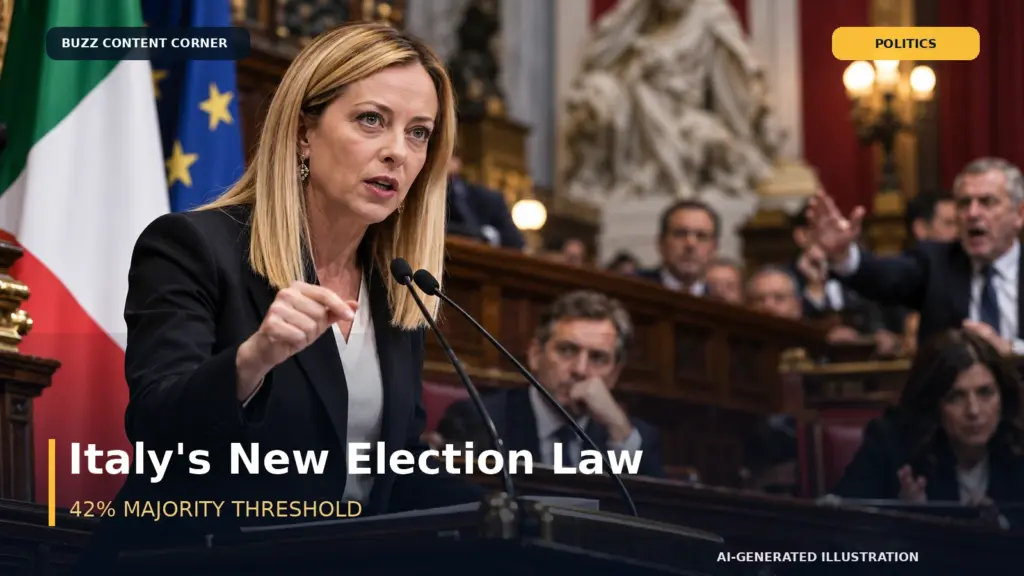
Italy’s parliament gave final approval to an electoral reform backed by Prime Minister Giorgia Meloni. The measure passed in a 227–164 vote after months of debate. Supporters describe the change as a route to more stable governing coalitions; critics argue it risks giving a winning alliance a disproportionate advantage. The next national election is expected in 2027, making the new rules a central part of campaign planning.
The essential distinction: this is a change to the way seats are allocated, not a referendum on an individual candidate. How many seats a coalition receives will still depend on votes cast, thresholds and the detailed rules of allocation.
What does the 42% threshold mean?
The reform replaces Italy’s previous mix of proportional and first-past-the-post constituencies with a proportional model that includes a majority bonus. A pre-election coalition receiving at least 42% of the vote qualifies for additional seats, subject to legal caps. Reporting on the detailed rules puts the maximum bonus at 70 seats in the Chamber of Deputies and 35 seats in the Senate. Those numbers should not be confused with a guaranteed outcome for any particular party.
The law also establishes electoral thresholds of 10% for coalitions and 3% for individual parties, and requires parties or alliances to indicate their proposed prime-ministerial candidate before voting. Italy’s president retains the constitutional role in appointing the prime minister; naming a candidate on the ballot does not replace that process.
Why did the government push the reform?
Coalition bargaining has historically been a defining feature of Italy’s political system. Meloni argues that linking more predictable majorities to pre-election alliances will give voters greater clarity over who is likely to govern. In principle, it may reduce negotiations after polling day. But a majority bonus can also alter how closely the legislature reflects the popular vote, particularly in a close three-way contest.
Why is the opposition critical?
Opposition politicians have accused the government of redesigning rules for political advantage and raised constitutional objections. Supporters counter that the same threshold would apply to any coalition that wins enough votes. There is also a strategic twist: encouraging bigger alliances could benefit a coordinated opposition rather than the incumbent alliance. Parties must decide whether they can agree on a common candidate and programme.
What should voters watch next?
- Whether opposition parties form a joint electoral alliance.
- How smaller parties respond to the 3% and 10% thresholds.
- Any legal challenge to the new system.
- The final seat projections as voting approaches in 2027.
BCC context: Electoral thresholds can change coalition strategy even when public opinion does not move. Compare political headlines with actual voter support and the official electoral rules rather than treating a bonus-seat projection as a poll result.
Sources and transparency
Reuters: key provisions; Associated Press: parliamentary vote and reactions. Published October 8, 2026. This explainer was prepared with AI drafting assistance using linked reporting; no on-the-ground interviews by BCC are claimed.
Editorial transparency: BCC prepared this original explanatory summary using AI drafting assistance and references listed below. AI-generated visuals, where used, are illustrative rather than documentary evidence. The article is based on information available October 8, 2026.