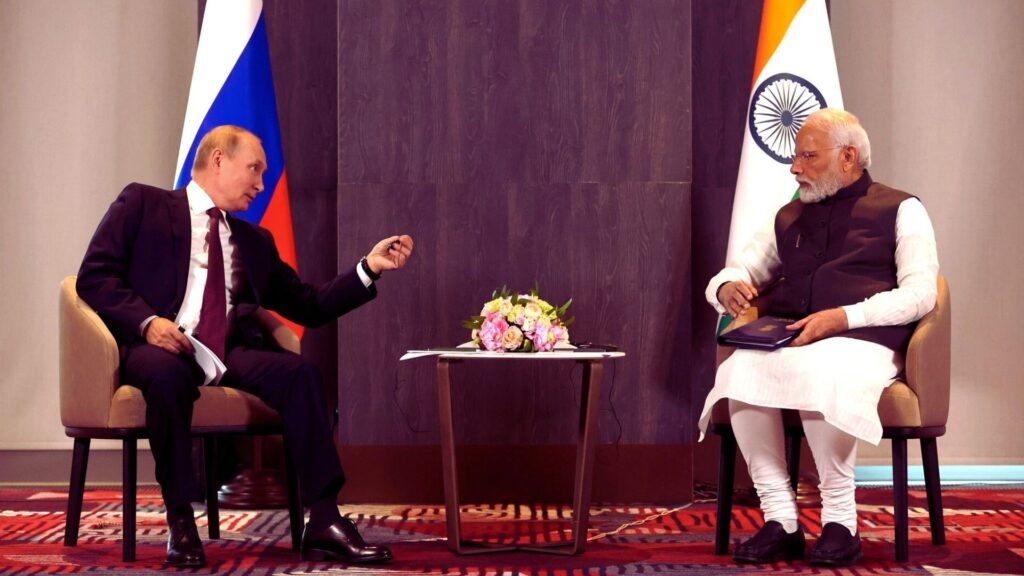
India and Russia describe their relationship as a “Special and Privileged Strategic Partnership.” The relationship remains significant in defence, energy, nuclear cooperation, space and diplomacy, but “unwavering” is too simple a description. Trade is heavily imbalanced, sanctions complicate payments and logistics, and India also maintains important partnerships with the United States, Europe and other countries.
Trade has grown, but the balance is uneven
India’s Ministry of External Affairs reported bilateral trade of about US$68.7 billion in FY2024–25 and US$59.863 billion in FY2025–26. The two governments have set a target of US$100 billion by 2030.
Much of the recent growth has come from Indian imports, especially energy. That creates a large trade imbalance and explains why official discussions repeatedly call for more Indian exports, diversified trade and smoother payment and transport arrangements.
Energy cooperation
Russia became a major crude-oil supplier to India after 2022. Indian officials have defended energy purchases as decisions shaped by national demand, affordability and market conditions. At the same time, sanctions and restrictions imposed by other countries can affect shipping, insurance, finance and counterparties.
The earlier version of this article cited Nord Stream 2 as an example of India–Russia cooperation. That was incorrect. Nord Stream 2 was designed to carry Russian gas to Germany and was not an India–Russia project.
Defence and technology
Defence cooperation has long included Russian-origin equipment in Indian service, licensed production, maintenance, spare parts and joint projects such as the BrahMos missile system. The relationship is evolving as India seeks more domestic production and a wider range of suppliers. Older dependence does not mean every future procurement will come from Russia.
Nuclear, space and other cooperation
The Kudankulam nuclear-power project remains a prominent example of civil nuclear cooperation. The countries also maintain work in space, science, education and people-to-people exchanges. These areas sit alongside commercial negotiations and implementation challenges that vary by project.
Diplomacy and areas of difference
India and Russia cooperate in forums including BRICS and the Shanghai Cooperation Organisation. India has also consistently called for dialogue and diplomacy over the war in Ukraine. That position shows continuing engagement with Russia while preserving an independent foreign-policy stance.
The partnership therefore combines durable institutions with practical differences. It is more accurate to assess each area—trade, energy, defence, technology and diplomacy—than to describe the entire relationship as automatically aligned.
Current official context
The trade figures and cooperation areas are drawn from the Indian government’s July 2026 India–Russia relations brief. The Prime Minister’s Office said in May 2026 that the two sides reviewed bilateral cooperation and discussed Ukraine and West Asia, with India reiterating dialogue and diplomacy. The December 2025 summit statement records the US$100 billion trade target for 2030.
Information checked through 27 October 2026.