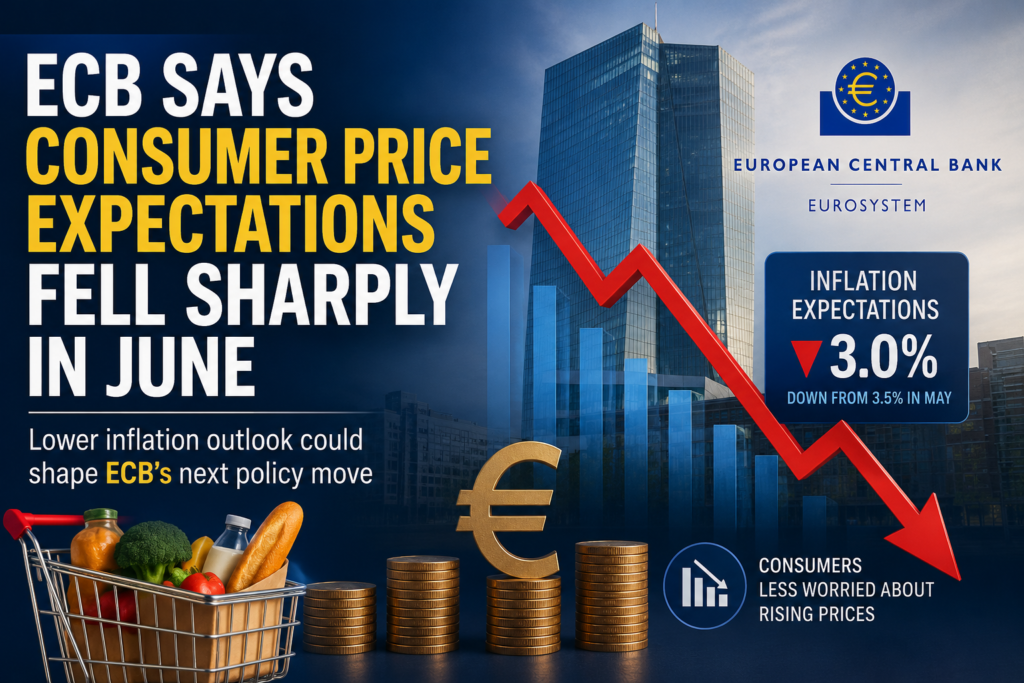
The ECB says consumer price expectations fell sharply in June, signaling that euro area households are becoming less worried about near-term inflation as price pressures cool. The shift matters because inflation expectations influence consumer spending, wage demands, borrowing behavior, and the ECB’s policy path.
The ECB’s latest survey comes as euro area inflation eased to 2.8% in June from 3.2% in May, according to Eurostat. That improvement gives policymakers and markets another sign that the inflation shock is fading, even though inflation remains above the ECB’s 2% target.
Key Highlights
- The ECB says consumer price expectations fell sharply in June.
- Euro area annual inflation eased to 2.8% in June from 3.2% in May.
- Reuters reported that one-year inflation expectations fell to 3.5% in the May survey from 4.0% in April.
- Three-year expectations were 2.9% and five-year expectations were 2.4% in the latest Reuters-reported survey reading.
- Lower inflation expectations can reduce pressure for further ECB tightening.
- Energy, food, and services inflation all eased in June.
- Risks remain from oil prices, geopolitics, wages, and services inflation.
What Happened?
The European Central Bank said consumer price expectations fell sharply in June, based on its Consumer Expectations Survey. The survey is one of the ECB’s most important tools for tracking how euro area households think about inflation, spending, income, and unemployment.
This matters because central banks watch expectations as closely as actual inflation. If households believe prices will stay high, they may adjust wages, spending, and pricing in ways that make inflation harder to bring back to target.
The timing is important because the latest Eurostat flash estimate showed inflation easing to 2.8% in June from 3.2% in May. That softer reading likely helped improve sentiment around the inflation outlook.
Reuters reported earlier that consumers had already trimmed one-year inflation expectations in May, while medium-term expectations remained more stable. The June update suggests that the improvement continued.
Key Findings from the ECB Consumer Expectations Survey
The ECB Consumer Expectations Survey tracks inflation expectations at three key horizons: 12 months, 3 years, and 5 years. That split matters because short-term expectations often react to visible shocks such as fuel and food prices, while longer-term expectations show whether inflation beliefs are anchored.
Reuters reported that consumers cut their one-year inflation expectations to 3.5% in May from 4.0% in April. The same report said three-year expectations stayed at 2.9%, while five-year expectations remained at 2.4%.
Survey snapshot
| Horizon | Latest reported reading | Prior reading | Trend |
|---|---|---|---|
| 12 months | 3.5% | 4.0% | Down |
| 3 years | 2.9% | 2.9% | Flat |
| 5 years | 2.4% | 2.4% | Flat |
The latest ECB June release was described as a sharp fall in consumer price expectations, reinforcing the idea that households are seeing less near-term inflation pressure. Even so, expectations are still above the ECB’s 2% target in the near term, which is why policymakers remain cautious.
The survey also measures expectations for income growth, spending, house prices, and unemployment. That broader view helps explain whether inflation fears are being driven by weaker confidence or by specific price shocks.
Why Inflation Expectations Fell
The biggest reason is that actual inflation eased in June. Eurostat said euro area annual inflation fell to 2.8% from 3.2% in May, and the breakdown showed clear moderation in energy, food, and services.
Energy was a major factor. Eurostat reported that energy inflation slowed to 8.7% in June from 10.8% in May, which likely helped reduce household anxiety about future prices. Consumers tend to notice fuel and utility changes quickly, so energy often shapes inflation expectations more than more abstract components do.
Food inflation also cooled. Eurostat said food, alcohol and tobacco inflation eased to 1.6% in June from 1.9% in May. That matters because grocery bills are one of the most visible and frequent signals households use when judging inflation.
Services inflation slowed too, falling to 3.2% from 3.5%. Since services inflation often reflects domestic demand and wages, this kind of easing can support the view that broader price pressure is becoming less intense.
Consumer confidence likely improved alongside the softer data. The ECB survey framework shows that households’ inflation views are tied to income, spending, and job expectations, not just price changes alone. If people feel the worst inflation shock has passed, they may become less defensive in their spending behavior.
How This Affects ECB Interest Rates
Lower inflation expectations can reduce pressure on the ECB to stay aggressive on rates. Reuters said the June survey suggested the central bank was not under pressure to quickly raise interest rates again.
That said, the ECB is not ready to declare victory. Officials still need to see whether inflation continues moving down in a lasting way and whether core and services pressures ease further. One better survey does not erase the fact that inflation remains above target.
The ECB’s own communications have stressed caution. President Christine Lagarde said the inflation shock was significant but that longer-term price bets had not become dangerously unanchored. That is an important distinction because it suggests the ECB still sees its credibility as intact.
For investors, the policy takeaway is simple: a rate pause or slower tightening path becomes more likely if inflation expectations keep falling and inflation data keep softening. But if energy prices surge again, the ECB could face renewed pressure.
Market Reaction
Lower inflation expectations usually ease bond-market pressure because investors infer less need for restrictive policy. When expectations cool, yields can fall if traders think the ECB will not need to stay hawkish as long.
The euro can also react to those expectations. If markets believe the ECB has less reason to tighten, the currency can lose some support relative to peers with stronger rate outlooks.
European stocks often welcome lower inflation pressure because it can support consumer demand and reduce fears of a policy mistake. At the same time, banks may see a mixed reaction since lower rates can help borrowers but also reduce interest margins over time.
Overall, the market signal from the survey is constructive but not decisive. Investors still need to watch inflation data, oil prices, and ECB language before concluding that Europe is entering a stable disinflation phase.
Impact on Consumers
For households, lower inflation expectations can improve confidence and reduce the urge to rush spending before prices rise again. That may help stabilize budgets and make consumers feel less squeezed month to month.
Mortgage borrowers could benefit if the softer inflation outlook eventually leads to a less restrictive ECB stance. That would matter most in markets where variable-rate loans or refinancing costs are still sensitive to ECB policy changes.
Savers face a more mixed picture. Lower inflation helps protect purchasing power, but if rate expectations fall, deposit returns may also soften. The real improvement comes if inflation falls faster than interest income does.
Lower-income households remain under the greatest pressure. Reuters reported earlier that inflation perceptions and expectations differed across income groups, with lower-income respondents generally seeing stronger inflation pressure. That means the cost-of-living problem is easing, but not disappearing evenly.
Impact on Businesses
For businesses, softer inflation expectations can make pricing and cost planning easier. If households expect slower price growth, companies may face less resistance in consumer demand and less uncertainty in forward planning.
Retailers tend to benefit when consumers feel more confident about future prices and income. A calmer inflation backdrop can support spending on discretionary goods rather than just essentials.
Manufacturers still face input-cost risks, especially from energy and supply chains. Even if headline inflation improves, a fresh oil shock or shipping disruption could quickly bring pressure back.
Exporters also have to watch the euro and the broader policy outlook. A more stable inflation path can help support planning, but abrupt currency or rate moves can still affect competitiveness.
Expert Analysis
The verified reading from Reuters and the ECB points in the same direction: inflation expectations are easing, but not enough to remove all concern. Reuters said the softer near-term expectations suggested the ECB was not under pressure to rush into another hike.
The ECB’s survey is important because it tracks real households rather than market pricing alone. That gives policymakers a direct view of how inflation is being felt across the euro area.
Lagarde’s public remarks reinforce the cautious tone. She said the inflation shock was serious but that medium-term expectations had not become unanchored. That supports the view that the ECB still sees inflation credibility as largely intact.
The verified conclusion is straightforward: households are becoming less worried about near-term inflation, but policymakers still need more evidence before easing policy materially.
Historical Comparison
Inflation expectations have moved through several phases over the past few years. In 2024, Reuters reported that euro zone consumers had trimmed inflation expectations to the lowest level in three years, showing a clear improvement from the peak inflation shock.
By 2026, the picture was more mixed. Reuters reported that one-year expectations were still above target, but three-year and five-year readings remained relatively stable. That suggests the ECB’s credibility was holding even as short-term shocks created noise.
The latest June 2026 reading adds to that pattern. Inflation is still above target, but the direction is more favorable than it was during the worst of the price surge.
Trend context
| Period | Inflation expectations | Market meaning |
|---|---|---|
| 2024 | Lower than earlier peak levels | Disinflation progress |
| April 2026 | Elevated short-term expectations | Inflation concern still high |
| May 2026 | One-year expectations fell to 3.5% | Near-term pressure easing |
| June 2026 | Expectations fell sharply | Stronger sign of cooling |
This historical pattern shows that inflation beliefs are improving in stages, not in a straight line. That is exactly why the ECB watches the survey so closely.
Risks Going Forward
Energy remains the largest risk. Eurostat’s June numbers showed energy inflation still far above the rest of the basket, which means another jump in oil or gas prices could quickly reverse the improvement.
Geopolitical tensions also remain a concern. If conflict or trade disruption pushes up transport or import costs, consumers may start expecting another round of price increases.
Wages and services inflation are also key. Even if goods inflation remains calm, stubborn domestic price pressure can keep the ECB cautious.
Supply chains are another variable. Any renewed bottleneck in shipping, manufacturing inputs, or food supplies could alter the inflation path quickly. That is why the ECB is likely to stay data-dependent.
What Investors Should Watch
Investors should watch the next ECB survey readings to see whether the June decline continues. If one-year expectations keep falling, that would strengthen the case that inflation fears are fading more broadly.
Eurostat inflation reports will be just as important. Markets will want to see whether headline inflation, energy, and services continue moving lower.
Wage growth and labor-market data matter too. Strong wages can keep services inflation sticky, limiting how quickly the ECB can become comfortable.
Oil prices, geopolitics, and bond markets remain crucial signals. These factors can change the policy outlook quickly, especially if inflation expectations stop improving.
Conclusion
The ECB says consumer price expectations fell sharply in June, a sign that euro area households are becoming more comfortable with the inflation outlook. That improvement came alongside softer official inflation data, with Eurostat showing euro area inflation at 2.8% in June, down from 3.2% in May.
For policymakers, the message is encouraging but not final. Inflation expectations are easing, yet risks from energy, services, wages, and geopolitics remain.
For consumers and investors, the key point is that the inflation story is moving in the right direction, but the ECB is still likely to stay cautious until the data show lasting progress.
FAQ
What is the ECB Consumer Expectations Survey?
It is a monthly ECB survey that measures how euro area households view inflation, income, spending, house prices, and unemployment.
Why did inflation expectations fall in June?
They likely fell because euro area inflation slowed, energy costs cooled, and services and food inflation also eased.
What did the ECB say about consumer price expectations?
The ECB said consumer price expectations fell sharply in June, showing households were less worried about near-term inflation.
What were the latest one-year inflation expectations?
Reuters reported that one-year inflation expectations fell to 3.5% in May from 4.0% in April.
What were the three-year and five-year expectations?
Reuters said three-year expectations were 2.9% and five-year expectations were 2.4%.
How does this affect ECB interest rates?
Lower inflation expectations can reduce pressure on the ECB to tighten further, though policy still depends on incoming inflation data.
How does this affect consumers?
It can improve confidence, support purchasing power, and eventually ease borrowing pressure if disinflation continues.
How does this affect businesses?
It can make pricing and planning easier, though companies still face risks from energy, wages, and supply chains.
What should investors watch next?
They should watch ECB surveys, Eurostat inflation data, wages, oil prices, and ECB policy communication.
Will the ECB cut rates?
The survey alone does not guarantee a cut, but it supports a less aggressive rate path if inflation keeps easing.
For more Updates, visit: Buzz Content Corner
Follow us on
Facebook: https://www.facebook.com/Buzzcontentcorners/
Instagram: https://www.instagram.com/buzzcontentcorner