Indian politics in early 2024 was dominated not only by campaigning but by alliances, seat-sharing negotiations and regional political calculations.
Two developments captured that complexity particularly well.
In Tripura, Congress opened talks with TIPRA Motha about forming a broader opposition front against the BJP. Within days, however, TIPRA Motha signed a major agreement with the BJP-led Union government and the Tripura government before eventually joining the BJP-led state government.
In Gujarat, Congress made a different kind of compromise. It gave the politically significant Bharuch Lok Sabha seat to the Aam Aadmi Party under an INDIA bloc seat-sharing agreement, despite the constituency’s strong association with late Congress strategist Ahmed Patel.
Both stories raised similar questions:
How much should political parties compromise to create alliances?
How powerful are regional interests?
And did these alliance strategies actually produce electoral results?
With the 2024 election now complete and new developments continuing into 2026, we can answer those questions much more clearly.
TIPRA Motha and Congress Began Alliance Talks in Tripura
In February 2024, TIPRA Motha and the Congress began discussions about creating a broader opposition arrangement ahead of the Lok Sabha election.
On February 23, leaders from the two parties held their first round of formal talks.
Tripura Congress president Ashish Kumar Saha confirmed that discussions had taken place after an invitation from TIPRA Motha founder Pradyot Kishore Manikya Debbarma and then-Leader of the Opposition Animesh Debbarma.
At the time, an expanded opposition alliance appeared politically significant.
TIPRA Motha had emerged as an important force representing indigenous communities in Tripura, while Congress and the CPI(M) were already cooperating against the BJP.
For Congress, an arrangement with TIPRA Motha could potentially have consolidated more anti-BJP votes.
But the political situation changed almost immediately.
The March 2024 Tripartite Agreement Changed the Equation
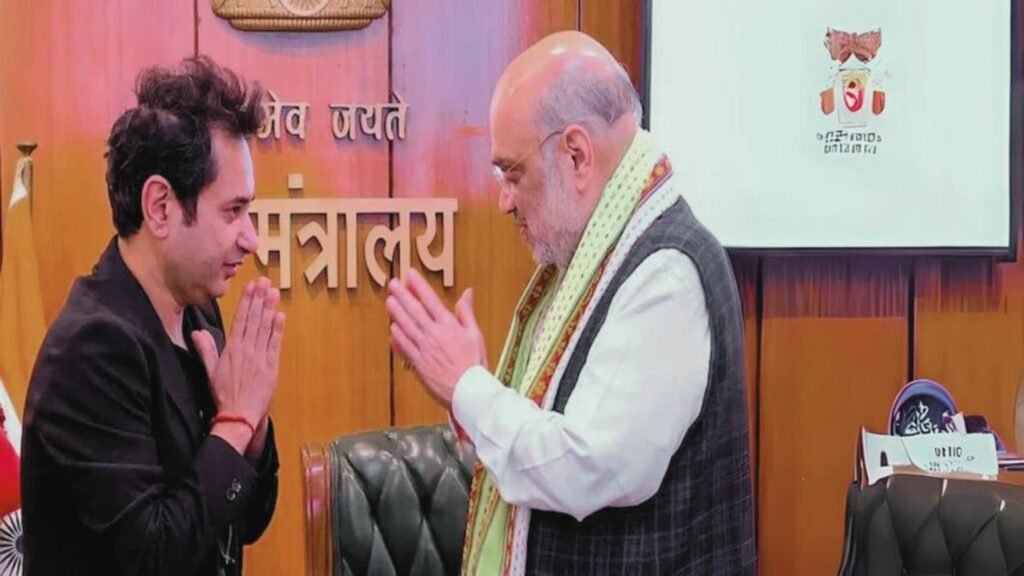
On March 2, 2024, the Government of India, Government of Tripura and TIPRA Motha signed a tripartite agreement in New Delhi.
The agreement was signed in the presence of Union Home Minister Amit Shah.
According to the Ministry of Home Affairs, the pact was intended to address issues concerning Tripura’s indigenous population, including:
- history;
- land and political rights;
- economic development;
- identity;
- culture;
- language.
The parties agreed to work toward an “amicable” resolution of those issues.
That development fundamentally changed the political story.
The question was no longer simply whether TIPRA Motha would join Congress in an anti-BJP alliance.
Attention moved toward TIPRA Motha’s relationship with the BJP-led governments at both the state and national levels.
TIPRA Motha Joins the BJP-Led Tripura Government
Only days after the agreement, TIPRA Motha formally entered the BJP-led state government.
On March 7, 2024, party MLAs Animesh Debbarma and Brishaketu Debbarma were sworn in as ministers in Chief Minister Manik Saha’s government.
Animesh Debbarma had previously served as Tripura’s Leader of the Opposition.
The shift was politically significant.
In the space of roughly two weeks, the story had moved from:
Congress–TIPRA Motha opposition alliance discussions
to:
TIPRA Motha joining a BJP-led government.
That is exactly why the old version of this Buzz Content Corner article became outdated so quickly.
Its speculative question—whether Congress and TIPRA Motha would combine against the BJP—was overtaken by events almost immediately.
What Happened in Tripura in the 2024 Lok Sabha Election?
The BJP subsequently won both Lok Sabha constituencies in Tripura.
Tripura West
Former Tripura Chief Minister Biplab Kumar Deb won for the BJP with:
881,341 votes
Congress candidate Ashish Kumar Saha received:
269,763 votes
giving Deb a very large victory.
Tripura East
BJP candidate Kriti Devi Debbarman won the Scheduled Tribe-reserved Tripura East constituency with:
777,447 votes
CPI(M) candidate Rajendra Reang received:
290,628 votes
a margin of 486,819 votes.
| Tripura Seat | Winner | Party | Votes | Runner-up |
|---|---|---|---|---|
| Tripura West | Biplab Kumar Deb | BJP | 881,341 | Ashish Kumar Saha, Congress |
| Tripura East | Kriti Devi Debbarman | BJP | 777,447 | Rajendra Reang, CPI(M) |
The opposition arrangement imagined during the February talks therefore never materialized in the way originally anticipated.
The TIPRA Motha Agreement Is Still Politically Important in 2026
The Tripura story did not end with the 2024 election.
As recently as September 4, 2026, Home Minister Amit Shah, Chief Minister Manik Saha and Pradyot Kishore Debbarma met in New Delhi.
Discussions included implementation of the 2024 tripartite agreement and upcoming elections in areas under the Tripura Tribal Areas Autonomous District Council.
A further development followed.
On September 7, reporting indicated that a Union Home Ministry delegation was preparing to visit Tripura to discuss accelerating implementation of the 2024 agreement after limited progress during the preceding two years.
The BJP, TIPRA Motha and IPFT were also reported to have decided to contest the September 2026 Village Council elections together.
That means the political relationship created in 2024 remains relevant in 2026.
The more important question today is no longer whether TIPRA Motha will align with Congress.
It is whether the promises in the 2024 Tripartite Agreement are actually implemented, particularly those connected with indigenous rights.
Bharuch: A Completely Different Alliance Problem
At roughly the same time that alliance discussions were changing in Tripura, Congress faced another difficult decision hundreds of kilometres away in Gujarat.
This time the issue was Bharuch.
Congress and the Aam Aadmi Party agreed in February 2024 to contest several constituencies together under an INDIA bloc seat-sharing arrangement.
In Gujarat, AAP was given two Lok Sabha seats:
Bharuch and Bhavnagar.
The Bharuch decision generated considerably more controversy because of the constituency’s association with former Congress leader Ahmed Patel.
Why Is Ahmed Patel Closely Associated With Bharuch?
Ahmed Patel was one of the Congress party’s most influential strategists and a longtime political adviser to Sonia Gandhi.
He came from Bharuch district and represented the constituency in the Lok Sabha three consecutive times:
1977
1980
1984
He later spent decades in the Rajya Sabha and became particularly influential behind the scenes within the Congress organization.
Because of this history, Bharuch retained symbolic importance for Congress even though the party had not won the Lok Sabha constituency for decades.
Ahead of the 2024 election, members of Patel’s family and some local Congress leaders hoped the party would field its own candidate.
Instead, the seat went to AAP.
Congress Gives Bharuch to AAP
AAP selected Chaitar Vasava, its MLA from Dediapada, to contest Bharuch as the INDIA alliance candidate.
The decision caused dissatisfaction among sections of the local Congress organization and Ahmed Patel’s family.
Congress leader Jairam Ramesh later acknowledged the emotional importance of Bharuch to the party but said alliances require compromises.
He noted that Congress had not won Bharuch for roughly four decades and explained that the final seat-sharing formula required the party to concede the constituency to its ally.
That was a much more complicated political calculation than the satirical version of this article suggested.
Congress was effectively choosing between:
preserving a historic seat association
and
making a broader opposition alliance workable.
Why AAP Wanted Chaitar Vasava
Chaitar Vasava was not a random candidate brought in from outside the area.
He was an elected MLA from Dediapada and had established a political base among sections of the tribal electorate.
Bharuch contains a substantial Scheduled Tribe population, making tribal political support particularly important in the constituency.
AAP therefore believed Vasava could offer a stronger challenge to the BJP than simply choosing a candidate based on Congress tradition.
The Congress-AAP calculation was straightforward:
combine the organizational and voter bases of both parties behind one opposition candidate instead of splitting anti-BJP votes.
Did the Congress-AAP Bharuch Alliance Work?
It made the contest competitive.
But it did not win.
Official Election Commission results show:
| Candidate | Party | Votes |
|---|---|---|
| Mansukhbhai Dhanjibhai Vasava | BJP | 608,157 |
| Chaitarbhai Damjibhai Vasava | AAP | 522,461 |
| Winning margin | 85,696 |
BJP candidate Mansukh Vasava therefore retained Bharuch.
The result is important because Chaitar Vasava still secured more than 522,000 votes, or roughly 44% of valid votes.
So the alliance produced a serious challenge.
It simply was not enough to overcome the BJP.
Bharuch Had Already Become a BJP Stronghold
The emotional connection between Congress and Ahmed Patel can sometimes obscure another important fact:
Congress had not won Bharuch since 1984.
Ahmed Patel won the constituency in 1977, 1980 and 1984.
The BJP began winning the seat from 1989 onward, and Mansukh Vasava subsequently became one of the constituency’s longest-serving representatives.
That historical context explains why Congress leadership was prepared to experiment with an AAP candidate despite local opposition.
It was giving away a historically important seat—but not one it had recently been winning.
What the Two Alliance Stories Tell Us
Tripura and Bharuch produced almost opposite outcomes.
| Issue | Tripura | Bharuch |
|---|---|---|
| Initial 2024 discussion | Congress–TIPRA Motha cooperation | Congress–AAP seat sharing |
| What happened | TIPRA Motha moved toward BJP-led government | Congress formally gave seat to AAP |
| Regional factor | Indigenous rights and Tripura tribal politics | Tribal vote plus Ahmed Patel legacy |
| 2024 election outcome | BJP won both Tripura seats | BJP retained Bharuch |
| Longer-term impact | BJP–TIPRA relationship continues in 2026 | 2024 alliance failed to win Bharuch |
Yet both cases demonstrate the same fundamental political reality:
alliances require parties to balance ideology, local leadership, regional interests and electoral mathematics.
Sometimes an alliance is abandoned because another arrangement offers greater political leverage.
Sometimes a party gives up a historically important constituency because it believes a partner has a better chance.
Neither guarantees victory.
Political Alliances Are More Than Seat Mathematics
It is easy to describe alliances as a simple equation:
Party A votes + Party B votes = victory.
Elections rarely work that neatly.
Supporters of one party may not automatically vote for an alliance partner.
Local leaders may resist giving up constituencies.
Regional parties may prioritize state-specific demands over national opposition strategies.
And voters may evaluate the candidate independently of the alliance.
The Tripura and Bharuch examples demonstrate all four problems.
In Tripura, regional indigenous demands ultimately became more important to TIPRA Motha’s political strategy than an immediate opposition arrangement with Congress.
In Bharuch, Congress accepted a compromise for alliance unity, but the combined opposition still could not defeat the BJP.
Latest Tripura Update in 2026
The most important current development involves implementation of the Tripartite Agreement.
In early September 2026, senior BJP and TIPRA Motha leaders again held discussions with Amit Shah.
A Home Ministry delegation was subsequently expected in Tripura to review implementation and identify unresolved issues.
Reporting described roughly two years of limited progress on the agreement and said the parties had committed to accelerate implementation.
That gives the 2024 political shift a longer-term test:
Did joining the government actually help TIPRA Motha secure the indigenous-rights commitments it sought?
That question remains more important in 2026 than the short-lived Congress alliance discussion that started the original story.
Frequently Asked Questions
Did TIPRA Motha form an alliance with Congress in 2024?
No. The parties held talks in February 2024 about opposition cooperation, but TIPRA Motha subsequently signed a tripartite agreement with the Union and Tripura governments and joined the BJP-led state government.
When did TIPRA Motha join the Tripura government?
Two TIPRA Motha legislators were sworn into the Manik Saha government on March 7, 2024.
Who won Tripura’s Lok Sabha seats in 2024?
The BJP won both. Biplab Kumar Deb won Tripura West, while Kriti Devi Debbarman won Tripura East.
Why did Congress give Bharuch to AAP?
Congress and AAP negotiated a wider Lok Sabha seat-sharing agreement. Congress leader Jairam Ramesh acknowledged Bharuch’s association with Ahmed Patel but said alliances require political compromises.
Who was the AAP candidate from Bharuch?
AAP fielded Chaitar Vasava, the MLA from Dediapada.
Who won Bharuch in 2024?
BJP’s Mansukh Vasava won with 608,157 votes, defeating Chaitar Vasava, who received 522,461 votes. The margin was 85,696.
Did Ahmed Patel represent Bharuch?
Yes. Ahmed Patel won the Bharuch Lok Sabha seat in 1977, 1980 and 1984.
Final Takeaway
The political developments that inspired the original version of this article were real, but the old satirical framing obscured what actually happened.
In Tripura, TIPRA Motha and Congress did discuss opposition cooperation in February 2024.
But the situation changed rapidly.
On March 2, TIPRA Motha signed a major agreement with the Union and Tripura governments covering indigenous rights, land, political representation, culture and economic development. Days later, the regional party joined the BJP-led state government.
The BJP then won both Tripura Lok Sabha seats.
In Bharuch, Congress took the opposite route: it made a formal electoral compromise.
Despite the constituency’s historical association with Ahmed Patel, Congress allowed AAP’s Chaitar Vasava to contest as the alliance candidate.
The strategy produced a competitive race, but BJP’s Mansukh Vasava retained the constituency by 85,696 votes.
Together, the two stories show that political alliances cannot be understood only through slogans about “opposition unity.”
Regional demands, constituency history, candidate strength and bargaining power can matter just as much.
And in 2026, the Tripura story remains active: TIPRA Motha and the BJP-led governments are still negotiating implementation of the agreement that fundamentally changed the political equation in March 2024.
For related BCC coverage, internally link this article to your dedicated TIPRA Motha–Congress article, your Ahmed Patel political legacy article, and the Politics category.