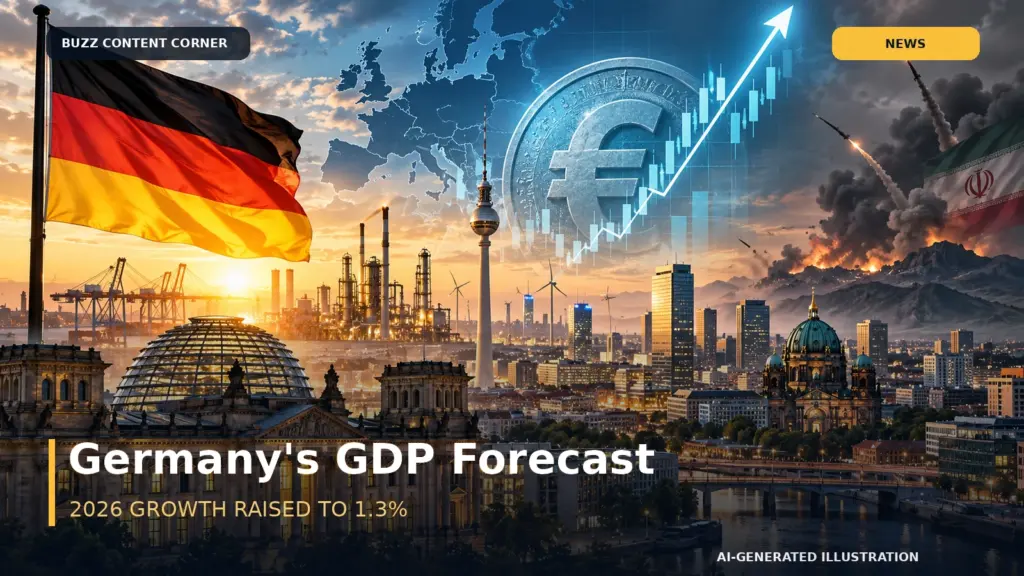
Germany’s revised GDP forecast
The German government on October 8 raised its forecast for economic expansion in 2026 to 1.3%, from 0.5% in its previous projection. The 2027 projection also improved, to 1.1% from 0.9%. Germany’s economy grew by 0.3% in the second quarter, according to reporting on the forecast update. These are forecasts of annual real GDP growth, not figures showing that households’ disposable income has increased by the same percentage.
What is supporting the recovery?
Export demand is an important part of the outlook. Reuters reported that government projections envisage exports rising around 3.7% in 2026, supported by stronger orders even as international trade conditions remain uncertain. Global spending on artificial-intelligence infrastructure also matters to some German industrial firms that supply equipment, machinery and components for large technology projects.
Government investment is another contributor. Chancellor Friedrich Merz’s administration has emphasised infrastructure and defence spending as a source of demand. Such spending can benefit construction and industrial suppliers, though the pace of projects matters: an announced budget is not identical to work completed or cash circulating through the economy.
What are the risks from energy and inflation?
The improved forecast comes amid an energy shock associated with the Iran conflict. Higher fuel and transportation costs can squeeze factories and households, even if export businesses are expanding. Imported energy prices are especially relevant in a manufacturing-heavy economy with international supply chains.
The government forecast also points to inflation pressures persisting into 2027. An increase in nominal wages or sales can look healthy without translating into a proportional gain in real purchasing power. Readers assessing whether the economy is ‘better’ should compare inflation, real wages and household spending with GDP.
How should businesses interpret the numbers?
- Manufacturers: Monitor incoming export orders and energy costs.
- Retailers: Look at household disposable income, not just GDP.
- Investors: Distinguish a government forecast from an achieved growth rate.
- Policy watchers: Track public investment execution and changes in European demand.
Could the forecast change again?
Yes. An escalation in regional conflict, new trade restrictions or weaker-than-expected private spending could lead the government to revise its outlook. Equally, stronger orders and investment could support an upside surprise. The sensible reading is that Berlin’s estimate improved markedly on October 8, but economic risks have not disappeared.
Sources and transparency
Reuters: updated government forecast; Euronews: economic outlook and energy shock. Analysis is explanatory, not financial advice. AI drafting assistance was used; sources are linked for verification.
Editorial transparency: BCC prepared this original explanatory summary using AI drafting assistance and references listed below. AI-generated visuals, where used, are illustrative rather than documentary evidence. The article is based on information available October 8, 2026.