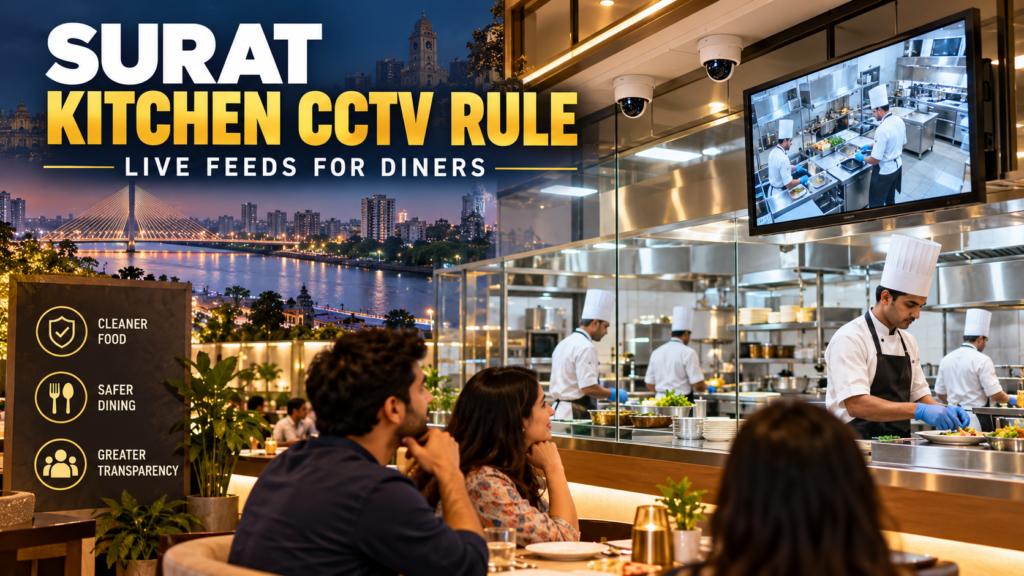
Updated: October 2, 2026. Diners in Surat may soon be able to see what is happening inside a restaurant kitchen before their food reaches the table.
The Surat Municipal Corporation (SMC) has directed restaurants and eateries across the city to install CCTV cameras inside kitchen areas and display the live footage on screens visible to customers. The move follows complaints, viral videos and surprise inspections that raised concerns about food preparation and hygiene.
For people searching for the Surat restaurant kitchen CCTV rule, the important point is that this is not just a surveillance measure. SMC is using visibility as a food-safety tool: customers should be able to see the kitchen environment in real time rather than relying only on what happens in the dining area.
Key takeaways
- SMC has directed restaurants and eateries to install CCTV cameras in kitchens.
- Live footage should be displayed where customers can see it in the dining or reception area.
- The step follows complaints and videos alleging unhygienic food preparation.
- SMC has also been carrying out surprise food-safety inspections.
- Local hotel-industry representatives have publicly welcomed the transparency measure.
- Implementation details and enforcement will matter as businesses install systems.
What has Surat Municipal Corporation ordered restaurants to do?
According to The Indian Express, restaurants and eateries in Surat have been instructed to place CCTV cameras inside kitchen areas and connect those cameras to screens that customers can view.
The practical idea is simple: a clean front-of-house should not be the only part of a restaurant visible to diners. The kitchen, where food is stored, handled and prepared, becomes part of the customer-facing transparency system.
Why did SMC introduce the kitchen CCTV requirement?
The order came after repeated complaints and viral videos showing alleged hygiene problems at food outlets. The Indian Express reported concerns involving old vegetables, poor preparation practices and sanitation issues.
Viral videos alone are not proof of conditions across an entire industry, but they can trigger inspections. SMC’s response has combined enforcement checks with a broader preventive measure intended to make hygiene easier for customers to observe.
Will customers be able to watch the kitchen live?
Yes, that is the central feature of the direction reported by The Indian Express. The cameras are not meant only for a back-office recording system. Restaurants are expected to show a live feed on screens visible in customer areas.
The effectiveness will depend on camera placement, whether the feed clearly covers food-preparation zones and whether restaurants keep the system operational during business hours.
Does CCTV guarantee that restaurant food is safe?
No. A camera can improve transparency, but it cannot replace food-safety inspections, temperature control, pest management, clean water, employee hygiene or correct storage.
Some problems are visible on camera; others are not. A refrigerator can look clean while operating at the wrong temperature. A food item can look normal while being stored beyond a safe date.
CCTV therefore works best as one layer within a broader inspection and compliance system.
What does the rule mean for Surat restaurant owners?
Businesses will need suitable cameras, displays, wiring or network infrastructure and a system that can run reliably during operating hours. Larger restaurants may already have surveillance systems and only need to add kitchen coverage or customer-facing screens.
Smaller eateries could face a more noticeable installation cost, although basic CCTV equipment is now widely available. The bigger operational requirement is maintaining the system rather than treating it as a one-time installation.
Can the live feed improve customer trust?
Potentially. Food businesses sell trust as much as food. Diners rarely see storage rooms, washing areas or preparation counters, so a visible kitchen feed can signal that the operator is comfortable showing its processes.
But the value will depend on authenticity. If screens are switched off, cameras point away from key areas or feeds are unclear, the trust benefit disappears.
How does this fit into SMC’s wider civic push?
The order arrives as Surat is talking more broadly about public-service delivery and its long-term urban vision. BCC recently examined SMC’s 2047 vision and the challenge of turning plans into day-to-day civic outcomes.
Food safety is a good example of that challenge because residents experience municipal governance through ordinary services: clean streets, safe food, drainage, water supply, transport and complaint response.
Surat’s recent infrastructure debates have also focused on flooding and drainage. See BCC’s report on heavy rains and infrastructure pressure in Surat.
What should customers do if they still see hygiene problems?
A live feed should not replace formal complaint channels. Customers who notice serious food-safety problems should preserve relevant details such as the outlet name, date and issue and report them through official SMC or food-safety channels.
Public videos can draw attention, but official complaints give inspectors information they can act on and document.
What should restaurants focus on beyond CCTV?
- clean food-preparation surfaces;
- proper cold storage and temperature logs;
- separation of raw and cooked food;
- pest control;
- safe water and ice;
- employee handwashing and hygiene;
- expiry-date and stock rotation;
- clean waste-disposal areas.
A camera makes some of these practices visible. The food-safety system still has to work when nobody is watching the screen.
Frequently asked questions
Has Surat made kitchen CCTV mandatory for restaurants?
SMC has directed restaurants and eateries to install CCTV cameras in kitchen areas, according to The Indian Express.
Do restaurants have to show the footage to customers?
The reported direction requires live footage to be displayed on screens visible to customers.
Why did SMC issue the order?
The move followed hygiene complaints, viral videos and inspections highlighting concerns at some food outlets.
Does the CCTV rule replace food inspections?
No. Cameras are a transparency measure; inspections and food-safety standards remain necessary.
Sources and further reading
- The Indian Express — Surat restaurants told to install kitchen CCTV
- Surat Municipal Corporation — official website
Follow Buzz Content Corner
For more Surat updates and local explainers, follow Buzz Content Corner (BCC) on Instagram and Facebook.