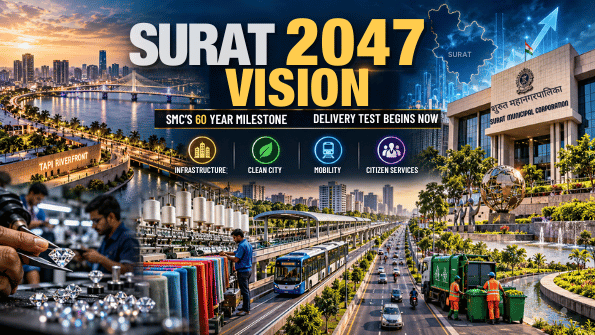
Updated October 1, 2026. Surat Municipal Corporation is marking 60 years since Surat became a municipal corporation on October 1, 1966. The milestone arrives with an ambitious 2047 vision: a larger, better-connected, globally competitive city-region built around economic growth, infrastructure, mobility, resilience and quality of life.
The vision is substantial. The harder question is delivery. Surat’s next two decades will be judged not only by investment announcements or skyline projects, but by whether everyday civic systems improve as the city grows.
Key takeaways
- Surat became a municipal corporation on October 1, 1966.
- NITI Aayog’s 2047 master plan treats the wider Surat Economic Region as a major national growth hub.
- The region already generates a large share of Gujarat’s economic output despite its relatively small geographic footprint.
- Flood resilience, mobility, drainage, waste management and citizen services remain practical tests of the 2047 vision.
- Execution across SMC, state agencies and regional planning bodies will matter as much as strategy.
Why Surat matters to Gujarat’s 2047 growth strategy
NITI Aayog’s Economic Master Plan identifies the Surat Economic Region as one of India’s pilot growth-hub regions. The plan notes that the region covers six districts, represents about 10.8% of Gujarat’s area and generates roughly a quarter of the state’s GDP.
That economic weight comes from textiles, diamonds, manufacturing, logistics, services and a growing technology and startup base. But the same concentration creates risk. The NITI plan notes that manufacturing accounts for more than half of regional GDP and that activity is heavily concentrated in Surat district.
BCC recently covered the Surat Diamond Bourse Special Notified Zone, an example of how the city is trying to strengthen its global trade position.
The civic-delivery test
Rapid economic growth increases pressure on roads, drainage, water systems, housing, public transport and waste infrastructure. Surat has built a reputation for municipal management, but recurring monsoon flooding and creek-related issues show that resilience remains unfinished work.
BCC has reported on residents demanding transparency over creek-merging documents and on overflowing creeks exposing infrastructure weaknesses.
Flood resilience and the Tapi riverfront
SMC’s planned riverfront and embankment work is intended to combine flood protection with urban redevelopment. BCC previously examined the ₹1,250 crore Tapi riverfront embankment approval.
The key issue will be whether large flagship projects are coordinated with neighborhood drainage, creek capacity, pumping systems and maintenance.
Mobility must scale with the city
As Surat expands outward, commuting patterns become more complex. Metro, BRTS, road upgrades, railway connectivity and last-mile transport need to work as one network. The 2047 vision will be weakened if new growth corridors add jobs but also add long travel times and congestion.
Waste, cleanliness and public health
Surat’s post-plague transformation is often cited as a municipal turnaround story. Maintaining that standard becomes harder as population and consumption grow. Waste segregation, processing capacity, wastewater treatment, air quality and neighborhood cleanliness all require continuous operating discipline.
Citizen services and digital governance
A 2047 global-city vision also depends on how easy it is for residents and businesses to interact with government. Digital permits, grievance systems, property services, public dashboards and transparent project tracking can reduce friction and improve accountability.
What should be tracked between now and 2047?
- Flooding frequency and recovery time after heavy rainfall.
- Public-transport ridership and average commute times.
- Waste segregation, processing and landfill diversion.
- Water-loss rates, sewage treatment and creek quality.
- Affordable housing near employment corridors.
- Project completion against announced timelines and budgets.
- Citizen grievance resolution and service turnaround times.
Frequently asked questions
When was Surat Municipal Corporation established?
Surat became a municipal corporation on October 1, 1966.
What is Surat’s 2047 vision?
It is a long-term city-region growth strategy centered on economic expansion, infrastructure, mobility, resilience and quality of life.
What is the Surat Economic Region?
NITI Aayog’s plan treats a six-district region around Surat as a coordinated growth hub rather than planning only for the municipal boundary.