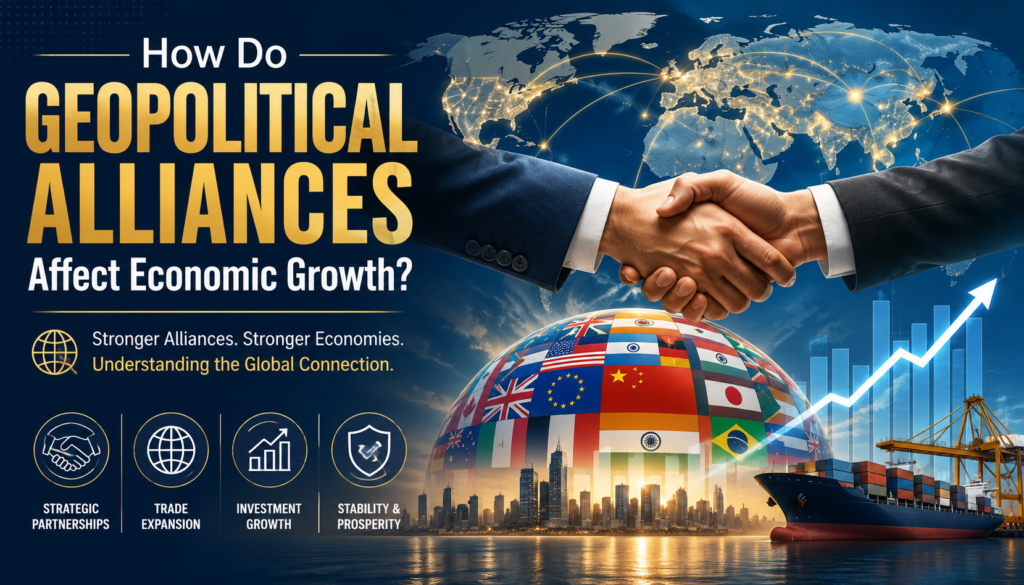
Geopolitical alliances shape the flow of trade, investment, and technology across borders, directly influencing long-term economic growth. When countries align politically and economically, they reduce uncertainty, lower trade barriers, and create stable environments for businesses to invest and expand. Conversely, rising geopolitical fragmentation—such as tensions between major powers or breakdowns in multilateral cooperation—has already reduced global GDP by an estimated 1% over the past decade, with emerging markets hit harder than developed ones.
What Are Geopolitical Alliances?
Geopolitical alliances refer to formal or informal partnerships between nations based on shared political, economic, or security interests. These alliances can take various forms:
- Military alliances (e.g., NATO, AUKUS)
- Economic blocs (e.g., European Union, BRICS+, USMCA)
- Trade agreements (e.g., RCEP, CPTPP)
- Strategic partnerships (e.g., U.S.–India, China–Russia)
Such alliances create frameworks for cooperation that extend beyond diplomacy into tangible economic activity.
How Geopolitical Alliances Boost Economic Growth
1. Enhanced Trade Flows
When countries align geopolitically, they typically reduce tariffs, streamline customs procedures, and harmonize regulations. This leads to:
- Lower trade costs: Reduced barriers make imports and exports cheaper.
- Increased market access: Businesses can tap into larger consumer bases.
- Supply chain efficiency: Aligned nations often coordinate logistics and infrastructure.
For example, China’s improved alignment with the West after Nixon’s 1972 visit led to decades of trade expansion and GDP growth.
2. Foreign Direct Investment (FDI) Inflows
Geopolitical stability attracts investors. When alliances strengthen:
- Capital markets open up: Countries gain better access to global financing.
- Investor confidence rises: Reduced political risk encourages long-term commitments.
- Technology transfer increases: Allied nations share innovations and expertise.
Research has found that a one standard-deviation improvement in geopolitical alignment can raise a country’s GDP by about 3% over seven years.
3. Lower Borrowing Costs
Aligned countries often enjoy better credit ratings and lower interest rates on sovereign debt. This happens because:
- Risk premiums fall: Lenders perceive aligned nations as safer.
- Currency stability improves: Reduced volatility lowers exchange rate risk.
- Fiscal discipline strengthens: Alliance members often adopt similar economic policies.
4. Innovation and Productivity Gains
Alliances facilitate collaboration in R&D, education, and technology. Benefits include:
- Joint research projects: Shared funding for scientific breakthroughs.
- Talent mobility: Easier movement of skilled workers across borders.
- Standardization: Common technical standards reduce duplication and costs.
The Cost of Geopolitical Fragmentation
1. Reduced Global GDP
Rising fragmentation over the past decade has cumulatively cut about 1% from global GDP, with emerging markets losing nearly 2% compared to 0.8% for developed economies. This happens because:
- Trade barriers increase: Tariffs and sanctions disrupt supply chains.
- Investment declines: Uncertainty discourages capital deployment.
- Commodity prices rise: Conflicts in key regions (e.g., Middle East, Ukraine) drive up oil and food costs.
2. Supply Chain Disruptions
Geopolitical tensions force companies to redesign supply chains, often at higher costs. Examples include:
- Friend-shoring: Moving production to politically aligned countries (e.g., U.S. shifting from China to Mexico or India).
- Redundancy investments: Building backup facilities to mitigate risk.
- Inventory buildup: Holding more stock as a buffer against disruptions.
3. Higher Inflation and Lower Growth
Geopolitical risks contribute to higher inflation and slower growth through multiple channels:
- Energy price spikes: Conflicts in oil-producing regions raise costs globally.
- Trade restrictions: Sanctions and tariffs increase import prices.
- Uncertainty: Businesses delay investment and hiring during tense periods.
Measuring Geopolitical Risk and Alignment
Researchers use advanced tools to quantify geopolitical dynamics:
Geopolitical Risk Index (GPR)
- Method: Analyzes newspaper articles mentioning wars, terrorism, and political crises.
- Findings: Higher GPR values correlate with higher oil prices, lower investment, and reduced trade.
- Limitations: Not forward-looking; doesn’t distinguish between different types of risks.
Geopolitical Alignment Index
- Method: Uses AI and large language models to assess historical events between countries.
- Findings: Alignment has deteriorated significantly since the mid-2010s, reaching levels not seen since the 1980s.
- Impact: A hypothetical return to mid-2010s alignment could boost global GDP by 0.8% by 2030.
Case Studies: Alliances in Action
1. Post-WWII Western Alliance (NATO, EU)
- Effect: Created the most prosperous economic zone in history.
- Mechanism: Reduced intra-European conflicts, enabled free trade, and attracted U.S. investment.
- Result: Sustained growth for decades, with the EU becoming a major global economic power.
2. China’s Opening (1972–2000s)
- Effect: Transformed China from an isolated economy to a global manufacturing hub.
- Mechanism: Improved U.S.–China relations led to trade agreements, FDI, and technology transfers.
- Result: China’s GDP grew at an average of 10% annually for three decades.
3. BRICS+ Expansion (2024–2026)
- Effect: Emerging economies seeking alternatives to Western-dominated institutions.
- Mechanism: New members (e.g., Egypt, Ethiopia, Iran) deepen trade and financial ties within the bloc.
- Result: Shifts global trade growth rates and redistributes investment flows toward the Global South.
Latest Trends in 2026
1. Friend-Shoring and Supply Chain Realignment
Countries are increasingly trading with political allies rather than the cheapest suppliers. This trend, known as friend-shoring, aims to:
- Reduce dependency on geopolitical rivals (e.g., U.S. reducing reliance on China).
- Enhance supply chain resilience against conflicts or sanctions.
- Strengthen strategic industries (e.g., semiconductors, rare earth minerals).
2. Fragmentation of Global Trade
Geopolitical distance—measured by political alignment—now acts as a barrier to trade. Key observations:
- Trade between opposing blocs (e.g., U.S.–China, EU–Russia) has declined sharply.
- Regional trade blocs (e.g., ASEAN, African Continental Free Trade Area) are growing stronger.
- Third countries (e.g., Vietnam, Mexico) benefit by serving as intermediaries.
3. Rise of Economic Diplomacy
Nations are using economic tools (trade deals, investment pacts, sanctions) as primary instruments of foreign policy. Examples include:
- AUKUS Pact: U.S., UK, and Australia collaborate on military technology to counter China.
- EU Trade Shifts: Europe is diversifying away from Russia and China toward allies in Africa and Latin America.
- U.S. Tariff Policies: Proposed 10% tariffs on all imports could disrupt global supply chains and reduce GDP.
Implications for Businesses and Policymakers
For Businesses
- Diversify supply chains: Avoid over-reliance on geopolitically distant suppliers.
- Monitor political risk: Use tools like the GPR index to anticipate disruptions.
- Leverage alliances: Prioritize trade and investment in aligned countries to reduce costs and risks.
For Policymakers
- Strengthen multilateral institutions: Reform the WTO, IMF, and World Bank to address fragmentation.
- Promote economic diplomacy: Use trade agreements to build strategic partnerships.
- Invest in resilience: Support domestic industries critical to national security (e.g., energy, tech).
Key Takeaways
- Geopolitical alliances boost growth by enhancing trade, attracting investment, and lowering costs.
- Fragmentation drags on GDP, with emerging markets suffering more than developed ones.
- Alignment effects are long-lasting (up to 14 years), while risk events have shorter-term impacts.
- 2026 trends show increased friend-shoring, trade bloc formation, and economic diplomacy.
FAQ: Geopolitical Alliances and Economic Growth
Q: How do geopolitical alliances affect inflation?
Alliances typically reduce inflation by stabilizing trade flows and commodity prices. Fragmentation, on the other hand, can drive up costs through supply disruptions and higher risk premiums.
1Q: Which countries benefit most from geopolitical alignment?
Smaller economies often see larger gains because they rely more heavily on trade and foreign investment. Emerging markets also benefit disproportionately from improved access to global capital.
Q: Can geopolitical risks be predicted?
While tools like the GPR index track current risks, they are not forward-looking. Analysts combine quantitative data with qualitative scenario planning to anticipate future developments.
For more Updates, visit: Buzz Content Corner
Follow us on
Facebook: https://www.facebook.com/Buzzcontentcorners/
Instagram: https://www.instagram.com/buzzcontentcorner
Pintrest: https://in.pinterest.com/latestbuzzcorner/