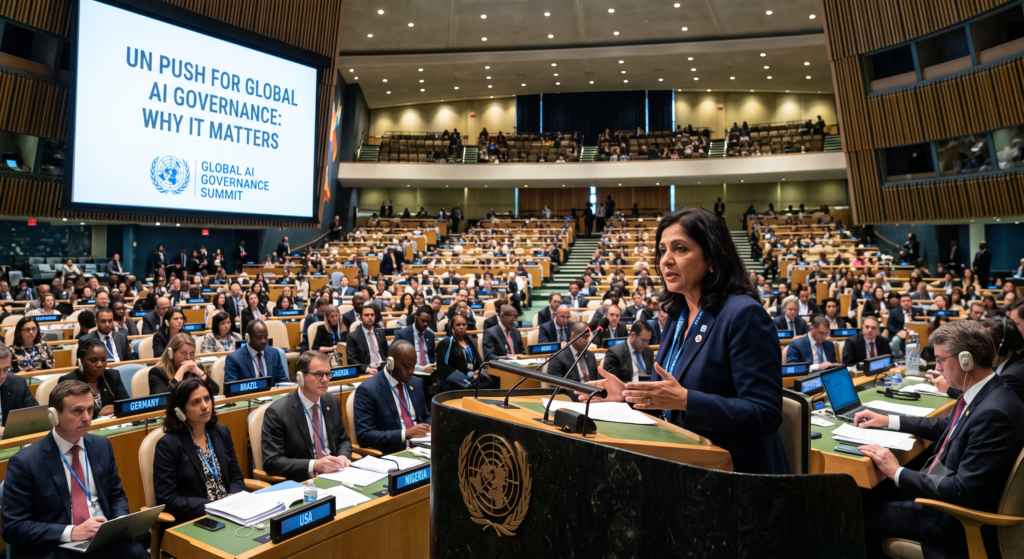
Artificial intelligence is advancing faster than most governments can regulate it. That gap has pushed the United Nations to call for stronger global AI governance, with the goal of creating rules that can guide how this powerful technology is developed and used.
The urgency is easy to understand. AI is now affecting communication, business, security, education, healthcare, and public decision-making. Without shared standards, the risks of misuse, bias, misinformation, and uncontrolled deployment continue to grow.
Why global AI governance matters
AI is no longer a niche technology. It is becoming part of everyday systems that influence how people work, learn, vote, shop, and receive information. That makes governance a global issue rather than a local one.
The UN’s push is important because AI does not stop at national borders. A model built in one country can influence users, markets, and institutions around the world. That means isolated regulation is no longer enough on its own.
The need for common standards
One of the biggest challenges in AI regulation is inconsistency. Different countries are moving at different speeds, and that creates confusion for companies, governments, and users.
Common standards can help establish clearer expectations around safety, transparency, accountability, and human oversight. They can also reduce the risk of harmful AI systems being deployed without proper checks.
Safety, ethics, and accountability
The main concern behind global AI governance is not just innovation. It is also safety. Powerful AI systems can be used to generate misinformation, manipulate users, automate harmful decisions, or create security risks if left unchecked.
Ethical AI governance aims to make sure these systems are developed responsibly. That includes asking who is responsible when AI fails, how decisions are made, and what protections exist for the public.
Why the UN is stepping in
The UN is uniquely positioned to push for international coordination because AI affects every region and every sector. Its role is not to replace national law, but to encourage cooperation and shared principles.
This matters especially for countries that may not have strong AI policy frameworks yet. A global approach can help close regulatory gaps and create a more balanced future for technology development.
The business and public impact
For businesses, stronger governance can create clarity and reduce uncertainty. Companies that understand the rules are better able to build trusted products and avoid future compliance problems.
For the public, better governance can improve confidence in AI systems. When people know there are rules in place, they are more likely to trust how the technology is being used in daily life.
The road ahead
The biggest challenge is turning broad principles into practical action. Countries will need to agree on definitions, enforcement, accountability, and what safe AI development actually looks like in practice.
That process will not happen overnight. But the UN’s push signals that the world is moving toward a more serious conversation about how AI should be governed before the risks grow even larger.
Final take
The UN’s urgent push for global AI governance reflects a simple truth: AI is too powerful to be left without clear rules. As the technology grows faster and reaches deeper into everyday life, cooperation, ethics, and accountability will become essential.
The countries and organizations that act early are more likely to shape a safer and more trusted AI future.
A useful related read is GEO (Generative Engine Optimization): Beyond Traditional SEO in Marketing, because it shows how AI is already changing content systems and digital visibility.
For more Updates, visit: Buzz Content Corner
Follow us on
Facebook: https://www.facebook.com/Buzzcontentcorners/
Instagram: https://www.instagram.com/buzzcontentcorner