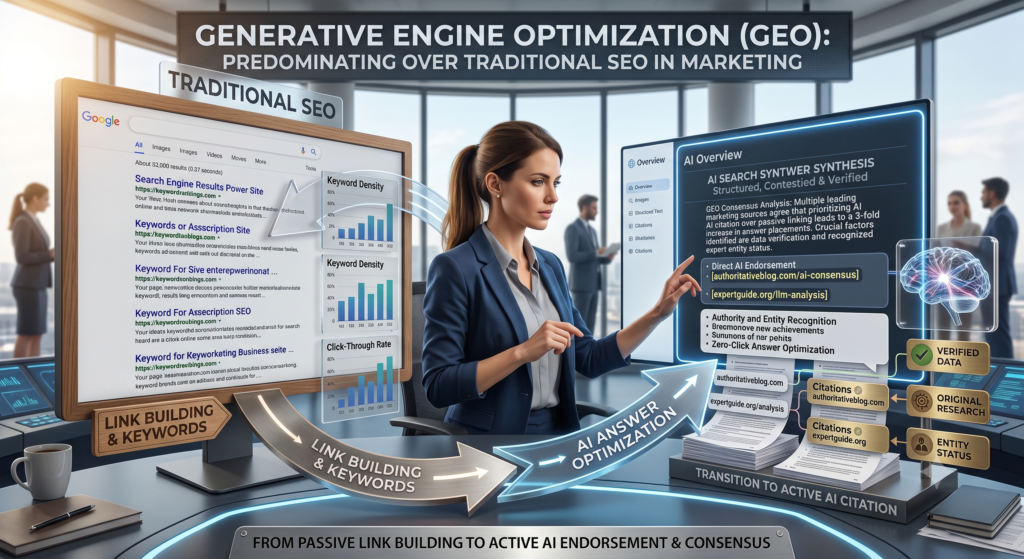
The digital marketing landscape is experiencing its most seismic disruption since the birth of the commercial internet. For over two decades, the core objective of Search Engine Optimization (SEO) was straightforward: rank on page one, earn the user’s click, and convert them on your website.
But the internet has fundamentally transformed. Millions of users no longer search through blue links; they ask conversational questions and receive instant, synthesized summaries from Large Language Models (LLMs) like ChatGPT, Perplexity, Claude, and Google AI Overviews.
When an AI engine answers a user’s question, your website often isn’t even visited. If your business isn’t part of the AI’s synthesized response, you effectively don’t exist to that consumer. This shift has given rise to a mandatory new marketing discipline: Generative Engine Optimization (GEO).
What is Generative Engine Optimization (GEO)?
Generative Engine Optimization (GEO) is the strategic process of structuring, optimizing, and distributing digital content so that generative AI engines select, synthesize, and cite it as an authoritative source in their conversational answers.
While traditional SEO focuses on winning a user’s click, GEO focuses on becoming the source the AI trusts.
The Metric Shift: In the GEO era, marketers are moving away from traditional Share of Voice (SoV) and organic impressions. Instead, success is measured by Share of Model (SoM)—the percentage of times your brand or content is cited across a statistically significant sample of AI prompts.
SEO vs. GEO: Understanding the Structural Rift
GEO does not replace traditional SEO; rather, it builds directly on top of it. AI engines still crawl the open web, meaning technical fundamentals like page speed, mobile optimization, and standard indexing remain essential. However, how content is judged and presented differs entirely.
| Attribute | Traditional SEO | Generative Engine Optimization (GEO) |
| Primary Goal | Maximize search engine rankings to drive website traffic. | Secure citations and brand synthesis inside AI answers. |
| User Behavior | Fragmentation (scanning lists of links, clicking 1-3 sites). | Conversational (multi-turn prompts, deep follow-up queries). |
| Content Priority | Keyword density, search volume, and URL backlink profiles. | Factual depth, expert data, and structured readability. |
| Target Platforms | Google, Bing, Yahoo. | OpenAI ChatGPT, Perplexity, Claude, Gemini. |
| Core Metric | Click-Through Rate (CTR) and Keyword Ranking position. | Share of Model (SoM) and Brand Citation Frequency. |
The AI Synthesis Architecture: How Engines Pick Sources
To optimize for generative engines, you must first understand how they gather real-time data. When a user inputs a query, systems like Perplexity or Google AI Overviews execute a multi-step pipeline:
[User Query] ➔ [Intent & Fan-Out Sub-Queries] ➔ [Source Discovery & Evaluation] ➔ [AI Synthesis & Citation]
- Query Understanding & Fan-Out: The AI breaks down a complex user prompt into multiple smaller sub-queries (e.g., “Best enterprise CRM for a 50-person remote team” gets fanned out into Enterprise CRM pricing, Remote CRM integrations, and CRM reviews 2026).
- Source Discovery: The engine crawls the web or hits index databases to find matching pages for those sub-queries.
- Content Evaluation: The AI scans the HTML layout, analyzing it for structural clarity, author credibility, and raw factual data.
- Synthesis & Generation: The engine merges information from the top selected sources into a single, cohesive answer, appending footnote citations to the statements it extracted.
4 Blueprint Frameworks to Optimize Content for GEO
Academic research, including pioneering studies from Princeton University, shows that implementing specific optimization frameworks can increase a brand’s visibility in AI search by 30% to 40%.
Here is how to optimize your content ecosystem for AI ingestion:
1. Hard-Code High “Synthesis Potential” Factors
AI engines love verifiable facts. To make your content undeniably attractive to an LLM’s retrieval system, weave these elements directly into your text:
- Authoritative Statistics: Don’t just say “Our software saves time.” Write “According to our 2026 Internal Impact Study, workflows were accelerated by 34% over a 90-day cycle.”
- Expert Quotations: Back up claims with attributed insights. Direct quotes from credentialed specialists give engines high-quality text strings to extract.
- Precise Terminology: Avoid fluffy marketing jargon. Use accurate industry terms and define complex jargon inline immediately to anchor semantic relevance.
2. Move to Server-Side Rendering (SSR)
This is a critical technical pitfall. Many modern sites rely heavily on client-side JavaScript to load dynamic pricing tables, feature tabs, or interactive widgets. While human eyes see them easily, many AI crawlers do not execute complex JavaScript reliably. If your key data is buried behind client-side scripts, accordions, or login walls, it is entirely invisible to the models. Ensure your core informational assets are written cleanly into the server-side HTML.
3. Structure for “Fan-Out” Intent and Scannability
Because AI engines split user prompts into smaller sub-queries, your content should naturally address these fragments. Use a clear, logical heading hierarchy (H2, H3) structured as direct questions. Follow this up with short, high-density responses:
1.Lead with a Direct Answer:First 2 sentences.
Place the explicit answer to the heading’s question directly at the top of the section. Do not bury the lede beneath paragraphs of introductory storytelling.
2.Provide Structured Support:Bullet points or tables.
Break down the supporting facts, dimensions, or data using Markdown bullet points or structured tables. LLMs extract data from lists much easier than from dense, heavy blocks of text.
3.Anchor with Authoritative Source Links:Outbound reference.
Link out to external, highly authoritative databases (like academic papers or government indices) to show the engine that your content is thoroughly grounded in reality.
4. Build Digital PR Beyond Your Own Domain
Generative engines don’t just rely on your website; they cross-reference the entire web to verify your brand’s authority. Unlinked brand mentions on User-Generated Content (UGC) platforms like Reddit, Quora, and YouTube, alongside high-authority industry forums, play a massive role in training data and retrieval parameters. A holistic GEO strategy requires active digital PR to ensure your brand is being positively discussed across the broader digital landscape.
Measuring GEO Success: The Share of Model (SoM) Checklist
Because traditional rank-trackers cannot see what happens inside a private ChatGPT or Claude conversation, monitoring requires an adjusted analytics approach.
- [ ] Identify Core Prompt Sets: Compile 20 to 50 complex, long-tail conversational questions that your target buyers would ask an AI assistant.
- [ ] Run Regular AI Audits: Manually or via automated API auditing tools, query these prompts monthly across ChatGPT, Gemini, and Perplexity.
- [ ] Calculate Your SoM: Track how often your brand is mentioned or cited in the text responses. If you appear in 10 out of 50 queries, your current Share of Model is 20%.
- [ ] Monitor AI Referral Traffic: Look closely at your analytics platform for inbound referral tags originating from domains like
perplexity.aioropenai.com. These are highly qualified leads who have already been pre-sold on your expertise by the AI.
The Future of Organic Visibility
Traditional SEO is evolving, not dying. It is forming the technical foundation for a vastly more sophisticated landscape driven by conversational synthesis. Marketers who continue trying to optimize purely for single-keyword rankings will see their organic traffic decay as zero-click AI responses take over.
By pivoting your strategy toward Generative Engine Optimization, you stop fighting the AI evolution and start fuel-injecting it. Optimize for clarity, prioritize verifiable data, make your site highly crawlable, and position your brand as the definitive source that the engines cannot afford to ignore.
Ready to deploy a GEO strategy for your marketing engine?
For more Updates, visit: Buzz Content Corner
Follow us on
Facebook: https://www.facebook.com/Buzzcontentcorners/
Instagram: https://www.instagram.com/buzzcontentcorner